Custom Streetwear, Casualwear & Denim Manufacturer•MOQ 50 pcs•Denim MOQ 100 pcs•7-Day Sample Available
How Much Does Clothing Sampling Cost
Learn what clothing sampling costs really include, why custom styles vary so much, and how brands should budget samples before production quoting.

For a graphic tee or printed hoodie, asking “How much does clothing sampling cost?” before choosing the print method can produce a quote that changes halfway through development. The garment might be straightforward, while the artwork needs a different ink system, extra testing, or a revised printing sequence.
Budget the sample around the decoration decision first. Your aim is to establish which method can deliver the intended appearance on the actual fabric, then pay for a complete garment that proves the approved combination. This makes the quote easier to evaluate and reduces the risk of buying several finished samples to answer a question a small print trial could have resolved.
Set the print brief before requesting a finished piece
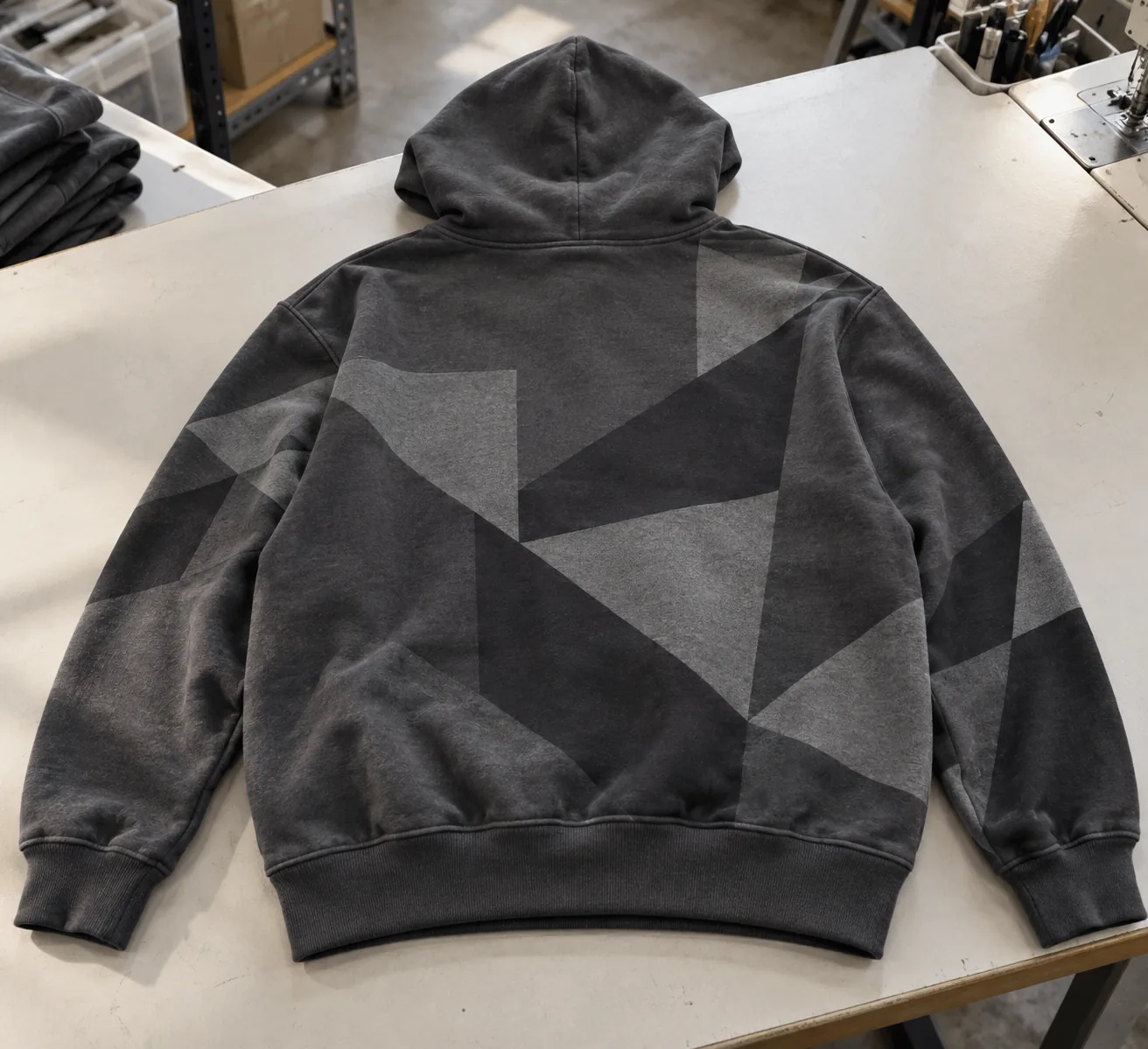
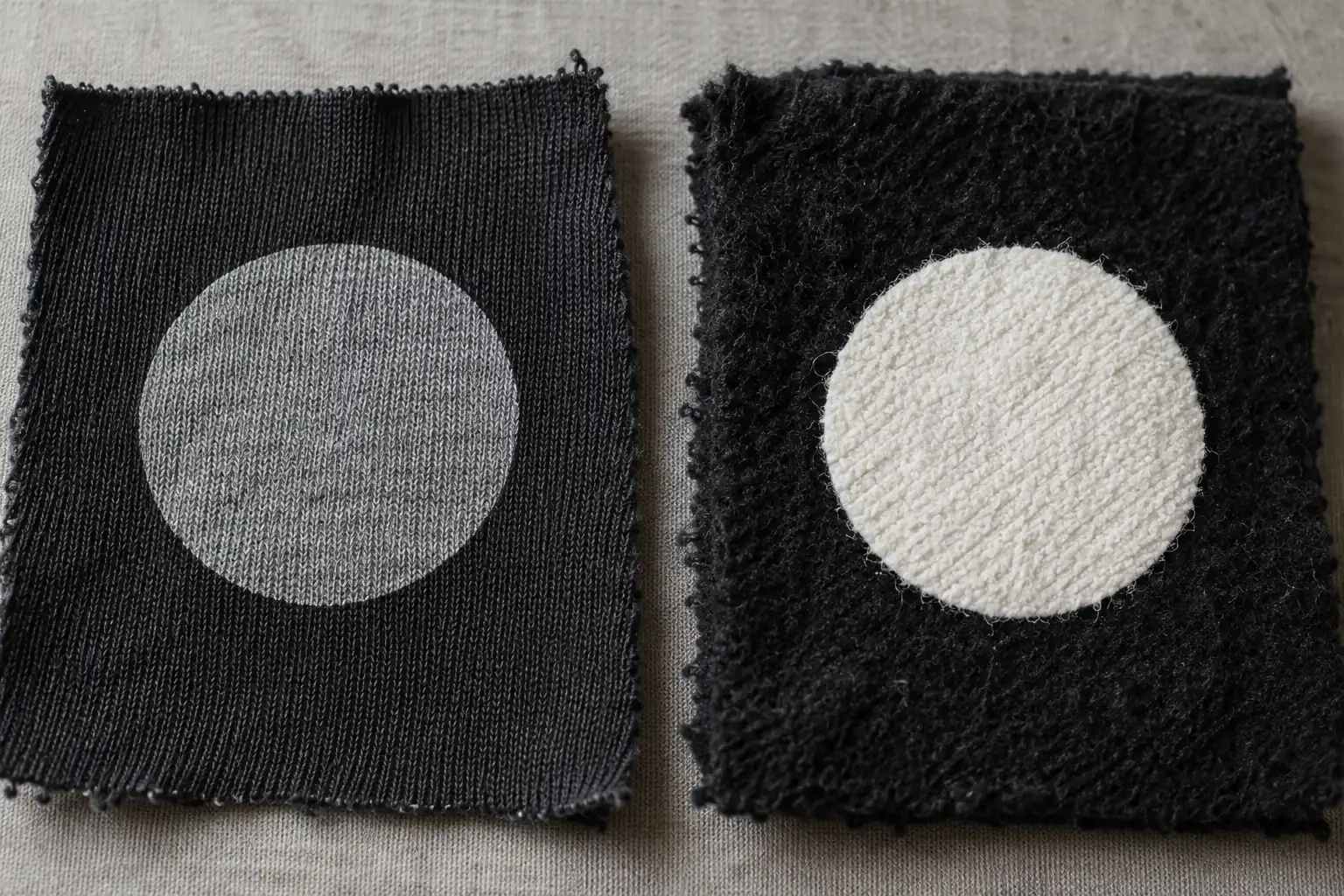
A reference image communicates mood, but it rarely defines a printable specification. Separate what must stay fixed from what the printer can propose. A washed charcoal tee with a soft, faded chest graphic has different development needs from a crisp, opaque graphic on heavyweight black fleece, even when both use the same artwork dimensions.
Provide the intended fabric composition, fabric color, artwork size, placement, color references, and desired hand feel. State whether fine lines, photographic gradients, stretch, or coverage over a dark ground matter most. If the fabric is undecided, ask which candidate should be tested first and whether changing it would invalidate the result.
Also describe how the garment will be used and cared for. A dense back graphic on a summer tee needs a different comfort discussion from a small mark on an outer layer. Those priorities give the supplier a practical basis for selecting a test.
Compare methods by what the trial must prove
Do not choose a method from its sample charge alone. Ask whether the trial uses the intended bulk process, or merely approximates its appearance. A digitally produced presentation sample may answer a design question without establishing how a later screen print will feel or reproduce detail.
| Candidate method | Development work to clarify | Question for the first trial |
|---|---|---|
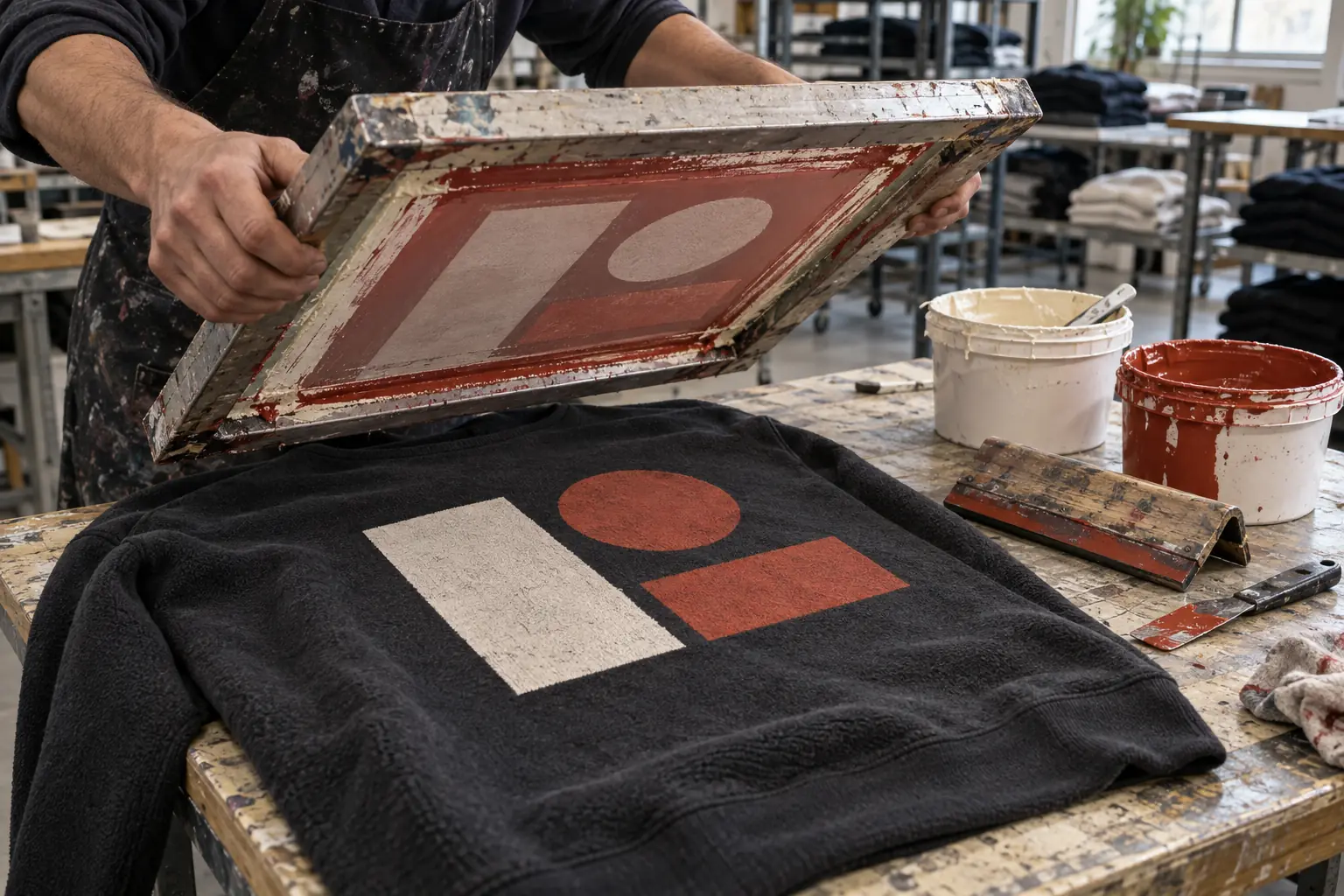
| Screen printing | Color separation, screens, underbase, ink and curing trials | Can the graphic achieve coverage and detail at the intended hand feel? |
| Direct-to-garment printing | Fabric suitability, pretreatment and color adjustment | Does the image reproduce consistently on this fabric and shade? |
| Heat-applied transfer | Transfer preparation, pressing conditions and placement | Are adhesion, edges and flexibility acceptable after care testing? |
These are discussion points, not a promise that every method suits every textile or is available for every project. Ask the supplier to recommend a viable route for the chosen material and expected order quantity, then identify the evidence needed to approve it.
Buy the smallest useful proof before the final sample
A strike-off is a small print trial on fabric. Where practical, use it to settle color, opacity, edge definition and surface feel before commissioning the decorated garment. Request the actual fabric and ground color; a result on white cotton is weak evidence for the same artwork on a dark blend.
For example, a brand developing a large tonal hoodie graphic might compare two ink deposits on matching fleece swatches. Once the preferred result is approved, the complete sample can establish placement, drape and how the printed area behaves when worn. Making two entire hoodies just to compare ink feel may add avoidable sewing and material work.
A swatch cannot answer every question. Artwork crossing a seam, printing near a pocket, or decoration requiring access to an open panel may need a sewn mock-up or a complete piece. Agree on the printing and sewing sequence early, because changing it can change both labor and the usefulness of earlier approvals.
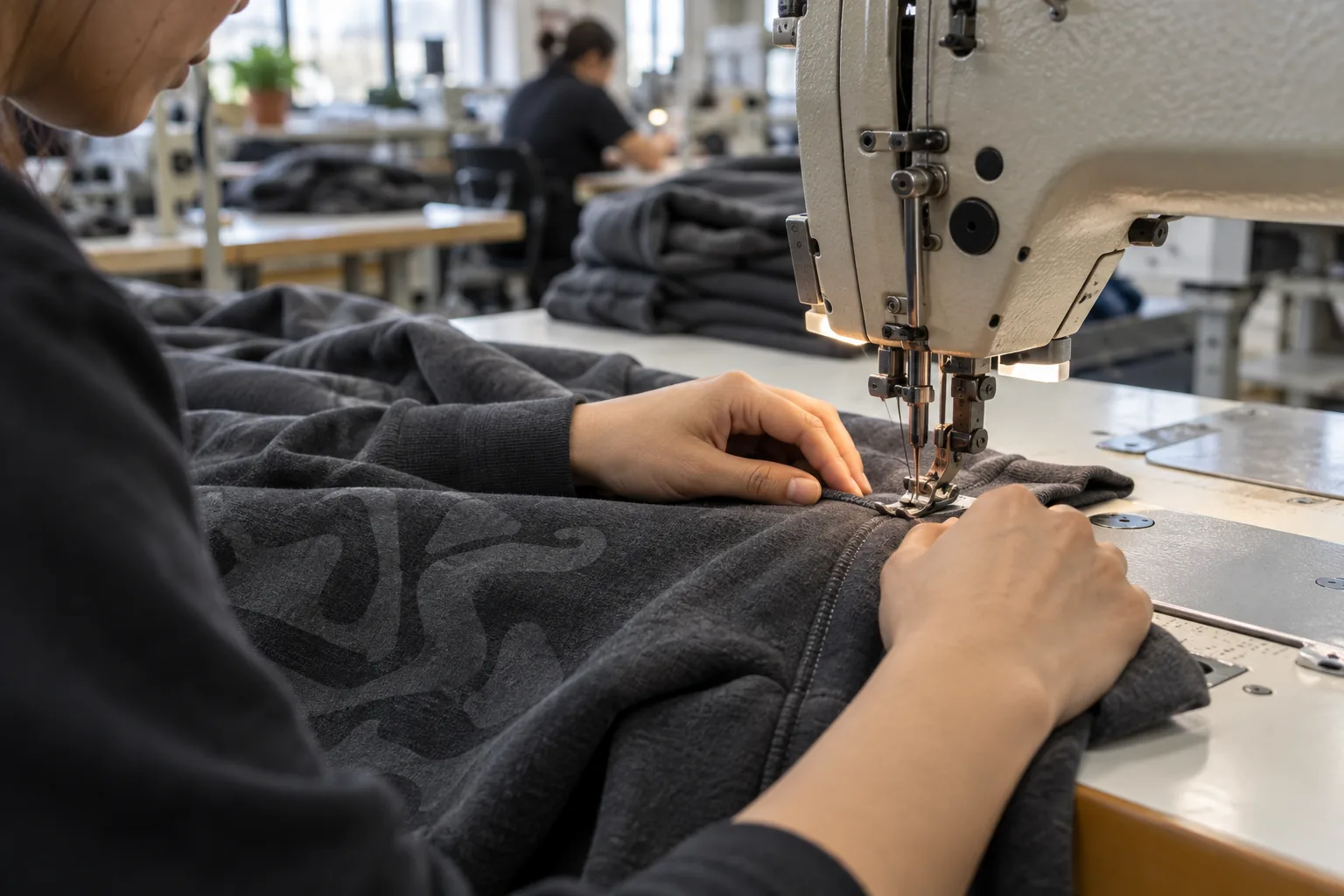
Read the quotation as a set of development charges
Request a breakdown separating the base garment sample, print preparation, print trials, decoration application, and delivery. Ask whether pattern development, fabric sourcing, special trims and testing are included. A single total is difficult to compare if one supplier includes a strike-off and another charges for it separately.
Clarify which charges recur. An artwork revision could require new separation or screens; a fabric substitution could require another adhesion or curing trial. Ask what happens if the first trial misses the agreed specification, and distinguish that correction from a buyer-requested redesign. Confirm any sample-credit arrangement in writing rather than assuming it applies.
Order quantity belongs in this conversation because the selected method must remain practical for production. StitchQuote’s MOQ for most categories starts from 50 pieces per style; denim starts from 100 pieces per style. These starting points do not establish a sample price or guarantee that a particular decoration route suits the order.
Make print approval a measurable QC checkpoint
Inspect the decorated sample against a single recorded specification. Keep an approved physical reference where possible and document any accepted limitations. Screen images alone are unreliable for judging subtle color and surface differences.
- Position and scale: Check graphic dimensions and distances from agreed garment reference points, using project-specific tolerances.
- Appearance: Inspect registration, opacity, fine detail, edges and unwanted marks under consistent lighting.
- Feel and movement: Assess stiffness, tackiness and distortion when the garment moves as intended.
- Care performance: Agree on the washing and drying procedure, then check for peeling, cracking, color change or other unacceptable changes.
- Process record: Confirm the approved fabric, artwork version, method and production sequence are identified together.
StitchQuote provides QC before packing. That checkpoint complements development approval; it cannot resolve an undefined print standard after production. Decide which checks must be completed before releasing the final sample for approval.
Specify fabric weight and measurement points before comparing trials
Record fabric weight in grams per square meter (GSM), alongside fiber composition, knit structure and finish. As a hypothetical brief, a 180 GSM cotton single-jersey tee and a 300 GSM cotton-polyester fleece hoodie should be treated as separate print developments. GSM describes mass per area, not surface smoothness, opacity or shrinkage. Ask whether the trial fabric has received the same finishing treatments planned for production, and identify its face side so the approved print is reproduced on the correct surface.
Define placement with the garment laid flat and relaxed. For a centered chest graphic, specify the distance from the bottom edge of the front neck seam to the top of the artwork, then measure horizontal alignment against the garment centerline. Record artwork width and height separately. Avoid a direction such as “10 cm below the collar” without identifying whether the reference is the collar edge or the neckline seam; those points produce different positions.
A buyer might propose a 240 mm graphic width with a tolerance of plus or minus 3 mm, and a vertical placement tolerance of plus or minus 5 mm. These are illustrative negotiating points, not StitchQuote standards or universal production limits. Confirm achievable tolerances with the supplier for the selected process, fabric and garment sizes. State whether the graphic remains the same size throughout the size range, and check that it clears armholes, pockets and seams on the smallest size.
Work through a small order before approving development costs
Consider a hypothetical order of 60 cotton tees in one style, one garment color and three sizes, with one front graphic. Submit the size quantities, fabric specification, artwork file and placement drawing together. Ask whether one artwork size works across all three garment sizes. If separate graphic sizes are needed, request a revised preparation breakdown because additional screen sets or transfer versions can change the development work even though the garment quantity stays the same.
Use three documented approval steps: confirm the undecorated fit, approve a print strike-off on the intended fabric, then approve the complete decorated sample. If the fit needs revision, check whether the neckline or body width change affects the approved placement. Record each decision against a dated artwork and specification version so the final garment does not combine an outdated pattern with the latest print.
For care testing, measure and photograph the sample before washing, follow the agreed care procedure, then remeasure after it has dried and relaxed under consistent conditions. Record garment length, chest width, graphic dimensions and visible print defects. Calculate dimensional change as the difference between the final and original measurement divided by the original measurement, multiplied by 100. A graphic that looks narrower after washing may reflect fabric shrinkage as well as print behavior; inspect both before deciding which process needs correction.
Questions to settle before authorizing the sample spend
Can fit development proceed while the print method is undecided?
Often it can, using an undecorated fit sample. Keep print approval separate, and confirm whether the eventual decoration could affect drape, stretch or assembly. If it could, assess those effects on the final decorated piece.
Does a smaller graphic always reduce the sampling bill?
No. Preparation work may remain similar even when the printed area shrinks. Ask which charges respond to dimensions, color count, placement count or method, rather than assuming the total scales with graphic size.
Can a standard sample be ready in seven days with an untested print?
StitchQuote offers a 7-day sample for standard styles with confirmed specs and available materials. An unresolved print trial needs its own timing confirmation. Complex styles, custom washes and custom-developed fabric take longer; confirm the schedule once the development scope is defined.
Prepare a brief that makes the next quote usable
Send one artwork version, the intended fabric, expected quantity, desired print result and the decision each sample must support. Ask for the recommended method, trial scope, itemized charges and approval sequence. StitchQuote’s services include cut-and-sew, private label, sampling, fabric and trim sourcing, and branding through woven labels, prints and embroidery.
Related reading and project support:
- Prepare the garment and artwork specifications
- Review sampling and minimum order quantities
- Plan the sampling timeline
- Discuss your print sample brief with StitchQuote
Request a manufacturing quote
Share your product type, quantity range, and destination. We usually reply within one business day.