Custom Streetwear, Casualwear & Denim Manufacturer•MOQ 50 pcs•Denim MOQ 100 pcs•7-Day Sample Available

How Fabric Shrinkage Affects Garment Measurements
See how fabric shrinkage affects garment measurements, why wash behavior matters before bulk, and how brands should protect fit consistency in production.

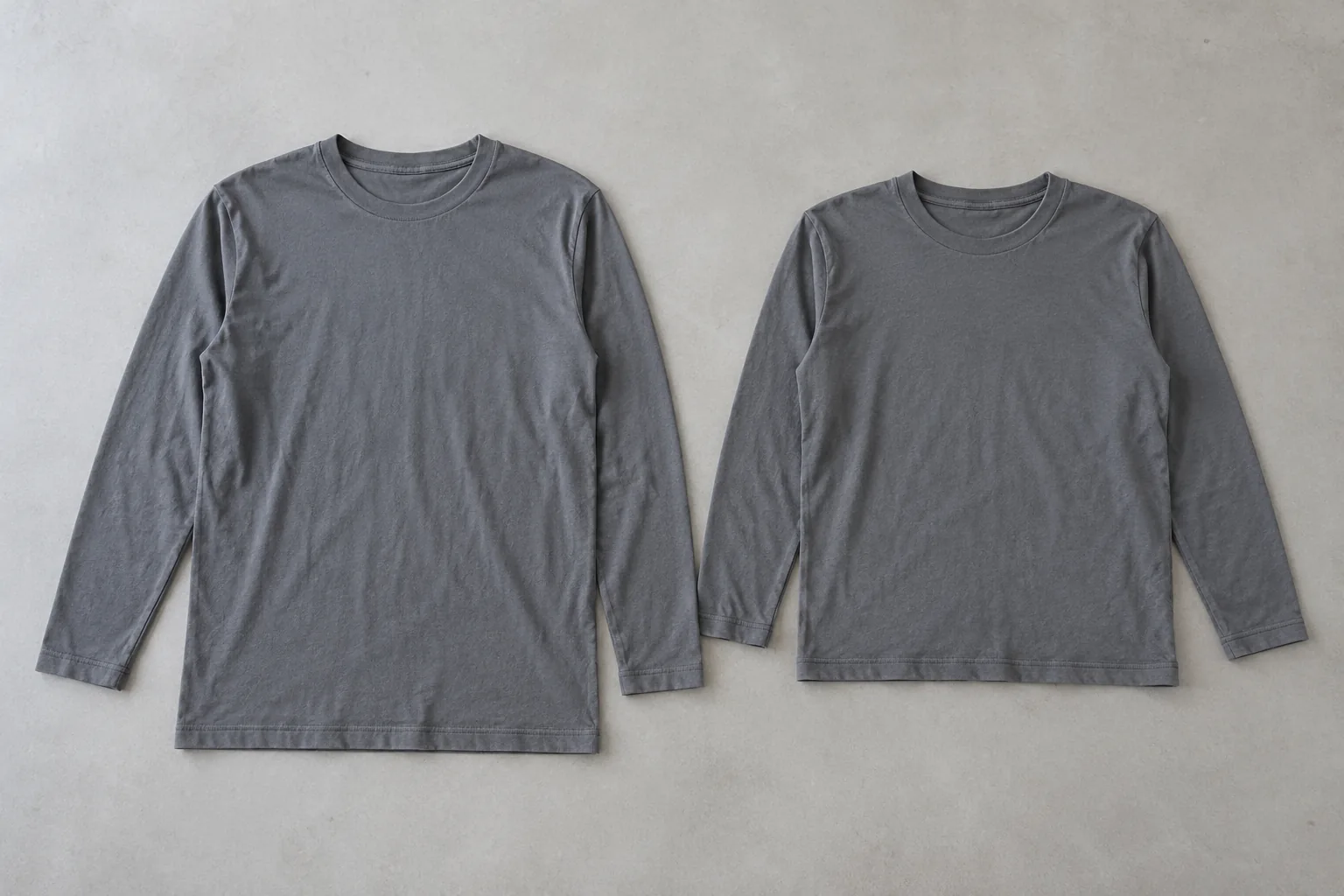
A fit block is the reference pattern behind a garment’s silhouette. Approving it means agreeing on more than how one sample looks on a model: the brand and manufacturer need to know which measurements should survive production finishing and customer care. A boxy tee that loses body length can become cropped even when its chest still measures correctly.
Understanding how fabric shrinkage affects garment measurements is therefore part of block approval. The useful question is whether a particular fabric, construction, and care route can reproduce your intended fit. Set that decision up before grading or treating the sample pattern as a reusable master.
Approve a measurement state before approving a silhouette
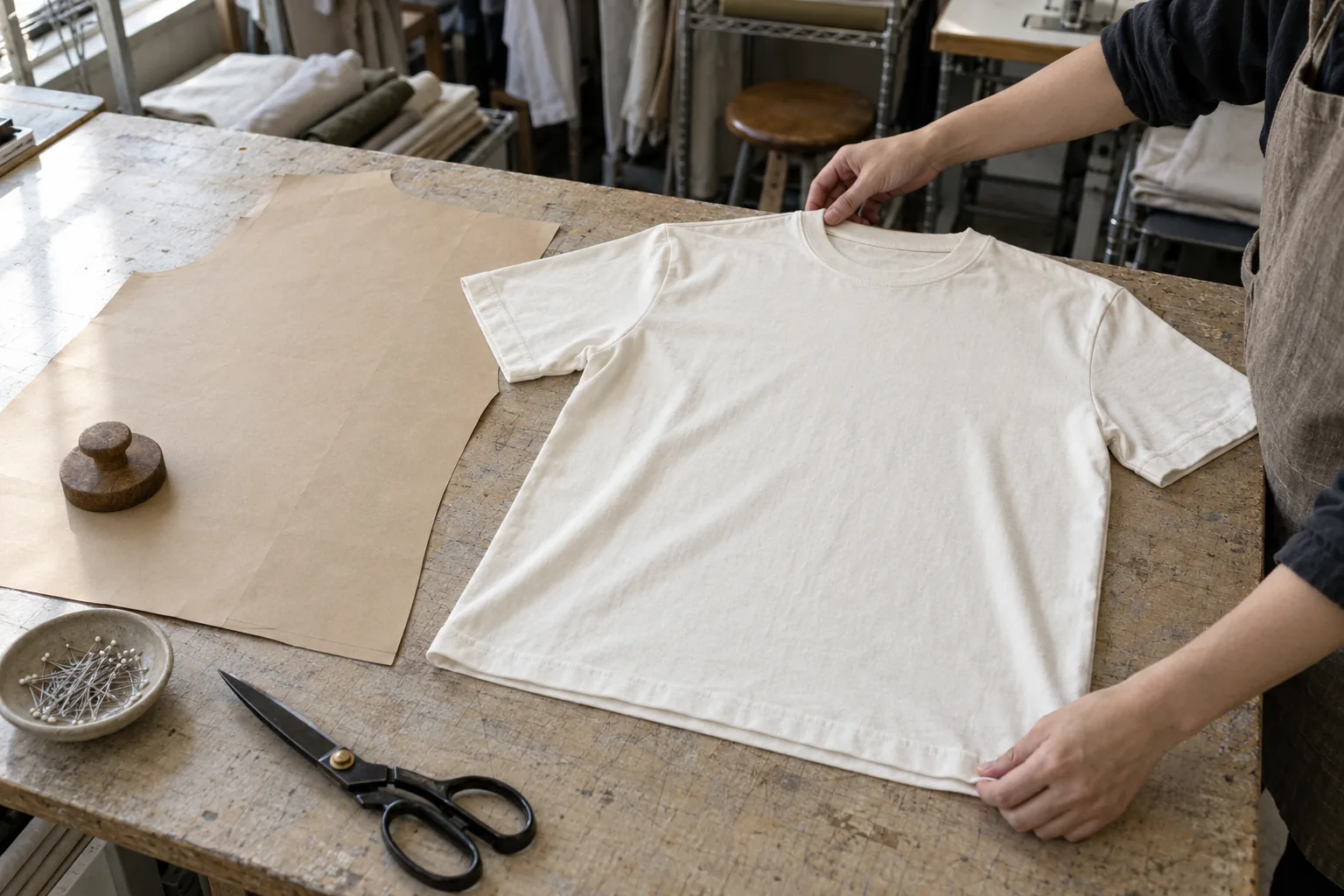
Separate three states: the sewn garment before factory finishing, the finished garment ready for shipment, and the garment after the agreed customer-care test. These may have different dimensions. A washed product should not be judged against an unfinished sample without identifying that difference.
Write the approval state beside the measurement chart. Specify the washing and drying procedure, the number of cycles, and how the garment rests before measurement. Use a consistent flat measurement method without stretching the fabric. If a laboratory method is required, agree on it explicitly instead of relying on “normal wash.”
For example, a relaxed long-sleeve tee might need a defined finished body length for merchandising and a separate acceptable length after care. Both matter, but they are different acceptance points. Record both before deciding that the base block is ready.
Give each fabric its own evidence before reusing the block
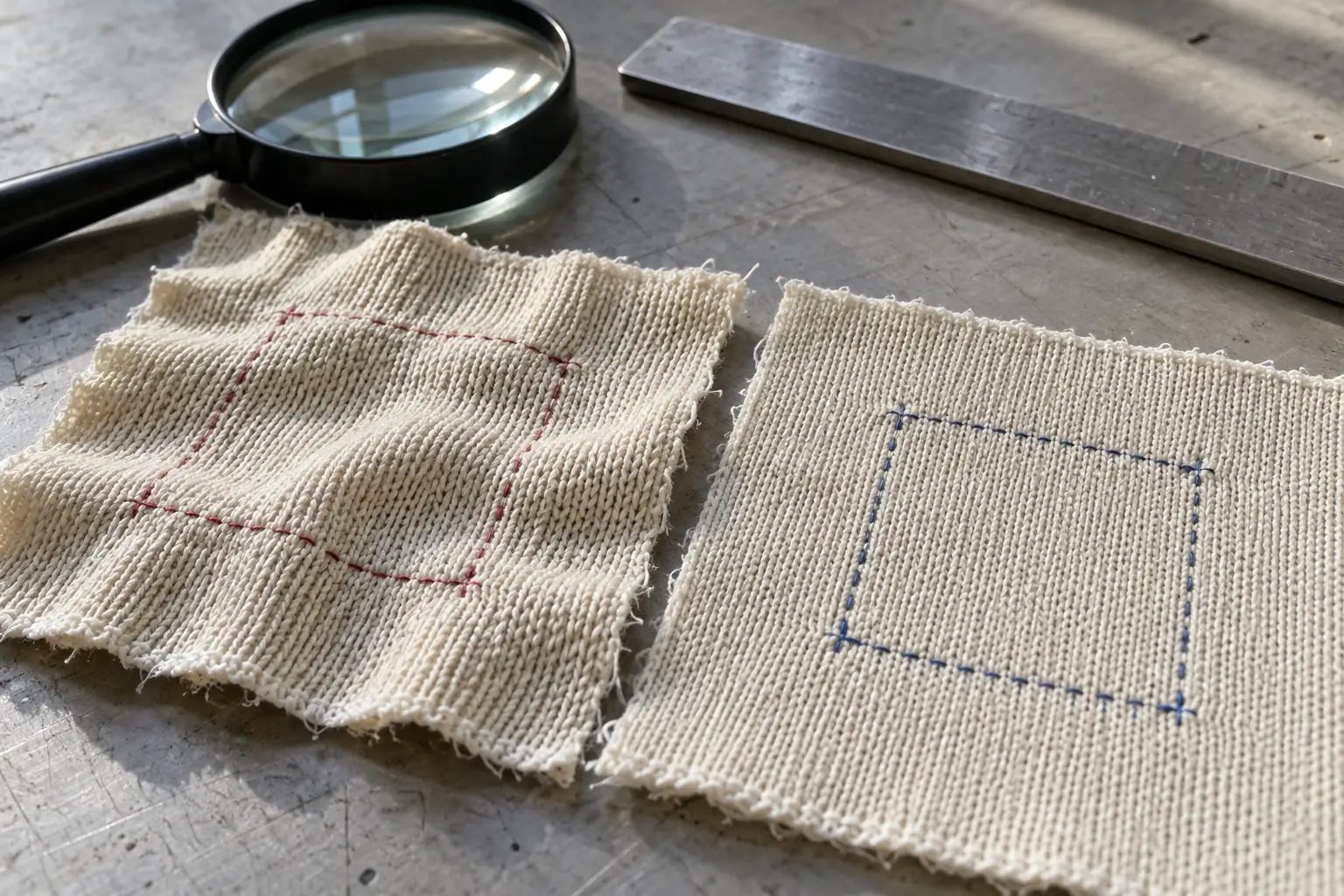
A successful block in one fabric is only a starting point for another. Knit structure, finishing, and residual tension can change dimensional behavior even when two fabrics have similar weight and fiber content. Test material representative of the intended order, and identify its lot with the results.
Measure lengthwise and widthwise change separately. A fabric that contracts more along the garment’s length may shorten the body and sleeves without producing the same reduction across the chest. Some materials can also grow in one direction; do not force every result into a positive shrinkage allowance.
Swatch results support an early decision, but assembled garments provide the approval evidence. Seams, neck rib, pockets, and decoration constrain the shell differently. For a pocket tee, compare the pocket opening and placement after care as well as the body dimensions. A stable pocket attached to a shrinking shell can distort an otherwise acceptable front panel.
Translate measured change into a trial pattern adjustment
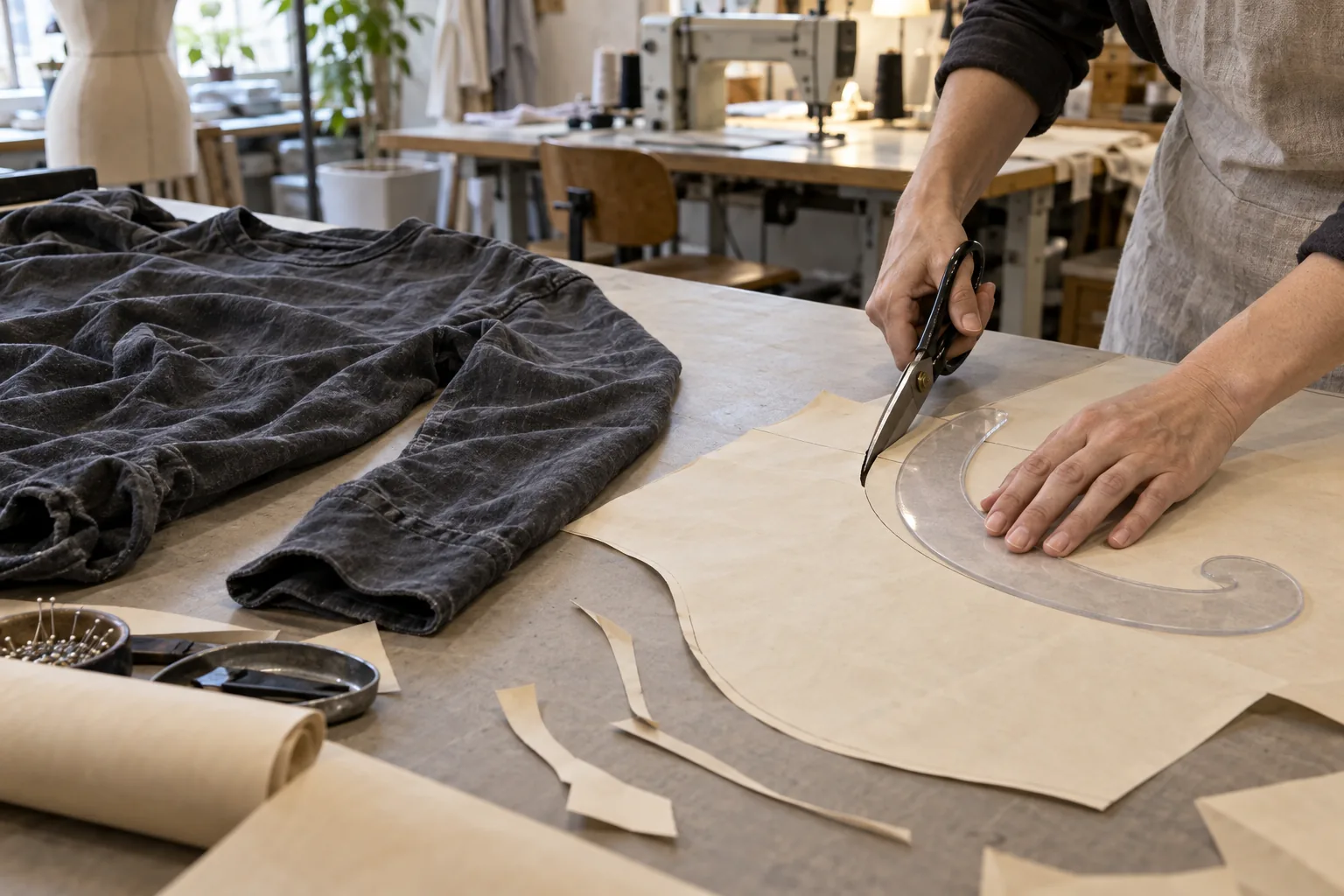
Calculate shrinkage as the original dimension minus the tested dimension, divided by the original dimension, multiplied by 100. A reference length changing from 50 cm to 48 cm shows 4% shrinkage under that test. It does not establish a universal 4% rule for the garment.
For illustration, a 70 cm target after a repeatable 4% reduction suggests a starting dimension of 70 ÷ 0.96, or approximately 72.9 cm. This is a trial calculation for the relevant processing stage, not a cutting instruction. Pattern development must still account for construction, seam allowances, and actual garment results.
Keep fit corrections distinct from dimensional compensation in sample comments. “Add sleeve length for the intended silhouette” and “compensate for tested sleeve shortening” explain different changes. Combining them into one unexplained amendment makes the next sample harder to diagnose and can lead to double compensation.
Use an approval gate that stops unresolved changes from spreading
Before extending the base size into a size range, close the connection between fabric evidence, pattern revision, and fit review. The following record keeps each decision tied to a tangible sample.
| Gate | Evidence to retain | Release decision |
|---|---|---|
| Material trial | Identified fabric and directional test results | Proceed to a garment trial or reconsider material |
| Base-size trial | Paired measurements and fit photographs before and after care | Revise compensation or approve the base block |
| Size-range check | Selected size samples in the agreed measurement states | Confirm grading before bulk cutting |
Choose size checks around proportion risks, such as a cropped body or narrow sleeve opening. A base size passing does not prove that every graded size will preserve the intended balance. If the fabric, wash, or construction changes after approval, reopen the affected gate rather than silently carrying forward the old result.
Make the QC handover traceable to the approved block
The production team needs a usable reference, not just an email saying “fit approved.” Retain the approved sample and its pattern revision, together with the measurement chart and care-test results. Define tolerances at each acceptance state; a sewing tolerance should not become an allowance for unexplained wash change.
- Material identity: Match shell fabric, rib, and relevant trims to the approved trial.
- Measurement method: Show endpoints for body length, chest, sleeve, and openings.
- Condition: Record finishing, care cycles, drying method, and resting conditions.
- Appearance: Check twisting, seam puckering, uneven hems, and pocket distortion alongside dimensions.
- Escalation: Agree which deviations pause release and who authorizes a correction.
Review representative production pieces against that record before packing, using an agreed sampling plan. If a measurement fails, investigate material variation and processing conditions before changing the master block. Adjusting the pattern to hide an inconsistent process can create a second fit problem.
Turn measurement points into repeatable inspection instructions
A measurement chart should let two inspectors reach the same result on the same garment. For a tee, define body length from the high shoulder point beside the neck seam to the bottom hem, and state whether neck rib is excluded. Define half-chest as a straight line across the flattened body at a specified distance below the armhole. Measure sleeve length from the shoulder seam to the sleeve edge for a set-in sleeve; a dropped shoulder or raglan needs its own illustrated endpoints. Measure openings flat and relaxed unless the chart explicitly calls for a stretched measurement.
Include a sketch for each ambiguous point and keep the garment orientation consistent before and after care. Smooth wrinkles gently without pulling the side seams into position. If the garment twists, photograph that condition before arranging it for measurement: forcing the seams straight can conceal a separate appearance defect.
Set tolerances according to the point’s fit sensitivity and the production method. As a hypothetical starting proposal, a buyer could request ±1 cm on body length and half-chest, but ±0.5 cm on a neck opening. These are discussion values, not StitchQuote specifications or universal industry limits. A 1 cm variation in half-chest represents approximately 2 cm around the body, so assess its effect on ease before accepting it. Keep post-care limits explicit instead of adding shrinkage to the finished-garment tolerance.
Build a trial order brief that separates material and process costs
Consider a hypothetical 100-piece cotton jersey tee order using one style and a proposed 220 GSM fabric. The brief should identify fiber composition, knit structure, finished fabric weight in grams per square metre, color, and intended care instructions. GSM alone cannot predict shrinkage or opacity; request a representative swatch and record whether the stated weight describes fabric before or after finishing. Identify neck rib separately, including its composition, because its recovery and dimensional change affect the neckline.
Start with the base-size sample, record its finished measurements, then run the agreed care procedure and measure the same numbered garment again. If the body meets its target but the neck ripples, investigate rib behavior, attachment tension, and seam construction before changing the entire body pattern. After a revision, repeat the affected checks and retain the superseded results so the reason for approval remains visible.
Ask the quotation to distinguish sample development, additional pattern revisions, fabric sourcing, decoration setup, labels, and any extra testing requested. A heavier fabric can increase material consumption by weight, while usable fabric width and cutting layout determine yield; neither cost effect can be inferred from GSM alone. Extra colorways may require separate material trials, and repeated wash tests consume samples and development time. Confirm the size breakdown, test-piece allowance, and approval milestones before committing the order quantity, so inspection garments are accounted for in the production plan.
Questions buyers ask before signing off
Can we approve the shape while wash testing is still pending?
You can record provisional silhouette feedback, but keep dimensional approval open. Identify the pending test and withhold release of the final block for bulk cutting until its result is reviewed.
Does every color need a separate block?
Not automatically. Check whether color-specific dyeing or finishing produces meaningful differences. Representative testing can support a shared block; divergent results may require process correction or separate compensation.
Should the first wash be the only approval check?
Only if the agreed test plan supports that choice. Dimensional change can continue across care cycles. Select the procedure around the intended care instructions and product expectations, then document the endpoint.
Will a standard sample schedule include block validation?
Confirm the testing scope separately. StitchQuote offers a 7-day sample for standard styles with confirmed specs and available materials; complex styles, custom washes, and custom-developed fabric take longer. Additional care trials and pattern revisions need their own agreed timing.
Carry the approval record into your next development brief
Send the intended silhouette, measurement states, material requirements, and unresolved test questions together. StitchQuote’s services include sampling, fabric and trim sourcing, cut-and-sew, private label, branding, and QC before packing. MOQ for most categories starts from 50 pcs per style; denim starts from 100 pcs per style. Confirm how the proposed block-validation work fits your project before scheduling production.
- Prepare a tech pack with clear approval references
- Review sampling and MOQ planning
- Compare hoodie fit proportions for streetwear
- Discuss your block approval brief with StitchQuote
Request a manufacturing quote
Share your product type, quantity range, and destination. We usually reply within one business day.