Custom Streetwear, Casualwear & Denim Manufacturer•MOQ 50 pcs•Denim MOQ 100 pcs•7-Day Sample Available

How to Create Brand Consistency Across a Small Apparel Range
Create brand consistency across a small apparel range by aligning fit, fabric language, trim choices, and packaging so the collection feels intentional.

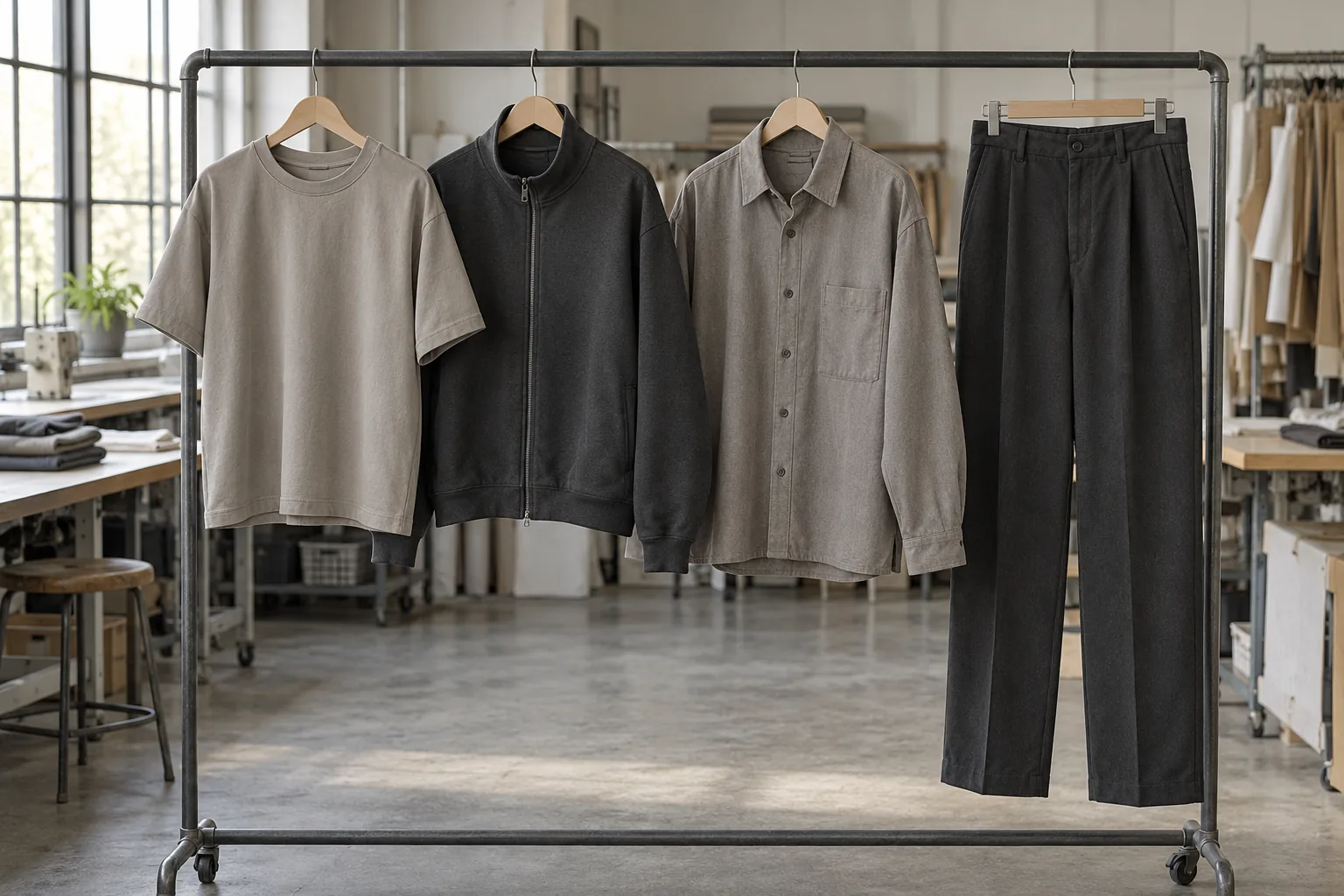
A small collection has little room for a garment that feels out of place. A boxy tee, a zip sweatshirt and a straight-leg trouser can share a clear identity without using identical fabrics or repeating the same graphic. The challenge is keeping that relationship intact as separate styles move through development.
To create brand consistency across a small apparel range, make approval a collection-level decision as well as a style-level decision. Each gate should identify what the buyer is accepting, what evidence supports that acceptance and what still prevents production release. This gives the manufacturer a usable standard instead of a general request to make everything feel cohesive.
Gate 1: Approve the relationships between products
Before reviewing individual samples, define three or four connections that must remain visible across the range. These might be a relaxed shoulder line, restrained surface decoration, matte hardware and a muted palette. Separate these shared rules from features that belong to one garment only.
For example, a woven overshirt does not need to copy a jersey tee’s measurements. It can repeat the tee’s broad silhouette and quiet branding while retaining enough sleeve volume for layering. Approve that relationship explicitly; do not translate “same attitude” into identical chest widths across different constructions.
Create a one-page collection standard with a reference image, material reference or measurable rule for each connection. Assign one buyer-side decision owner. When design and merchandising disagree, the factory needs a consolidated answer before the next gate opens.
Gate 2: Accept material differences deliberately
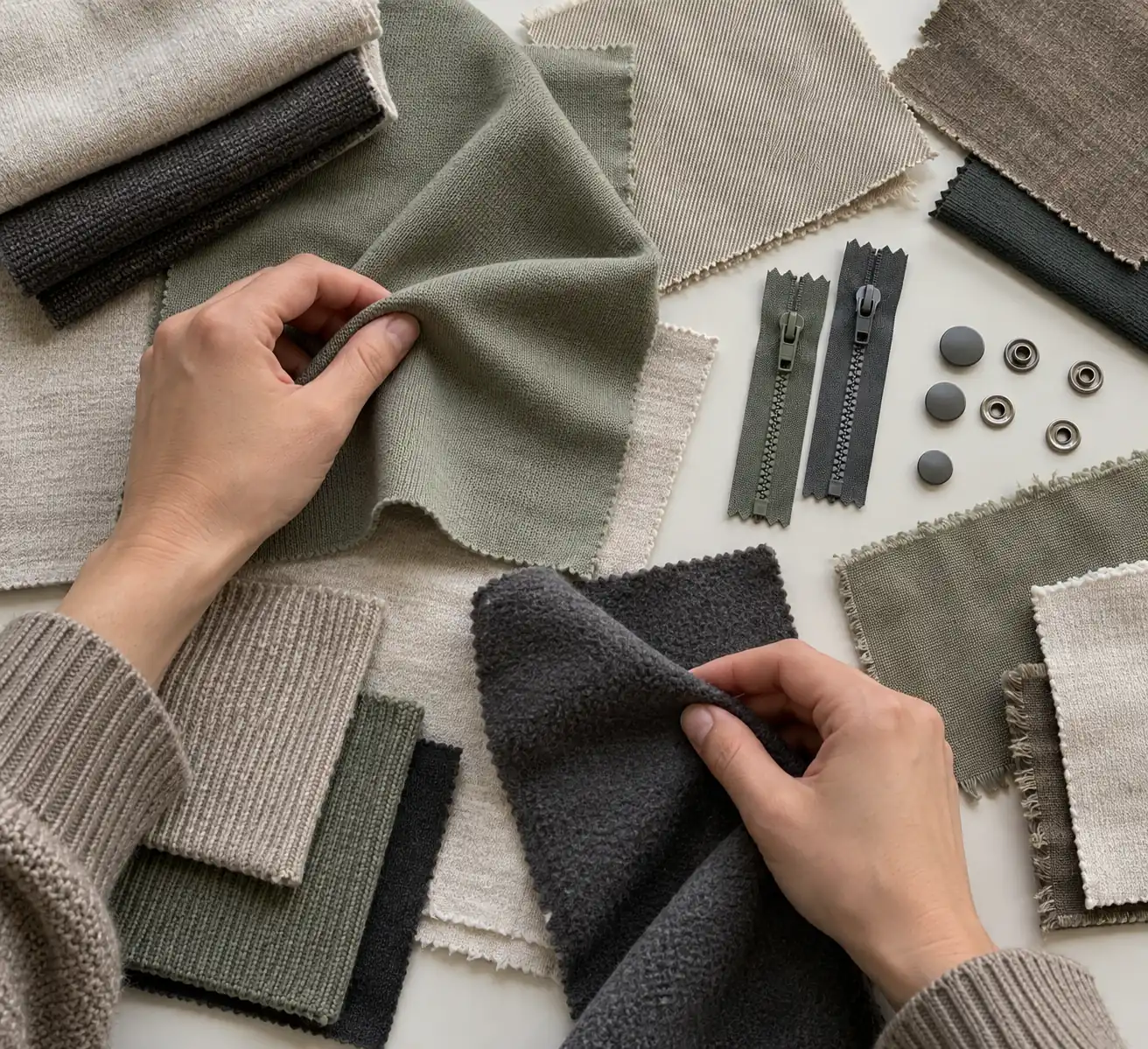
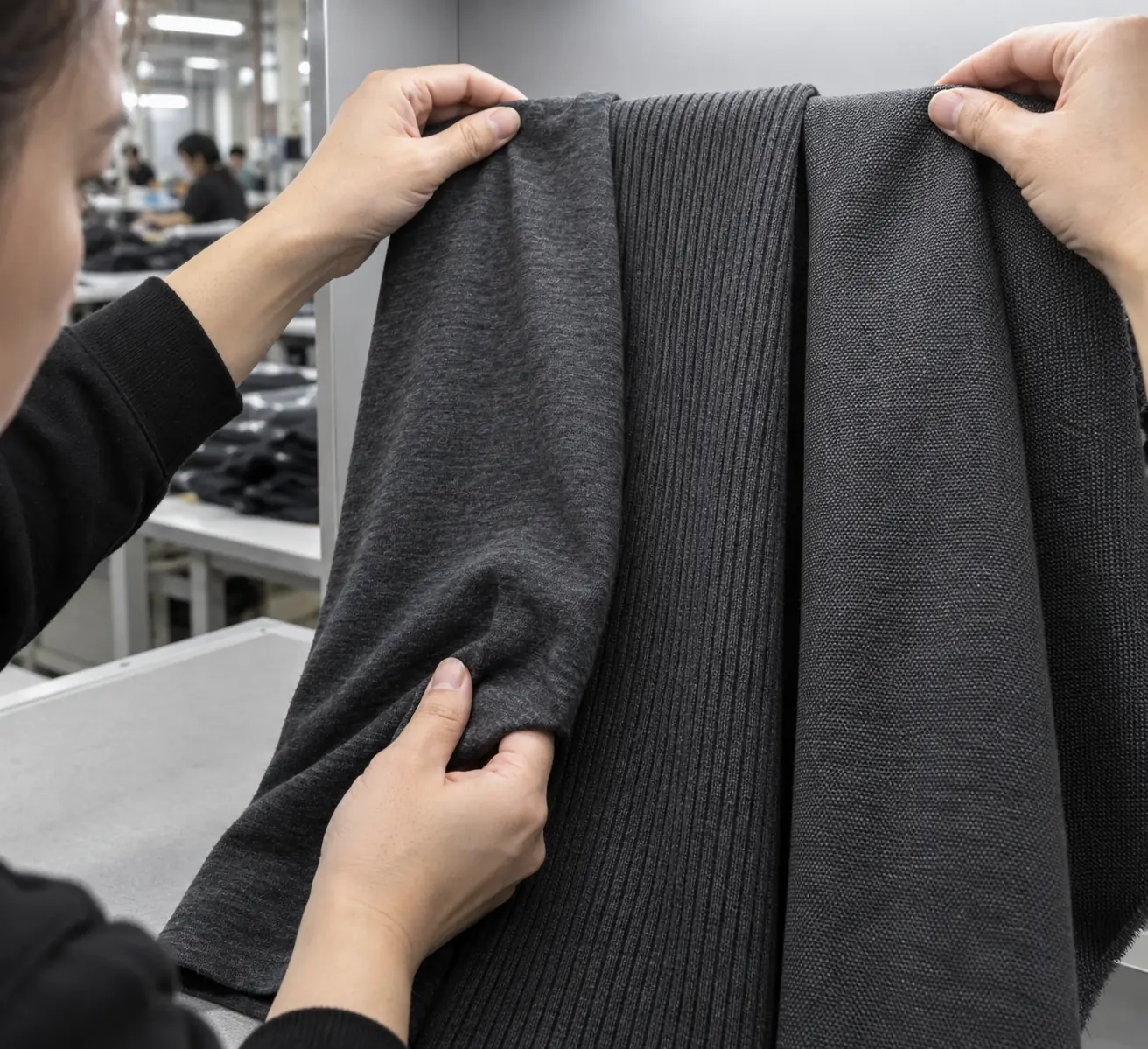
The same color name can produce visibly different results on brushed fleece, rib and woven cotton. Texture, fiber content and finishing affect how color is perceived. Decide whether the range needs a close visual match or a controlled tonal relationship, then assess physical references together under agreed lighting.
Use the table below as a buyer approval record. Replace broad descriptions with the actual references selected for the project. An unresolved item should remain on hold rather than becoming an assumed acceptance.
| Relationship | Evidence to compare | Release condition |
|---|---|---|
| Main fabric and rib | Physical color submissions side by side | Match or intentional contrast accepted |
| Hardware across styles | Actual zipper and snap finishes | Surface appearance approved together |
| Light and heavy fabrics | Swatches plus garment drape | Different weights support the same silhouette direction |
Do not approve by swatch alone when the decision concerns how a garment hangs. A crisp fabric and a fluid fabric may look compatible on the desk but produce unrelated silhouettes. Keep color approval distinct from approval of garment behavior.
Gate 3: Review samples as a complete outfit
Once samples are available, review them together on the intended wearer or a consistent fit model. A sweatshirt may pass its own measurements yet conceal a trouser pocket detail or overwhelm the tee underneath. Record those interactions before accepting the collection proportions.
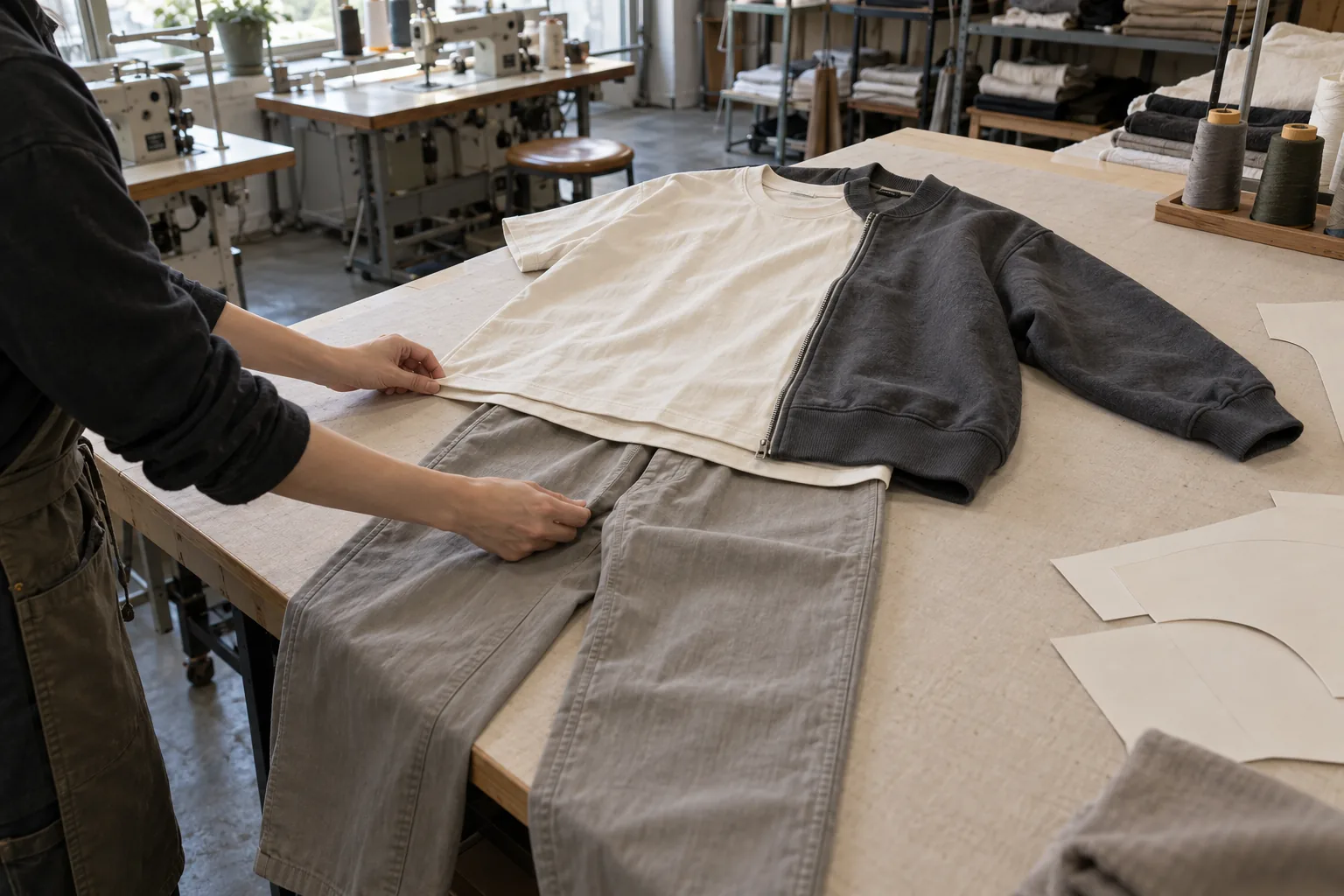
Check front, side and back views, then test the intended combinations. If the overshirt is meant to remain open over the tee, assess the visible neckline, hem relationship and sleeve layering in that configuration. Photograph the accepted combination for reference, while keeping written measurements as the construction authority.
At StitchQuote, a 7-day sample is available for standard styles with confirmed specifications and available materials. Complex styles, custom washes and custom-developed fabric take longer. Plan the collection review around the necessary samples rather than treating the fastest completed garment as approval of the whole range.
Gate 4: Close comments before releasing production
Comments such as “make the logo subtler” leave too much interpretation. Specify the revised decoration dimensions, placement reference, technique and color. For an embroidered mark on two fabrics, evaluate each application: the same artwork can look different on dense twill and soft jersey.
Give every revision a status: accepted, revise and resubmit, or intentionally different. Record the date and specification version alongside it. An intentional difference might allow a larger mark on outerwear while keeping the same placement logic. That exception should be documented, not left in a message thread.
Release only the styles whose required approvals are complete. Before releasing one early, check whether a pending shared decision could affect it, such as a common label size or hardware finish. StitchQuote offers cut-and-sew, private label, sampling, fabric and trim sourcing, and branding through woven labels, prints and embroidery; the buyer’s approval record should identify the selected execution for each style.
Gate 5: Inspect bulk against the accepted collection
QC should confirm both garment conformity and the agreed relationships between styles. StitchQuote performs QC before packing. Provide the approved references and acceptance criteria so inspection can distinguish an intentional difference from an error.
- Version control: Confirm that the garments correspond to the released specification and recorded revisions.
- Color relationships: Compare representative pieces from each style together under the agreed lighting, using accepted physical references.
- Proportion: Check specified measurement points and tolerances, including the dimensions that control layering.
- Branding hierarchy: Verify decoration size, orientation and placement against each style’s approved execution.
- Shared details: Compare label construction, visible thread choices and hardware finishes wherever the collection standard requires consistency.
Agree the inspection coverage and treatment of nonconforming pieces before the check. If a discrepancy affects a shared component, assess every style using it. Correcting one garment does not establish that the rest of the range is acceptable.
Turn collection proportions into measurable checks
For each style, add a measurement diagram that defines the garment condition and exact endpoints. Measure a tee flat and relaxed, with half-chest taken straight across at a stated distance below the armhole. Define body length from the high shoulder point beside the neckline to the bottom hem, and specify whether any hem band is included. On a zip sweatshirt, state whether measurements are taken with the zipper closed. For trousers, distinguish relaxed waist from extended waist and define the crotch seam intersection used for inseam measurement.
Use tolerances that suit the measurement and construction rather than applying one allowance everywhere. As an illustrative buyer specification, a tee might allow ±1 cm at half-chest and body length, while a small chest print might allow ±0.5 cm in placement from its defined reference. These are proposed starting points for discussion, not StitchQuote production guarantees. Agree feasible limits before approving the sample, and keep size grading separate from tolerance: grading changes the target between sizes; tolerance defines permitted variation around each target.
Check the combined effect of acceptable variation. If a layered tee is intended to extend 3 cm below a sweatshirt, allowing ±1 cm on each body length can reduce the visible difference to 1 cm or increase it to 5 cm. Assess those extremes against the intended outfit. A sample with both lengths exactly on target does not demonstrate that the full permitted range will look acceptable.
Specify fabric behavior and budget the assortment
Record fabric composition, knit or weave structure, finishing and target GSM, meaning grams per square meter. An illustrative brief could pair a 220 GSM cotton jersey tee with a 340 GSM brushed fleece sweatshirt. Those numbers describe proposed development targets, not available StitchQuote stock. Equal GSM does not guarantee equal thickness, softness or drape, so retain an approved physical reference and identify which properties matter most for the silhouette.
Before closing the material gate, agree a wash-check procedure using the intended care instructions. Measure the sample before washing, repeat after the agreed washing and drying cycle, and record dimensional change at the same points. For example, a body length changing from 70 cm to 68.6 cm represents 2% shrinkage. Assess twisting, rib recovery, print appearance and zipper waviness alongside the numerical result. Set acceptance limits with the manufacturer rather than assuming that one shrinkage allowance suits every fabric.
For a worked assortment plan, consider 50 tees, 50 sweatshirts and 100 denim trousers: 200 pieces across three styles, meeting the stated starting MOQ by style. Confirm color splits, size quantities and material requirements separately before treating that plan as order-ready. Ask for costs broken down by garment construction, fabric, decoration, trims, sampling and packaging. More embroidery stitches, additional print locations, custom hardware and separate fabric developments can change the budget even when the piece count stays fixed. Resolve those choices before approving shared branding so a later cost adjustment does not force the collection back through several approval gates.
Questions buyers ask at collection approval
Can one approved style become the master for everything?
It can establish selected visual references, such as decoration restraint or hardware finish. It cannot replace fit and construction approval for another category. State which attributes transfer and which require separate evidence.
What if a shared fabric is unavailable for one style?
Reopen the material gate for the affected relationship. Review the proposed substitute’s color, surface and garment behavior alongside the accepted styles. A sourcing substitution should not inherit approval simply because its composition sounds similar.
Does a coordinated range qualify for one combined MOQ?
Do not assume that coordinated products share a single minimum. StitchQuote’s MOQ for most categories starts from 50 pieces per style; denim starts from 100 pieces per style. Confirm the planned styles and material requirements before committing the assortment.
When should an aesthetic mismatch stop release?
Stop release when it breaches a recorded collection requirement, such as an unapproved hardware finish. If the difference is acceptable, document the exception and update the reference set before release. Avoid moving the standard informally during inspection.
Keep the next decision tied to evidence
A useful approval handoff contains the current specification, accepted physical references, closed comments and any remaining holds. Keep those items together so the next decision can be made against the same standard. These resources support that preparation:
- Prepare the tech pack that carries your approved requirements
- Review sampling and minimum order planning
- Discuss your range and approval requirements with StitchQuote
Request a manufacturing quote
Share your product type, quantity range, and destination. We usually reply within one business day.