Custom Streetwear, Casualwear & Denim Manufacturer•MOQ 50 pcs•Denim MOQ 100 pcs•7-Day Sample Available


What Details Increase Perceived Value in Private Label Apparel
See which details increase perceived value in private label apparel, from fabric and fit to trims and packaging, without wasting budget on low-impact extras.

A customer can judge a garment before trying it on: the neck label scratches, the hangtag feels flimsy, or the stated size disagrees with the sewn label. These small contradictions make a carefully developed product feel unfinished. The opposite impression comes from details that agree with the garment and survive handling.
For brand buyers, a label and hangtag approval gate is a practical way to protect perceived value before bulk trims are ordered and attached. This gate is a documented decision that the garment, sewn labels, removable tags, and attachment method work together. It should test the complete customer encounter, rather than treating artwork approval as the end of branding development.
Make the first touch support the product promise
Start with the moment a shopper lifts the garment. A heavyweight sweatshirt might benefit from a quiet neck label with soft edges and a restrained matte tag. A lightweight jersey top needs trims that do not pull its neckline out of shape. Neither product automatically gains value from a larger logo, thicker card, or more layers of packaging.
Choose one visible cue and one tactile cue to prioritize. For a clean everyday tee, that could mean an accurately positioned size label and a neck finish that feels smooth against skin. For an overshirt, it might mean a neatly secured brand label and a tag attachment that leaves the fabric undamaged. Make those priorities explicit before reviewing trim options.
Approve a physical label set beside the actual sample
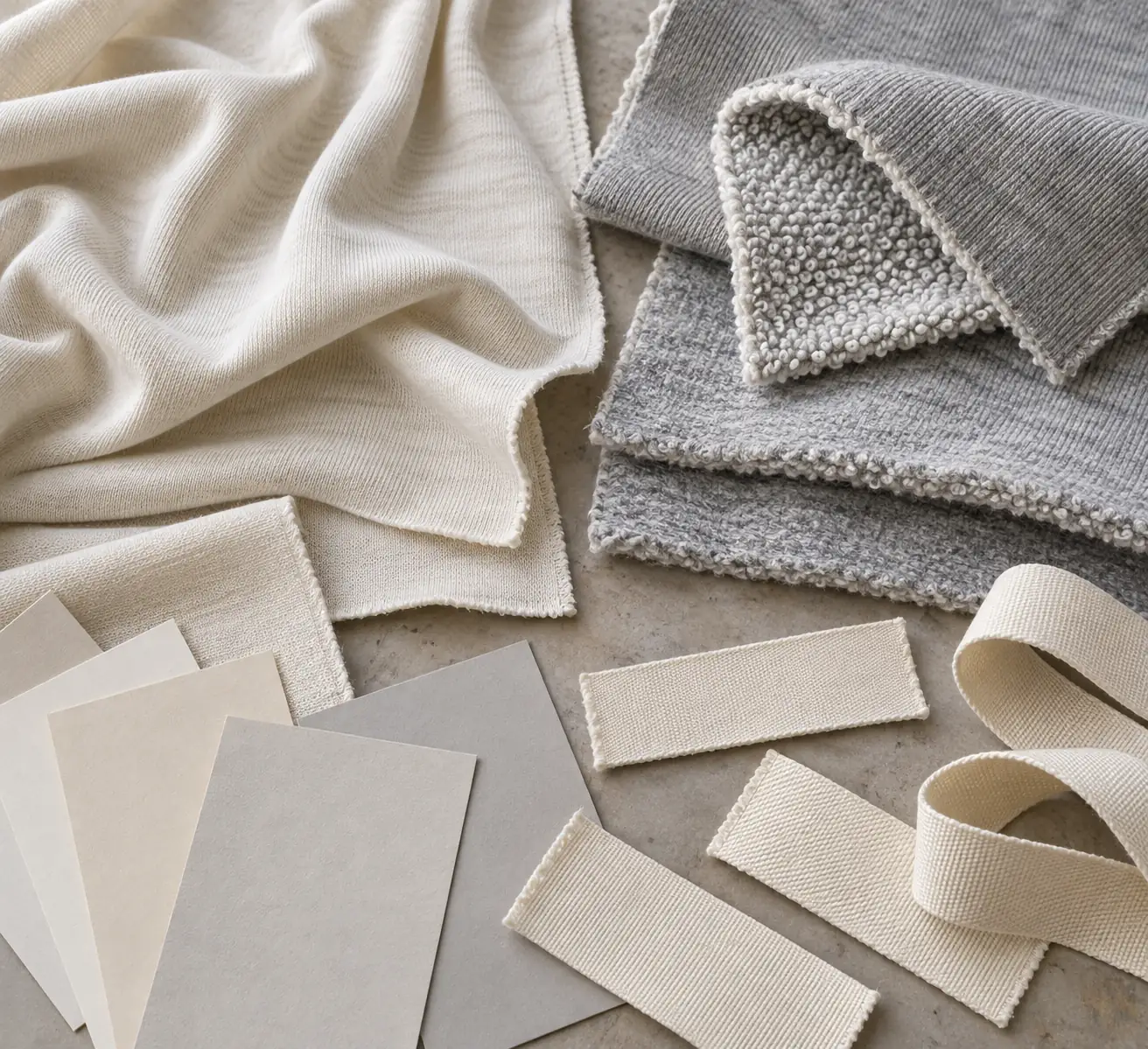
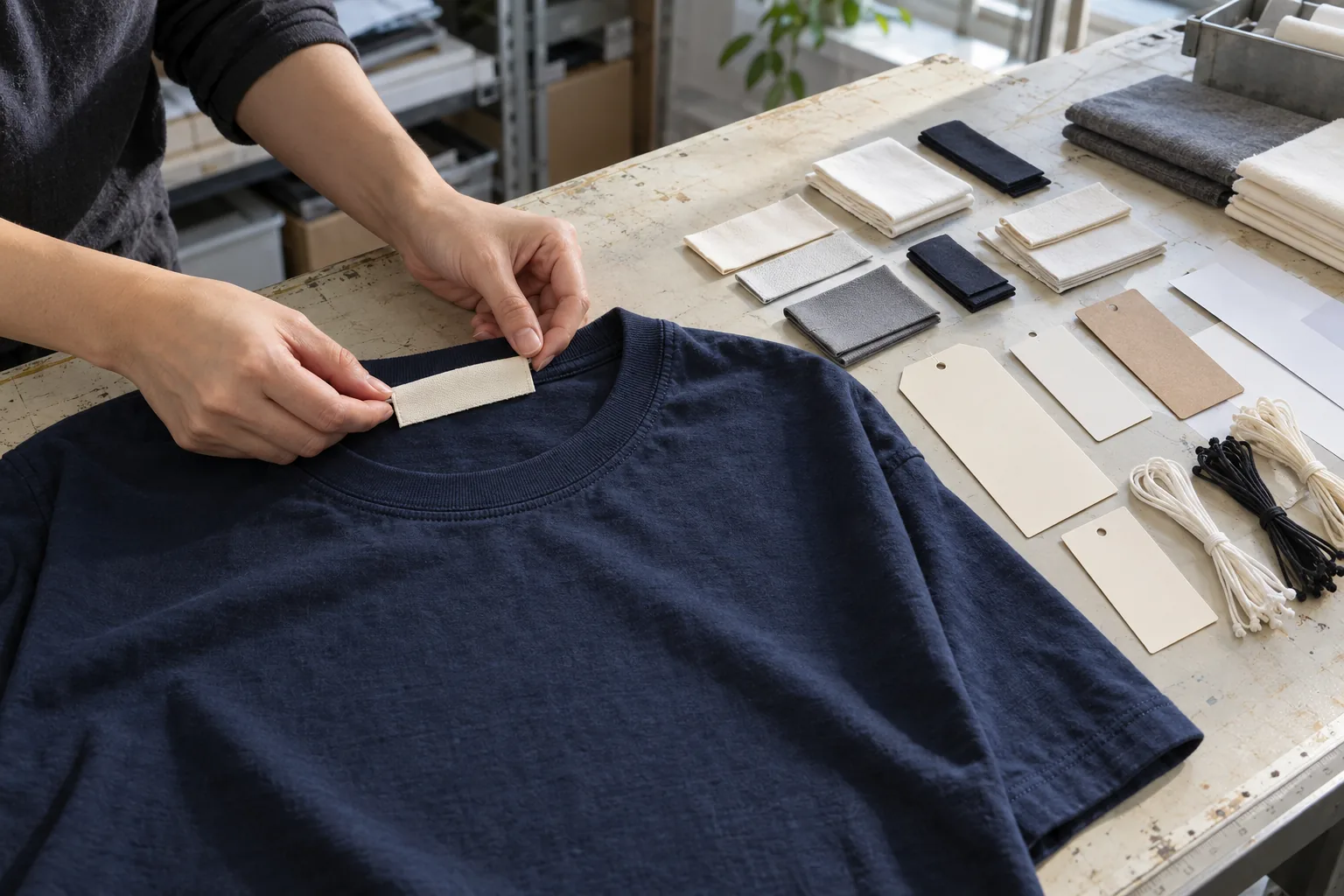
A screen proof can confirm spelling and layout, but it cannot reveal a sharp folded edge or a stiff label backing. Ask for a physical set containing the brand label, size identifier, care label, hangtag, and attachment components. Review these against the intended fabric color and construction, preferably on the garment sample.
Check how the branding reads at normal handling distance. Fine lettering can lose clarity when woven at a small size; a print that looks subtle on white paper can disappear against a dark textile. If clarity requires enlarging the label, check whether the new dimensions interfere with the neckline or seam allowance.
The approval record should identify the artwork revision, dimensions, material, color reference, fold type, placement, and attachment method. Record any approved variation separately. A comment such as “make it more premium” is not a usable production instruction; “soften the edge finish and submit a replacement for touch approval” is.
Give every tag a job before adding another
A label set feels considered when each component answers a different customer question. The brand label establishes identity. The size identifier helps selection. The care label carries required product information for the destination market. A hangtag can explain a useful construction detail or present retail information without crowding the garment itself.
Separate permanent information from removable storytelling. Buyers should verify destination-market labeling requirements and the accuracy of fiber, origin, and care information before release. Decorative copy must not contradict the permanent label. Avoid unsupported claims such as “organic” or “recycled” merely because they fit the visual concept.
| Component | Value test | Reason to hold approval |
|---|---|---|
| Brand label | Legible identity with comfortable contact | Rough edges or distorted stitching |
| Size identifier | Quick, unambiguous selection | Mismatch with garment or hangtag |
| Care label | Readable, verified product information | Unconfirmed composition or instructions |
| Hangtag | Useful information and clean presentation | Unverified claims or damaging attachment |
Treat attachment as part of garment construction
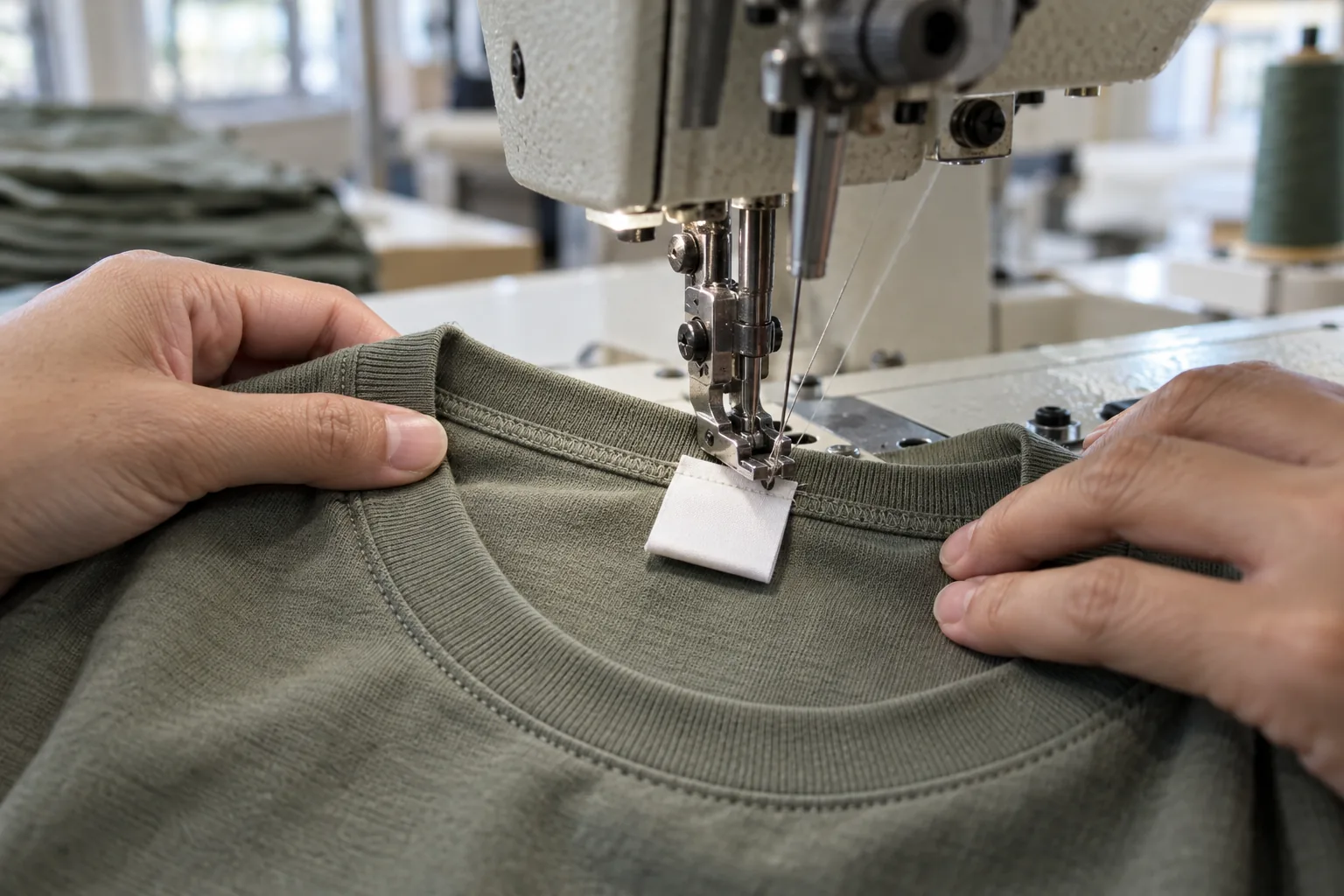
Even a well-made label can cheapen the garment if sewing puckers the surrounding fabric. Review stitch tension, label alignment, exposed corners, and thread ends on the assembled sample. A label caught into a seam needs enough allowance to remain secure without forcing its visible face into an awkward position.
Hangtag placement deserves the same attention. Test the proposed cord or fastener on the intended attachment point. Check that it does not puncture a visible panel, stretch a loop, snag a knit, or rub against a delicate finish. The customer should be able to remove it without leaving an obvious mark.
Evaluate the garment both hanging and folded. A tag that sits neatly on a rail may bend across a fold during packing. Adjust the attachment location or cord length using a physical trial, then photograph the approved arrangement so packing teams have a clear reference.
Use a release checklist that catches mixed identities
Make the gate a recorded pass or hold decision before bulk trim commitment, followed by verification before packing. Keep one approved garment and its matching trim set as references. Artwork files alone are insufficient when the issue is feel, placement, or an attachment mark.
- Identity: Confirm that style, color, and size agree across the garment, sewn labels, hangtag, and order record.
- Information: Check approved spelling, composition, care instructions, and any retail codes against the current files.
- Comfort: Handle label edges and seams at skin-contact points; investigate stiffness, exposed corners, and rough thread ends.
- Appearance: Compare position, alignment, contrast, and stitching with the retained sample.
- Durability: Assess sewn-label readability and attachment after the agreed garment-care trial; remove disposable tags first.
- Packing readiness: Check for bent cards, loose fasteners, transfer marks, and tags assigned to the wrong variant.
Define which failures stop release and who can approve corrections. A wrong size identifier needs containment of the affected units, not a general reminder to be careful. If a replacement trim changes material or construction, review it physically before treating it as equivalent.
Budget the approval gate into a small production run
Ask the supplier to separate garment quantities from any trim sourcing constraints. A garment minimum does not establish the minimum for every custom label or card. Confirm trim quantities, spare allowances, ownership of leftovers, and what happens if artwork changes before committing to an elaborate set.
StitchQuote’s MOQ for most categories starts from 50 pieces per style; denim starts from 100 pieces per style. Services include cut-and-sew, private label, sampling, fabric and trim sourcing, branding through woven labels, prints and embroidery, and QC before packing. A 7-day sample is available for standard styles with confirmed specifications and available materials; complex styles, custom washes, and custom-developed fabrics take longer. Confirm whether the intended branded trims are available for the proposed sample schedule.
Turn label placement into measurable instructions
Define placement from a stable construction reference rather than an instruction such as “center at back neck.” Specify the label’s finished width and height, its centerline relative to center back, and the distance from the neckline joining seam to its upper edge. Measure with the garment laid flat and relaxed. Pulling a stretch neckline taut can hide puckering around the attachment stitches and distort the placement reading.
A buyer-proposed specification might call for a 40 mm wide label centered within 3 mm of center back, with its upper edge 10 mm below the joining seam and a vertical placement tolerance of ±2 mm. These are illustrative approval targets, not universal tolerances or StitchQuote specifications. Agree achievable limits after reviewing the actual construction. Include a photograph with measurement arrows so the inspector measures the same edges each time.
Record fabric weight and structure alongside the trim specification. A proposed 160 GSM single-jersey tee and a 320 GSM brushed-fleece sweatshirt need separate attachment trials even if they share artwork. The lighter knit may sag beneath a stiff label or reveal excessive stitch tension; fleece thickness can make folded label corners bulky. GSM measures mass per square meter, not softness or stretch recovery, so assess the actual fabric and assembled seam before approving compatibility.
Reconcile trim quantities against a worked order
Consider an illustrative order of 100 tees in one style and two colors, with 50 garments per color. For each color, the buyer requests 10 small, 20 medium, and 20 large. The size-label requirement is therefore 20 small, 40 medium, and 40 large before separately agreed replacement allowances. Confirm acceptance of the color and size split when quoting. A common brand label may serve the whole order, while size-specific hangtags or retail codes need separate counts.
Create a variant matrix linking each garment color and size to its sewn size label, approved care-label revision, and hangtag code. During packing, compare the garment against that row. Comparing only the hangtag with the sewn label can miss two matching but incorrect identifiers. For scannable retail codes, test printed production tags with the receiving system and verify the returned variant rather than simply checking that the scanner beeps.
Ask the quote to identify artwork setup, label dimensions and color count, card stock and finishing, attachment labor, and separate trim minimums. Extra versions can increase setup work and leftover stock without increasing garment quantities. Agree how replacements and unused trims will be counted and identified by artwork revision. After a label change, isolate obsolete stock so it cannot accidentally return to the packing line.
Questions buyers ask before releasing branded trims
Can the garment sample pass while the label set stays on hold?
Yes, if approvals are recorded separately. Fit approval should not imply approval of temporary labels. Identify the unresolved trims and prevent their bulk release until the physical replacements pass review.
Does a thicker hangtag always look more expensive?
No. Proportion, clean cutting, surface finish, and relevant information matter more than thickness alone. An oversized rigid card can feel awkward on a light garment and complicate folding.
What if a fabric substitution changes the care information?
Reopen the information check before printing or sewing the affected labels. Verify composition and care instructions for the substituted material, and reconcile any related hangtag copy before releasing the revised set.
Related reading and project support:
- Document label placement in your tech pack
- Review sampling and minimum order planning
- Explore private label manufacturing support
- Discuss your garment and trim approval requirements
Request a manufacturing quote
Share your product type, quantity range, and destination. We usually reply within one business day.