Custom Streetwear, Casualwear & Denim Manufacturer•MOQ 50 pcs•Denim MOQ 100 pcs•7-Day Sample Available

Why Set-Level MOQ Planning Is Different from Single-Style MOQ Planning
Learn matching set MOQ planning through a clearer factory-side view that helps brands reduce rework, align sample goals, and move toward approval with better timing.

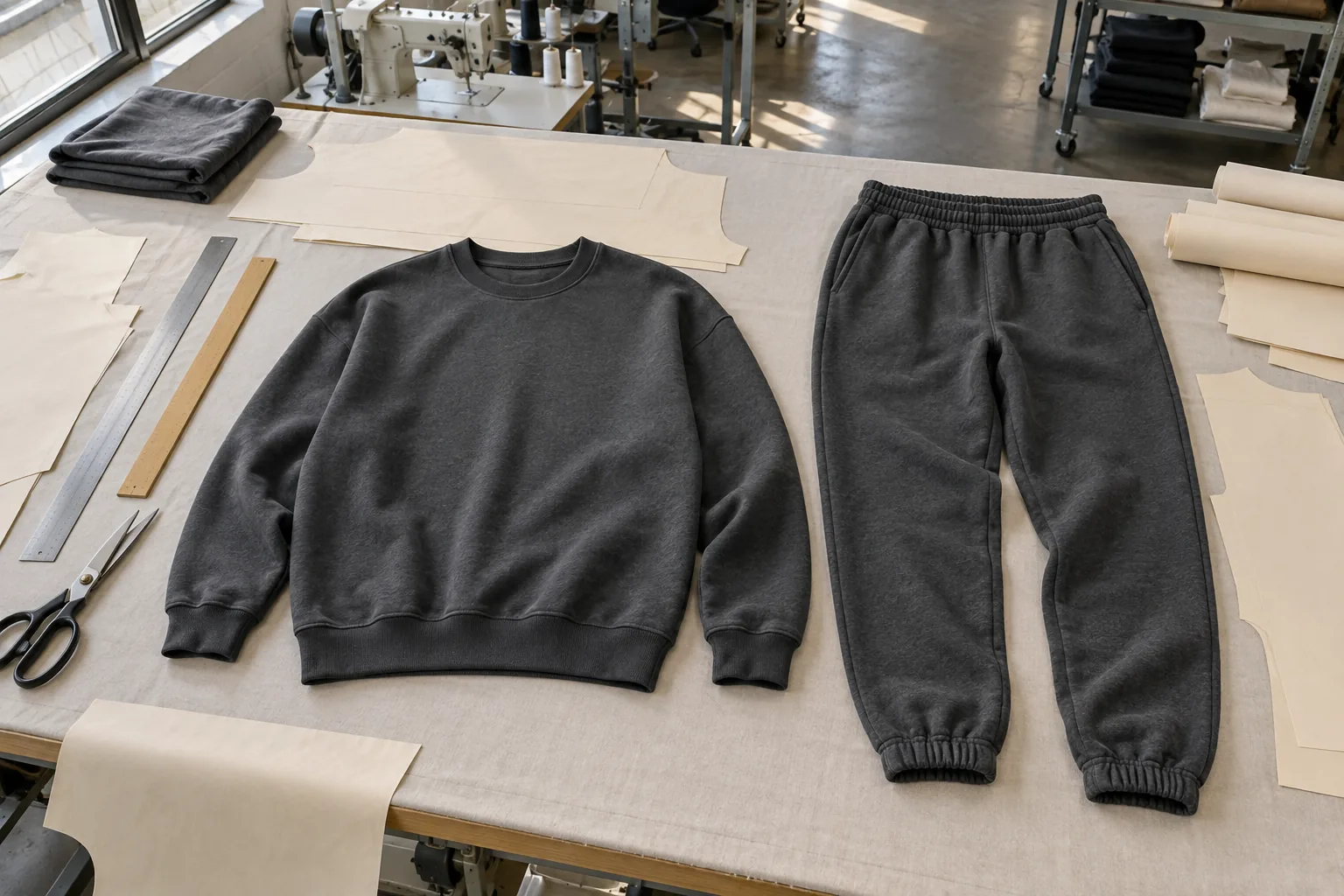
A matching outfit is one product on a storefront, but it can be several production orders behind the scenes. A sweatshirt and jogger may share fabric while requiring separate patterns, sewing operations, trims, and decoration setups. Ordering 80 sets therefore means specifying 80 tops and 80 bottoms, not submitting an undivided quantity of 160 garments.
For a buyer deciding which combinations to launch, set-level MOQ planning starts with the processes each component needs. The useful question is which operations can share a batch and which must stand alone. Answer that before committing to colors or advertising complete outfits, and the order can be assessed against both production requirements and saleable set quantities.
Translate the outfit into separate production quantities
Build the inquiry around component styles, even if customers will purchase only complete sets. List the top and bottom separately, then show the intended pairing. Include quantities by color and size for each component; a single set total conceals the splits that material suppliers and production planners need.
StitchQuote’s MOQ for most categories starts from 50 pcs per style; denim starts from 100 pcs per style. These starting points do not establish a universal minimum per set or guarantee every color and process combination. Ask how each component is classified and whether the requested fabric, wash, or branding introduces another minimum.
For example, a proposed 60-set jersey tee and denim short pairing contains 60 pieces of each style. The tee quantity may meet the general starting point, while the denim component sits below the denim starting point. Combining the two counts does not resolve that difference.
Find out where shared fabric actually reduces fragmentation
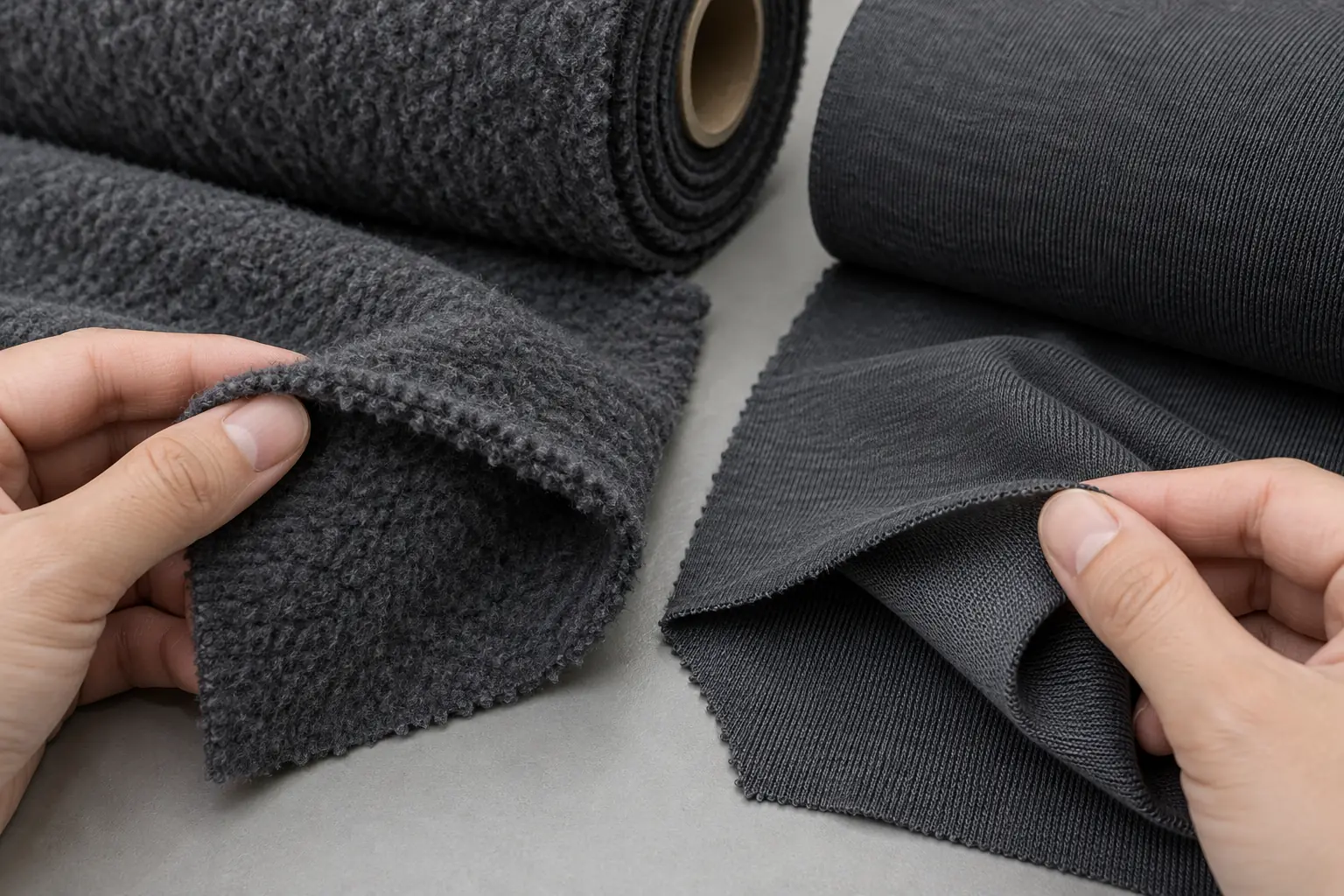
Matching components offer a purchasing advantage only when their material specifications align. Confirm fiber composition, construction, weight, finish, and color standard. Two fabrics described as charcoal cotton may need separate sourcing because one is brushed fleece and the other is jersey.
When both components use the same approved fabric, ask whether purchasing can be consolidated. Fabric demand depends on consumption per garment and cutting allowances, so equal top and bottom quantities will not necessarily require equal material lengths. Wider legs, larger sizes, and directional fabric can change the calculation.
Also establish how shade continuity will be managed. If a top and bottom come from different dye lots, each might look acceptable alone while the outfit looks mismatched. Request a plan for lot allocation and a paired shade review. Treat shared purchasing and visual matching as separate questions that both need answers.
Price the setups that cannot travel between components
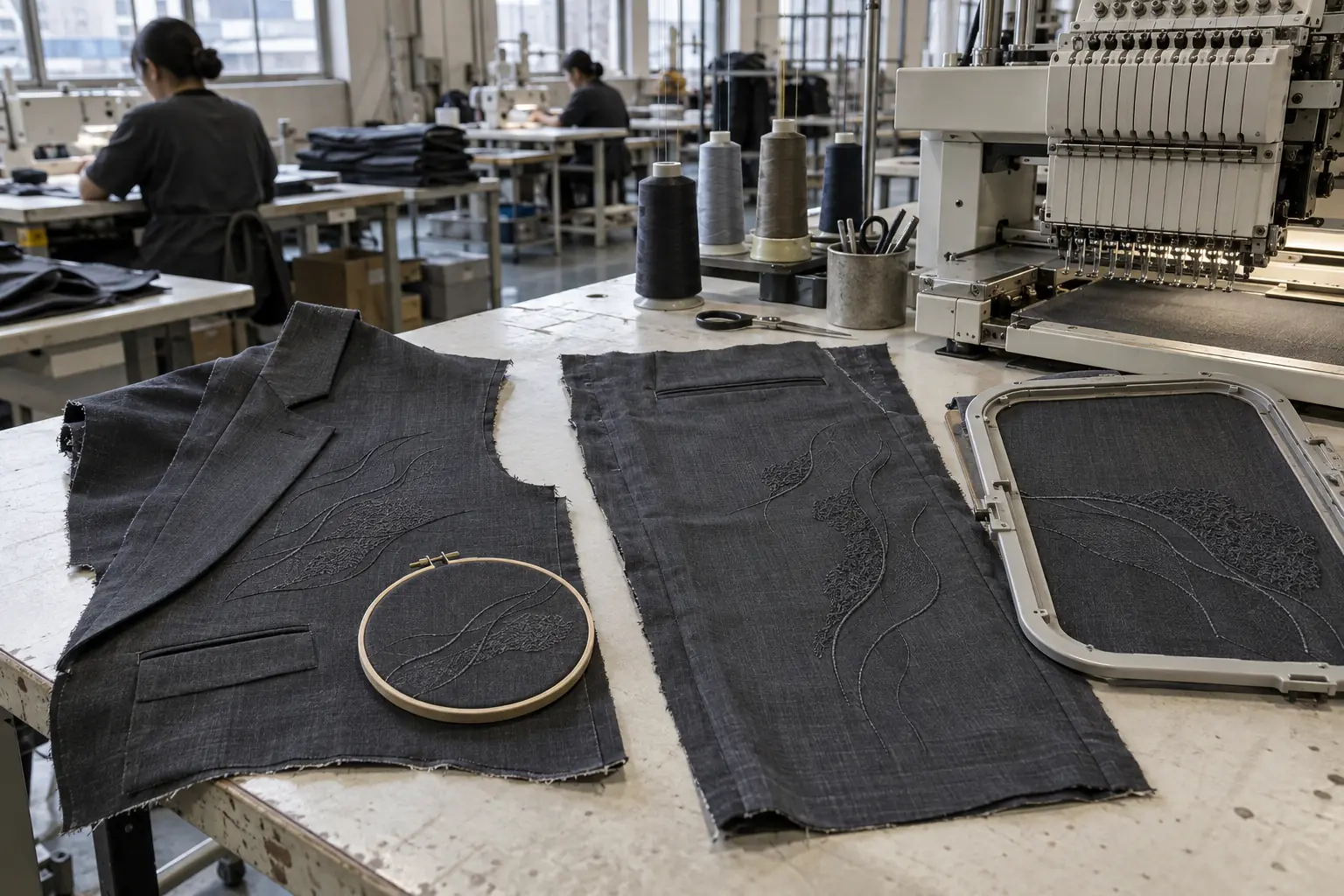
Fabric consolidation does not eliminate the work required to construct two garments. A zip jacket and elastic-waist trouser have different sewing sequences and hardware requirements. Decoration can create further splits when artwork size, placement, thread, or application method changes.
| Process | Possible shared input | What to confirm separately |
|---|---|---|
| Fabric sourcing | Identical base fabric and color | Consumption, lot allocation, and purchasing minimum |
| Cutting and sewing | Some materials and thread | Patterns, size ratios, and component quantities |
| Print or embroidery | Artwork concept or colors | Dimensions, placement, setup, and batch minimum |
| Washing and finishing | Target appearance | Recipe suitability and paired appearance |
Request a quote that identifies the constraint behind each minimum: finished style quantity, material purchase, decoration batch, or trim order. If a custom zipper is the limiting input, increasing the quantity of an unrelated tee may accomplish nothing. This breakdown lets the buyer change the specification that actually drives the requirement.
Choose the launch assortment around the tightest process
Before sampling, compare a small number of practical assortment options. An illustrative 100-set order split evenly across four colors leaves only 25 tops and 25 bottoms per color. Even when both styles meet a starting style quantity, that color depth still needs confirmation for sourcing and processing.
Useful alternatives include fewer shared colors, available fabric instead of custom-developed material, or a simpler decoration specification. Ask which change improves feasibility before removing a feature customers value. A lower total quantity with several custom processes may be harder to execute than a larger order with consistent inputs.
If the components have different minimums, decide explicitly whether surplus pieces can be sold separately. Buying 100 bottoms against 80 tops creates at most 80 complete outfits before defects or size mismatches. Record the extra 20 bottoms as planned inventory rather than treating them as additional sets.
Approve and inspect the outfit as a pair
Sampling should test the relationship between the garments as well as each garment’s individual measurements. Check whether the top length works with the waistband height and whether the intended sizes produce a coherent silhouette. A correct chest measurement does not prove that the complete outfit fits as intended.
StitchQuote offers sampling, fabric and trim sourcing, cut-and-sew, private label, branding through woven labels, prints and embroidery, and QC before packing. A 7-day sample is available for standard styles with confirmed specs and available materials; complex styles, custom washes, and custom-developed fabric take longer. Confirm the sample scope and timing for both components.
- Paired shade: compare tops and bottoms together under consistent lighting, including after any agreed wash test.
- Component measurements: verify each garment against its approved tolerances and review the outfit together.
- Branding relationship: check artwork scale, placement, and color across the pair.
- Size availability: reconcile accepted top and bottom counts against the required pairings.
- Packing accuracy: confirm component identities, sizes, and the agreed method for packing complete sets.
Define how failed components will be handled before packing. If one size has 18 accepted tops and 16 accepted bottoms, only 16 same-size sets are available. Total garment acceptance alone will miss that shortage.
Questions to settle before requesting the final quote
Can the top and bottom have different size ratios?
Yes, this can be proposed, especially when shoppers can choose sizes independently. Supply separate ratios and explain the selling model. For fixed pairs, the ratios must support the promised combinations; otherwise accepted garments may remain unpaired.
Does identical embroidery mean one decoration minimum?
Not necessarily. Different placements, garment shapes, or artwork dimensions can change setup and handling. Ask whether quantities can be combined for that specific operation instead of assuming identical artwork creates a shared batch.
Should a reorder repeat both components?
Base the request on remaining inventory, then reconfirm the minimums for whichever component needs replenishment. A bottom-only reorder may face fresh material or process requirements, and its shade must be checked against the tops already held.
What information makes the set quote reviewable?
Provide component specifications, color and size quantities, shared-material intentions, decoration details, and packing requirements. Ask for component prices and an explanation of any excess material or trim commitment so the commercial decision reflects complete saleable outfits.
Write measurement rules that both components can pass
Give each component its own measurement sheet, with diagrams showing where the tape starts and ends. For a sweatshirt, specify half chest measured flat at a defined distance below the armhole, body length from the high shoulder point, shoulder width, and sleeve length. For joggers, include relaxed and extended waistband widths, front and back rise, inseam, thigh width at a stated distance below the crotch, and leg opening. State whether measurements apply before or after washing and whether the garment should rest before inspection.
Tolerances should reflect fit sensitivity and construction rather than one allowance copied across the sheet. As a buyer’s proposed specification, a half-chest tolerance of plus or minus 1 cm and a cuff-opening tolerance of plus or minus 0.5 cm can start a technical discussion; these are illustrative values, not StitchQuote acceptance standards. Agree the final limits during sample review. A 1 cm difference in a flat half-chest measurement represents approximately 2 cm around the body, which can change the intended ease.
For fabric, replace descriptions such as “heavy cotton” with a measurable brief. An illustrative request might specify 320 GSM brushed fleece for both bodies, a stated fiber composition, and a separately specified rib for cuffs and waistband. Confirm an acceptable weight range, stretch and recovery needs, and the wash method used to assess shrinkage. If the sweatshirt body and jogger leg shrink differently, an initially balanced outfit can change proportions. Record measurements before and after the agreed wash test for both pieces rather than relying only on a fabric swatch.
Reconcile a worked order before approving packing
Consider a proposed order of 100 sweatshirt-and-jogger sets in one color, with matching size quantities of 20 small, 40 medium, 30 large, and 10 extra-large for each component. The production brief contains two style lines of 100 pieces each. This clears the general starting quantity of 50 pcs per style, but fabric availability, trims, and decoration still require confirmation. Attach the same color reference to both style lines and identify which labels and packaging materials are shared.
At final reconciliation, suppose the accepted medium quantities are 39 sweatshirts and 37 joggers, while all other sizes are complete. The order contains 97 saleable fixed-size sets, plus two unmatched medium sweatshirts. Record the missing three medium pairs separately from the unmatched inventory. Decide whether affected components will be corrected, replaced, or held before issuing the packing list, and update the available-to-sell quantity accordingly.
Request separate quote lines for the two garments, decoration setups, labels, and set packing where applicable. Ask how unused custom trims and any material balance are treated. These details explain why dividing the invoice by 200 garments can obscure the commercial result: the buyer ultimately needs the cost and availability of complete outfits, with any separately saleable pieces identified.
References for preparing the component brief
- Prepare the specifications for each garment
- Review sampling and MOQ considerations
- Explore hoodie manufacturing cost drivers
- Send StitchQuote your proposed set breakdown
Request a manufacturing quote
Share your product type, quantity range, and destination. We usually reply within one business day.