Custom Streetwear, Casualwear & Denim Manufacturer•MOQ 50 pcs•Denim MOQ 100 pcs•7-Day Sample Available

Why Freight Terms Should Be Discussed Earlier in Small Orders
Learn freight terms small clothing orders through a clearer factory-side view that helps brands reduce rework, align sample goals, and move toward approval with.

A small apparel order can be ready to leave the factory while the buyer is still discovering who must arrange collection, handle import clearance, or pay destination charges. Freight terms deserve attention during the first quotation because they define responsibilities that a garment unit price cannot explain. Resolving them early does not require a logistics manual.
The practical aim is to expose the few unknowns that could derail a modest launch: the delivery point, the importer, the transport budget, and the handover evidence. A brand ordering one sweatshirt style needs a short, usable agreement that connects production to receipt, with room to update shipment estimates as packing details become firm.
Protect the launch with a one-page shipping brief
Start with the actual destination and required arrival window. A warehouse with booked receiving slots has different constraints from a studio that accepts parcels during business hours. Provide the postcode, receiving contact, access restrictions, and whether delivery requires an appointment. These details can affect the service available and the charges quoted.
Separate the desired arrival date from the factory-ready date. Goods ready on Friday are not necessarily collected that day, and collection does not guarantee immediate departure. Leave space for export handling, transit, customs clearance, and final delivery. Ask the logistics provider to identify which dates are estimates and which services carry a specific commitment.
For a first order, a single page is enough: destination, timing, proposed shipping basis, responsible contacts, and unresolved items. Assign one person on the brand side to close those items before bulk approval.
Name the handover point before comparing quotations
“Shipping included” is incomplete unless the quote identifies where delivery ends and what is excluded. If using Incoterms, record the rule, named place or port, and version, such as Incoterms 2020. The named location matters as much as the abbreviation.
Under FCA, the seller delivers to the buyer-nominated carrier at the agreed place; the exact loading responsibility depends on that place. Under DAP, the seller arranges carriage to the named destination, while the buyer generally handles import clearance and import duties and taxes. DDP assigns import obligations to the seller, but feasibility must be confirmed for the destination. These are different allocations of responsibility, not interchangeable service tiers.
FOB applies to sea or inland waterway transport and should not be used as shorthand for an air or courier shipment. Ask for a basis appropriate to the actual movement. Also clarify payment timing, ownership, insurance, and claims handling separately; an Incoterm does not settle every commercial question.

Compare the delivered total without building a forecasting system
Two offers can look similar until destination costs appear. Instead of creating a complex model, compare both against the same destination, carton assumptions, and service level. Keep unknown amounts visible rather than entering zero. Confirm classification and import treatment with the appropriate broker or adviser.
| Cost group | Minimum question to resolve |
|---|---|
| Origin handling | Are collection, export clearance, and terminal charges included? |
| Main transport | What weight or volume basis and quote validity apply? |
| Destination handling | Who pays clearance, handling, and final delivery charges? |
| Import costs | Who is responsible for duties, taxes, and broker fees? |
| Exceptions | What triggers storage, redelivery, or appointment charges? |
Small shipments can be particularly sensitive to minimum charges because those costs are spread across fewer garments. Compare the total expected spend first, then divide by saleable units for planning. A lower garment price does not establish a lower delivered cost when the shipping scope differs.
Use packing estimates to test the transport choice
A run of heavyweight fleece can occupy substantially more space than the same number of lightweight jerseys. Ask for estimated carton count, outer dimensions, gross weight, and units per carton while reviewing the quote. Treat these as provisional until actual packing confirms them. Courier and air charges may use volumetric rather than actual weight; confirm the provider’s calculation.
Test one practical alternative if freight looks disproportionate: consolidated dispatch instead of several releases, or a smaller packing format that still protects the garments. Do not compress decorated pieces or omit protective packaging merely to reach a target estimate. Assess creasing, print contact, moisture exposure, and handling conditions before changing the pack.
StitchQuote’s MOQ for most categories starts from 50 pieces per style; denim starts from 100 pieces per style. Those production thresholds do not imply a particular freight rate. Model shipment size separately from the minimum production quantity.
Work through carton weight before approving a freight allowance
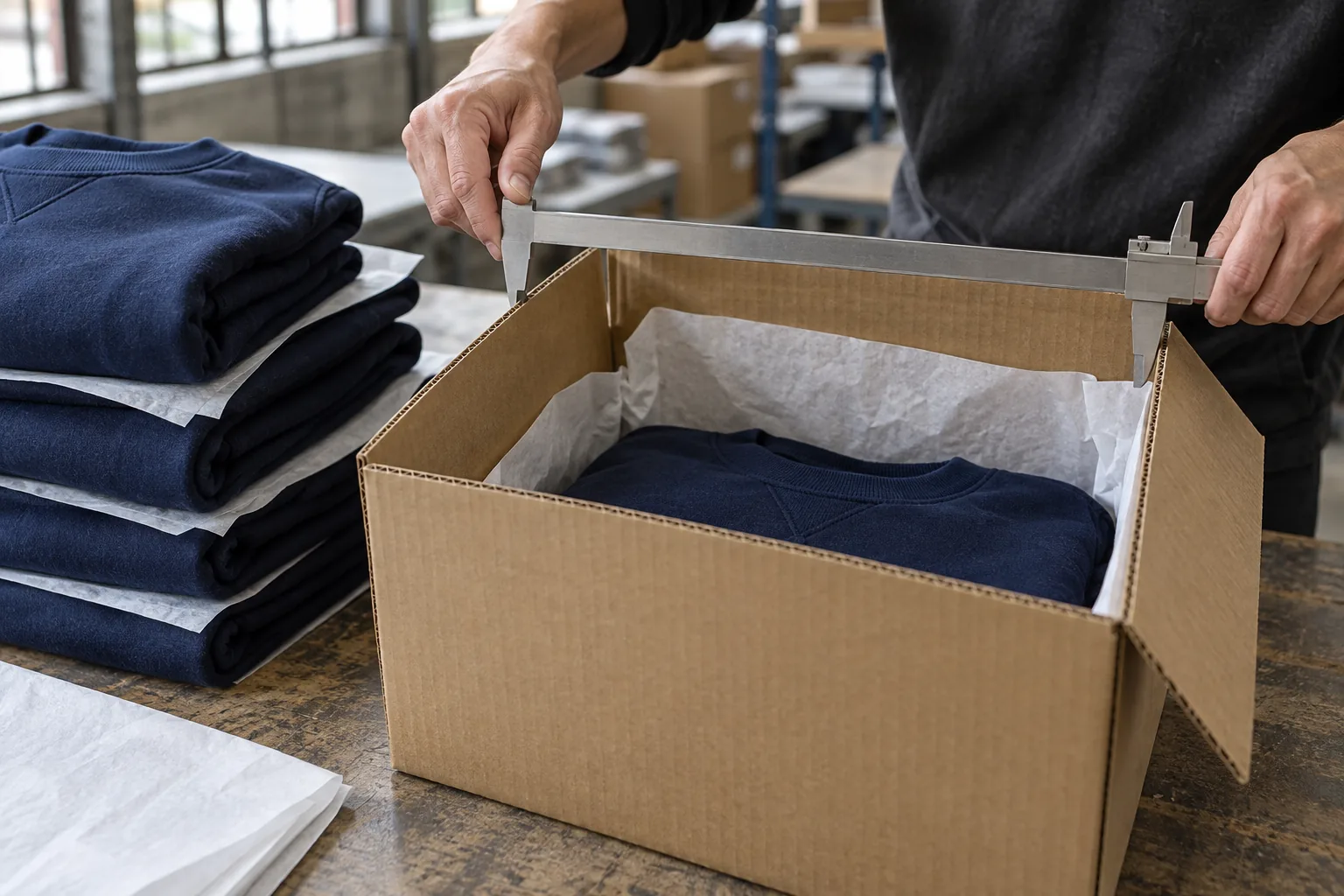
Consider an illustrative order of 100 sweatshirts packed in five cartons, with 20 garments per carton. Suppose each closed carton measures 60 × 40 × 40 cm and weighs 12 kg gross. The shipment has 60 kg of actual gross weight and 0.48 cubic metres of volume. If a courier quotes using a divisor of 5,000 for dimensions measured in centimetres, each carton produces a volumetric weight of 19.2 kg: 60 × 40 × 40 ÷ 5,000. That gives 96 kg across five cartons before any carrier rounding rules. This is a planning example, not a StitchQuote packing specification or freight offer.
Ask the carrier whether it compares actual and volumetric weight per package or across the shipment, what divisor applies, and how it rounds dimensions and billable weight. Measure the outermost points of sealed cartons, including bulging sides, rather than relying on the carton supplier’s nominal dimensions. A packing list that records only garment net weight cannot support this comparison because cartons, bags, and other packing materials also travel.
Fabric GSM helps explain differences between proposed styles, but it does not directly establish packed garment weight. A 320 GSM fleece specification describes fabric mass per square metre; garment size, pattern area, rib trims, hoods, and pockets also affect the finished piece. Ask for a weighed representative garment and a trial packed carton once the approved sample and packaging are available. Keep fabric specifications and freight measurements as separate fields so a fabric substitution triggers a fresh packing estimate.
Connect the size specification to the shipment release record
Before production, define how critical measurements will be taken and which tolerances apply at each point. For a sweatshirt, useful checkpoints include half-chest measured flat at an agreed distance below the armhole, body length from the high shoulder point, and sleeve length from a clearly identified seam or neck point. State whether measurements are taken before or after laundering and how the garment should rest before inspection. These choices prevent two people from measuring the same piece differently.
Write tolerances beside individual measurements instead of applying an unexplained blanket allowance. For example, a buyer might propose ±1 cm for half-chest and body length, then agree a tighter allowance for a small pocket placement where a centimetre would look conspicuous. Those are illustrative acceptance criteria to discuss, not published StitchQuote tolerances. Confirm feasibility against the fabric, construction, and approved sample before adopting them.
At release, request a record identifying the sizes inspected, measured results, defects found, and any corrective action. Agree the inspection coverage in advance; a photograph of one correctly measured garment does not establish that every size meets the specification. Reconcile accepted quantities by size against the packing list, and identify cartons containing any approved substitutions or separated units. This makes a shortage or quality query traceable when the receiving team opens the shipment.
Make shipment release a short QC and document gate
Product inspection and transport preparation answer different questions. StitchQuote provides QC before packing, but the buyer should still agree on the evidence needed for shipment release. Keep the checklist focused on defects or discrepancies that would be expensive to discover after dispatch.
- Product approval: Confirm the approved style, quantities, size breakdown, and disposition of any unresolved defects.
- Packing condition: Check garment protection, carton integrity, and any agreed moisture precautions.
- Shipment totals: Reconcile the packing list with actual carton count, net and gross weights, and dimensions.
- Document consistency: Check invoice descriptions, quantities, consignee details, and broker-requested information against the order.
- Release ownership: Name who approves collection, receives tracking or transport documents, and reports damage or shortages.
Record discrepancies before pickup and retain dated packing photographs. Confirm insurance arrangements and claim notification requirements with the relevant provider. Photographs support investigation, but they do not replace the required transport documents or guarantee recovery.
Set two decision points instead of reopening everything
At quotation approval, agree on the shipping basis, destination, importer arrangements, and provisional budget. Before dispatch, confirm actual packing data, the current freight quote, and the collection plan. Revisit the commercial decision between those points only when something material changes, such as quantity, destination, packing volume, or the required delivery date.
Sampling timelines should stay separate from transport promises. StitchQuote offers a seven-day sample for standard styles with confirmed specifications and available materials; complex styles, custom washes, and custom-developed fabrics take longer. That sampling availability does not establish a bulk completion date or delivery date. Build the launch calendar from separately confirmed milestones.
Questions buyers ask before their first dispatch
Can we request a production quote before choosing a carrier?
Yes. State the destination and request a clearly defined shipping basis with provisional packing data. Carrier selection can follow, provided someone owns the booking and the quote clearly separates included costs from unresolved ones.
Does dividing the order into two deliveries reduce risk?
It may help a launch deadline, but it can duplicate collection, clearance, and minimum handling charges. Compare the incremental cost with the value of receiving part of the stock earlier, and confirm which sizes or products the first delivery must contain.
What if the final cartons exceed the original estimate?
Ask for the measured dimensions and weights, then obtain a revised transport quote before collection. Check whether the difference comes from added units, protective packaging, or the estimate itself. Agree on who authorizes any additional spend.
Related reading
- Discuss your order and delivery requirements
- Prepare garment specifications for quotation
- Review sampling and minimum order quantities
Request a manufacturing quote
Share your product type, quantity range, and destination. We usually reply within one business day.