Custom Streetwear, Casualwear & Denim Manufacturer•MOQ 50 pcs•Denim MOQ 100 pcs•7-Day Sample Available

Why Lead Time Problems Often Start with Incomplete Early Decisions
Use this factory-side guide to compare lead time problems often start with incomplete early decisions more clearly across supplier fit, quote scope, approvals, and.

A launch calendar can look settled while the product is still undecided. A buyer books campaign photography around an estimated delivery date, yet the sweatshirt fabric remains provisional and nobody has authority to approve the neckline. The calendar records elapsed time; it does not reveal the decisions needed to make production possible.
For a brand moving from development into a purchase order, approval gates make that gap visible. Each gate should identify the evidence required, the person authorized to accept it, and the work that acceptance releases. This approach helps explain why lead time problems often start with incomplete early decisions, and gives buyers a practical way to stop carrying those decisions into bulk.
Make every approval release a specific action
“Approved” is incomplete unless it names what can happen next. Accepting a silhouette does not necessarily authorize fabric purchasing. Accepting a print placement does not confirm the print color. If those distinctions stay inside separate email threads, different people can reasonably interpret the same approval differently.
Use a simple gate record for each style: reference version, decision owner, outstanding issue, due date, and permitted next action. Name one buyer-side approver who can consolidate merchandising and design feedback. Otherwise, a factory can receive a fit approval on Monday and a conflicting length request on Tuesday.
The record should also distinguish a target date from a confirmed commitment. Ask what event starts each quoted duration and what assumptions support it. Waiting for buyer feedback, material replenishment, or a revised sample needs to appear in the calendar rather than disappear inside a single production estimate.
Close the material gate before committing to its consequences
Materials are often treated as a visual choice when they are also a scheduling choice. Consider a heavyweight jersey tee: the stock fabric may meet the intended hand feel, while a custom-developed alternative needs further evaluation. Leaving both options open prevents a reliable decision about what to buy and when it will be ready.
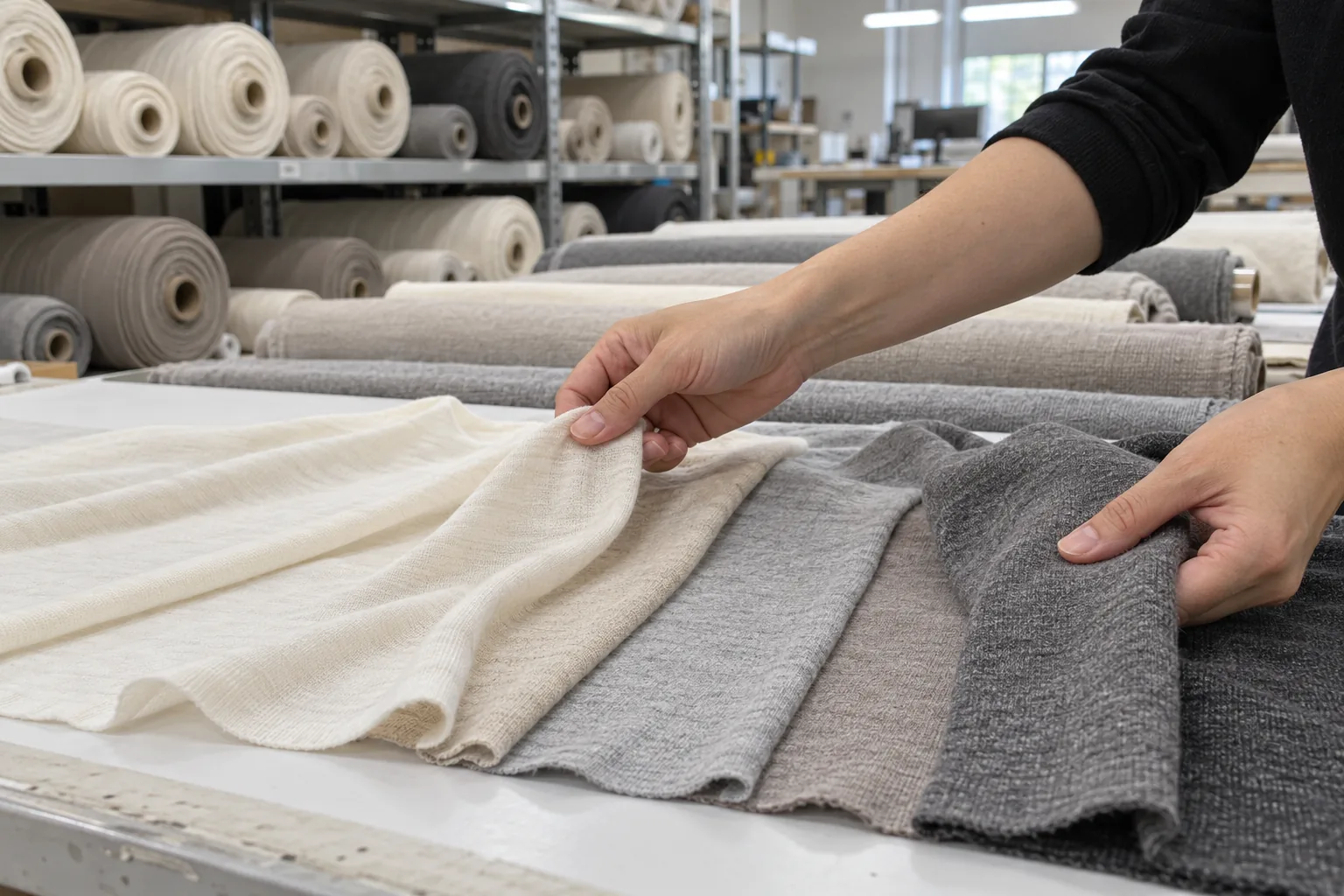
At this gate, confirm the fabric reference, composition, weight, color route, and any finish that affects appearance or dimensions. Record whether the reviewed swatch represents available stock or a material still requiring development. Include trims: a zipper or branded label can remain an unresolved dependency even after the main fabric is selected.
If purchasing must begin before every detail closes, define the limited authorization in writing. Specify the exact material and quantity being released, the unresolved points, and who accepts the exposure if the product changes. A conditional purchase decision should not silently become permission to cut garments.
Separate sample acceptance from permission to start bulk
A sample answers only the questions it was built to answer. A fit sample made in substitute fabric may help assess proportions, but it cannot establish the final fabric’s shrinkage or drape. Likewise, an embroidery trial can establish stitch appearance without settling its placement across every size.

StitchQuote offers a 7-day sample for standard styles with confirmed specs and available materials. Complex styles, custom washes, and custom-developed fabric take longer. Treat that availability as a defined sampling option, not a promise covering development, buyer review, revisions, and bulk production together.
| Gate | Evidence to accept | Action it can release |
|---|---|---|
| Development sample | Fit and construction comments resolved against a named version | Preparation of the final production reference |
| Material approval | Identified fabric and trim references with availability confirmed | Agreed material purchasing |
| Bulk release | Production reference, size quantities, and specifications aligned | Cutting and assembly as agreed |
| Packing release | QC findings closed and packing instructions confirmed | Packing against the accepted requirements |
Agree the sequence for the project rather than assuming every supplier uses these labels identically. Some reviews can run together; their acceptance criteria still need to remain distinct.
Give late changes a clear route back through approval
A gate has little value if anyone can reopen the product without reviewing the schedule. Suppose a casual trouser passes fit review, then the brand requests a wider leg opening. That change may affect the pattern, fabric consumption, grading, and the approved visual reference. Calling it a small styling adjustment does not remove those dependencies.
Ask for a change assessment before authorizing the revision. Identify which approvals are invalidated, what work must pause, and whether materials already purchased remain usable. Request a revised calendar tied to the new decision, then explicitly accept the change or retain the approved specification.
Reserve buyer review time as deliberately as sample-making time. Arrange cover when the approver is traveling and send consolidated comments by the agreed deadline. Silence should leave a gate open; it should not be interpreted as acceptance.
Audit the bulk release against inspectable requirements
The last review before cutting should test whether QC can judge the order without guessing. “Premium finish” offers little guidance when an inspector must accept or reject a seam. A named reference and agreed measurable requirements make the decision usable.
- Match the approved sample to the current specification revision, including resolved comments.
- Confirm measurement points, size grading, and tolerances for the ordered size range.
- Identify accepted fabric, color, trim, and decoration references.
- Define relevant checks after washing or finishing, with methods and acceptance criteria agreed for the project.
- Verify label placement, size identification, quantity breakdown, and packing instructions.
- Assign an owner to unresolved defects and define what evidence closes them before packing.
StitchQuote’s services include cut-and-sew, private label, sampling, fabric and trim sourcing, woven labels, prints, embroidery, and QC before packing. Buyers still need to establish the acceptance requirements for their order. Inspection cannot retroactively settle an aesthetic choice that the approval team left open.
Turn the measurement sheet into a repeatable inspection method
A measurement number needs a method beside it. For a tee, define half-chest width with the garment laid flat and specify the distance below the armhole where the tape crosses the body. Define body length from the high shoulder point to the finished hem, and state whether sleeve length starts at the shoulder seam. For a dropped-shoulder style, also record shoulder width: changing that dimension can alter where the sleeve ends even when sleeve length stays constant.
Set tolerances by measurement point rather than applying one allowance everywhere. As an illustrative buyer proposal, a relaxed tee might allow plus or minus 1 cm at half-chest and body length, while neck opening width might need plus or minus 0.5 cm to protect the intended appearance. These are discussion values, not StitchQuote standards; confirm what is appropriate for the fabric, construction, and fit. Keep the intended size grade separate from the tolerance so an inspector can distinguish a permitted manufacturing variation from an incorrect size specification.
Identify whether measurements apply before or after washing, and agree the wash and drying method. Record both sets of results when assessing shrinkage. A sample that measures 70 cm before washing and 68.6 cm afterward has lost 2% of its length; that calculation alone does not establish acceptability. Compare the result with the agreed limit and the intended finished fit before approving the pattern for cutting.
Work through a small order before releasing its materials
Consider a hypothetical order of 100 cotton jersey tees in one style and one color, split into 20 small, 40 medium, 30 large, and 10 extra-large pieces. A buyer might request 220 GSM fabric, but that weight is only one part of the brief. Specify composition, knit structure, finish, and the accepted swatch reference alongside GSM. Two fabrics of the same weight can differ in opacity, stretch recovery, and drape, so weight alone cannot establish interchangeability.
Before purchasing, check the proposed fabric against the sample and confirm how any substitution will be approved. Before cutting, reconcile the 100-piece size breakdown with the measurement sheet and label quantities. Approve the artwork dimensions and placement from a defined garment reference point, then verify that the decoration fits the smallest ordered size. At the first production review, compare measurements, seam appearance, neck shape, and decoration alignment with the accepted reference; record any correction before the same defect spreads through assembly.
Use the same example to examine cost drivers without assuming a unit price. A wider body or longer sleeve can increase fabric consumption; directional artwork or fabric can constrain cutting layouts. Additional print colors, embroidery coverage, separate label operations, and individual packing requirements can add work. Request an itemized explanation when comparing alternatives, and resolve these choices before bulk release. If the buyer later adds a second color, reassess material availability, shade approval, and quantity allocation instead of treating the change as a simple update to the order total.
Questions buyers ask when a gate stays open
Can we keep the launch date if material approval slips?
Ask which downstream activities depend on that material and whether any independent work can continue. Obtain an updated schedule before retaining the launch commitment. A missed approval does not automatically translate into an equal number of delayed delivery days; availability and production scheduling also matter.
Does meeting the minimum quantity make a style ready?
No. StitchQuote’s MOQ for most categories starts from 50 pcs per style; denim starts from 100 pcs per style. Quantity eligibility and production readiness are separate decisions. Confirm the size breakdown and technical approvals alongside the applicable minimum.
What should a conditional sample approval say?
Name the accepted features, the outstanding corrections, and the work allowed to proceed. For example, accept the body fit while requiring a revised pocket placement reference before cutting. Assign a deadline and approver for the remaining item.
Where should we begin if approvals are scattered across messages?
Create one current decision record per style, attach the accepted references, and ask both sides to confirm the remaining open items. Use the resources below to prepare the specification, clarify sampling assumptions, and discuss the next release decision.
- Prepare a tech pack for a clear approval reference
- Review sampling and MOQ guidance
- Discuss your project’s approval requirements with StitchQuote
Request a manufacturing quote
Share your product type, quantity range, and destination. We usually reply within one business day.