Custom Streetwear, Casualwear & Denim Manufacturer•MOQ 50 pcs•Denim MOQ 100 pcs•7-Day Sample Available

How to Develop an Oversized Hoodie That Still Fits Consistently
Understand develop oversized hoodie fit through fit, fabric, decoration, and production logic so streetwear and premium basics buyers can make cleaner development.

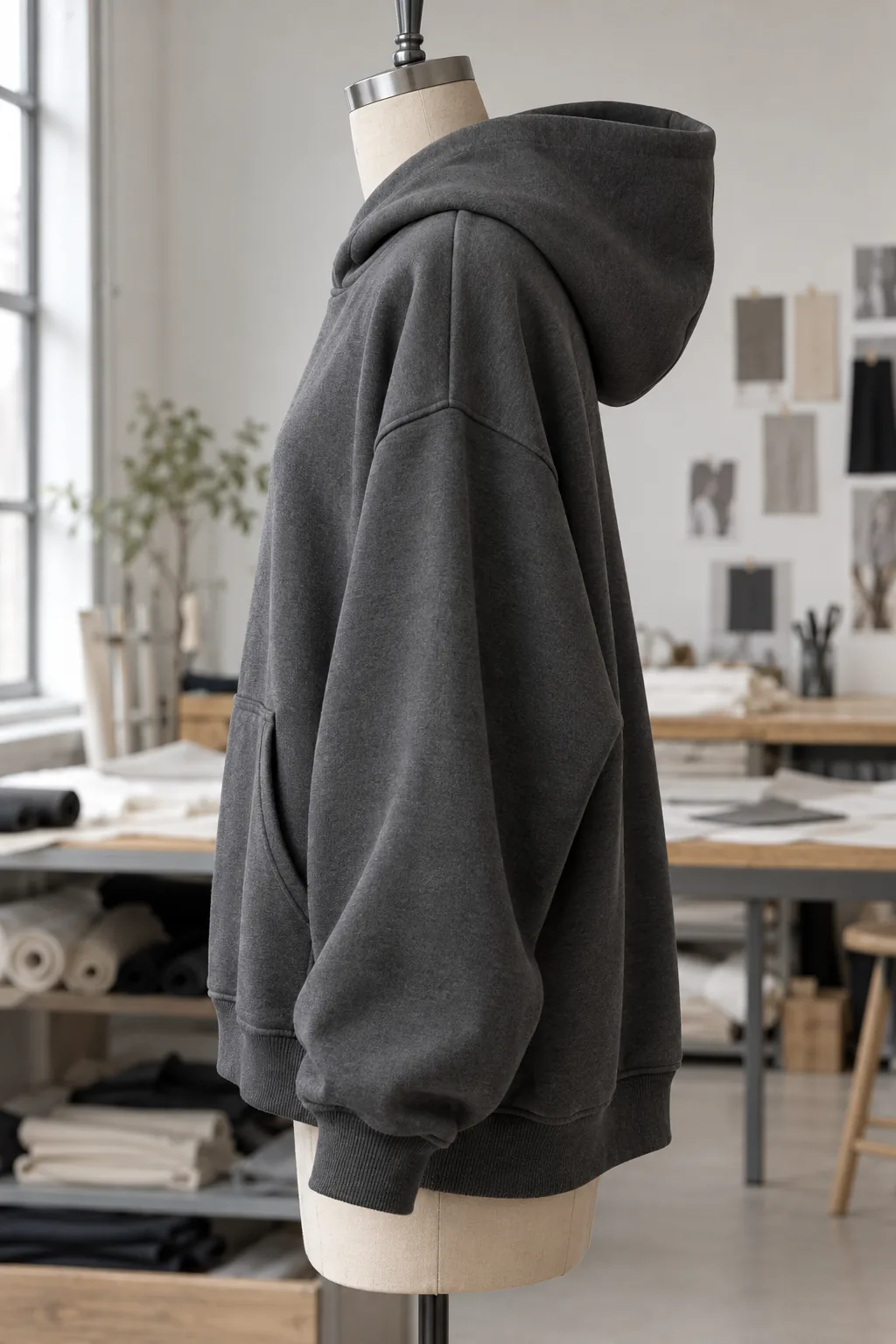
An oversized hoodie can meet every measurement on a flat specification sheet and still fit differently from the approved sample. A softer fabric drops farther from the shoulder; a dense fleece holds the sleeve away from the arm. When the material changes, the apparent volume changes with it.
For a brand choosing fabric before committing to bulk, consistent fit starts with a repeatable relationship between GSM, handfeel, and pattern. Approve that relationship before treating the size chart as final. The aim is to preserve the intended silhouette across sizes, fabric lots, and laundering, rather than simply buying a heavier cloth.
Define the shape you want the fabric to hold
Start with a wearing brief that separates volume from stiffness. A rounded, cropped silhouette needs enough body to keep the chest and upper sleeve open. A longer silhouette intended to fall close to the torso may need a more flexible knit, even if both garments have generous chest ease. “Heavy and soft” does not tell a fabric supplier which behavior matters most.
Describe three observable outcomes: where the shoulder seam should sit, how the hem should hang, and whether the hood should stand or collapse when down. For example, specify a dropped shoulder with a smooth sleeve fall and a hem that rests loosely at the hip. Photograph an approved reference from the front, side, and back on the same wearer.
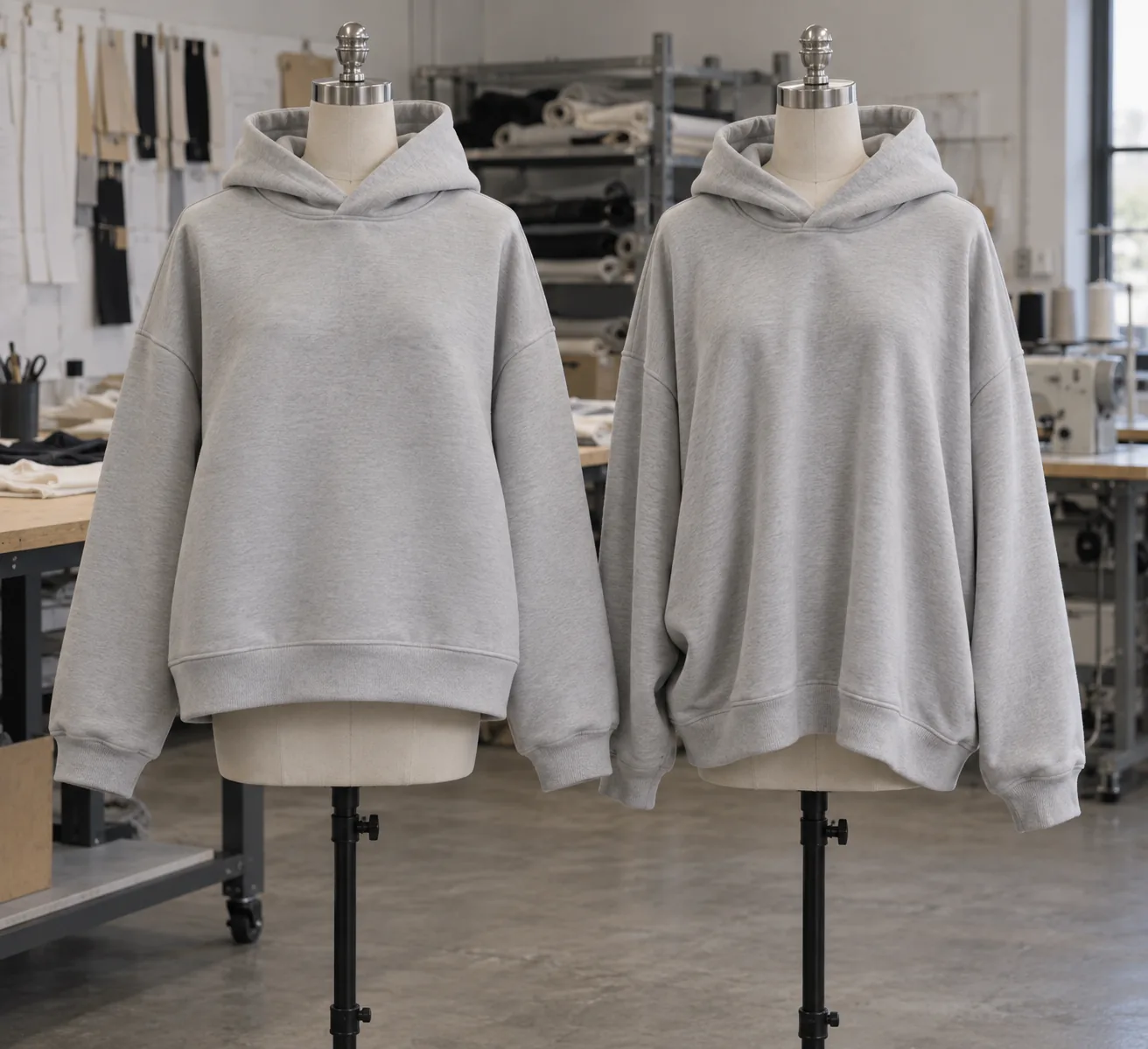
Record the reference wearer’s body measurements and the garment size. Without that context, “oversized” becomes a moving target during fittings. Also state the intended first-wear and after-laundering appearance; a deliberately relaxed finish should not be confused with uncontrolled stretching.
Use GSM to shortlist cloth, then compare its behavior
GSM measures mass per unit area, not thickness, softness, warmth, or resistance to bending. Two fabrics at 400 GSM can behave differently because of yarn size, knit structure, fiber composition, brushing, and finishing. A lofty brushed back can feel thick without giving the face enough support to maintain a broad sleeve shape.
The following bands are indicative screening ranges, not fit guarantees or StitchQuote product specifications. Confirm the actual construction and finished weight for each project.
| Indicative GSM | Behavior to investigate | Useful sample comparison |
|---|---|---|
| 280–330 | Whether the cloth collapses at the dropped shoulder | Compare smooth-back and loopback candidates on one pattern |
| 340–400 | Balance between drape and sleeve volume | Compare similar-weight fabrics with different finishing |
| 410–480 | Hood pull, seam bulk, and restricted movement | Compare hood constructions before increasing body width |
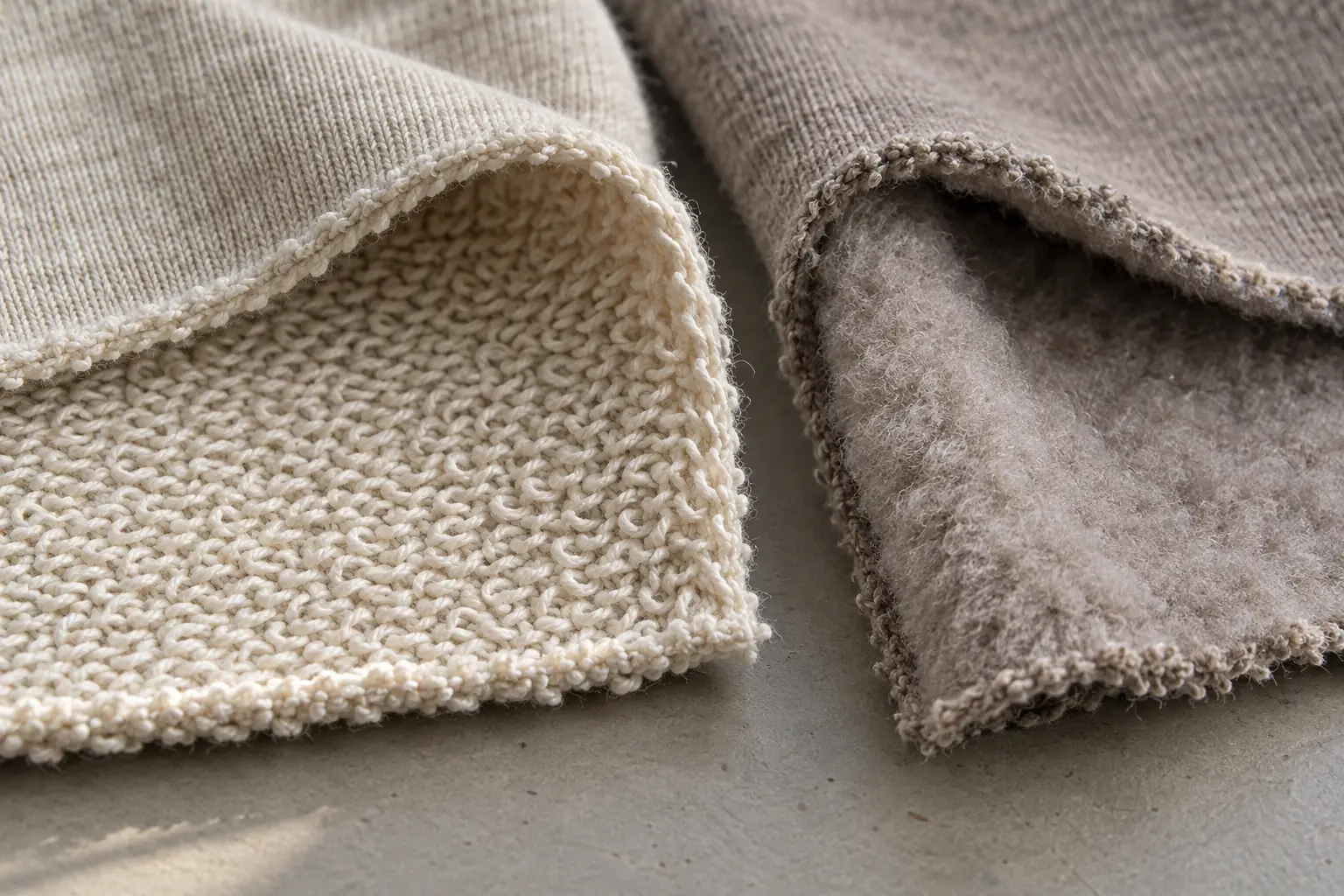
Ask whether quoted GSM describes the fabric before or after its intended finishing. Compare samples in the same relaxed, dry condition using an agreed conditioning method. A weight tolerance such as ±5% may be a starting point for discussion, but it needs supplier agreement and should not replace a drape assessment. Passing weight alone cannot approve an alternative fabric.
Turn soft, dry, and springy into approval evidence
Choose one physical fabric standard and retain matching swatches with the buyer and manufacturer. Record composition, knit construction, usable width, finished GSM, color, and finishing route. Keep an unwashed reference and a second piece washed according to the proposed care instructions. Date both so later comments refer to the same material state.
Replace a single “softness” score with separate observations. Surface touch describes what the hand meets first; compressibility describes how the cloth feels when squeezed; bending resistance affects how it hangs. Recovery describes whether a squeezed fold or stretched area returns. A smooth surface can coexist with a rigid body, and those properties should be assessed separately.
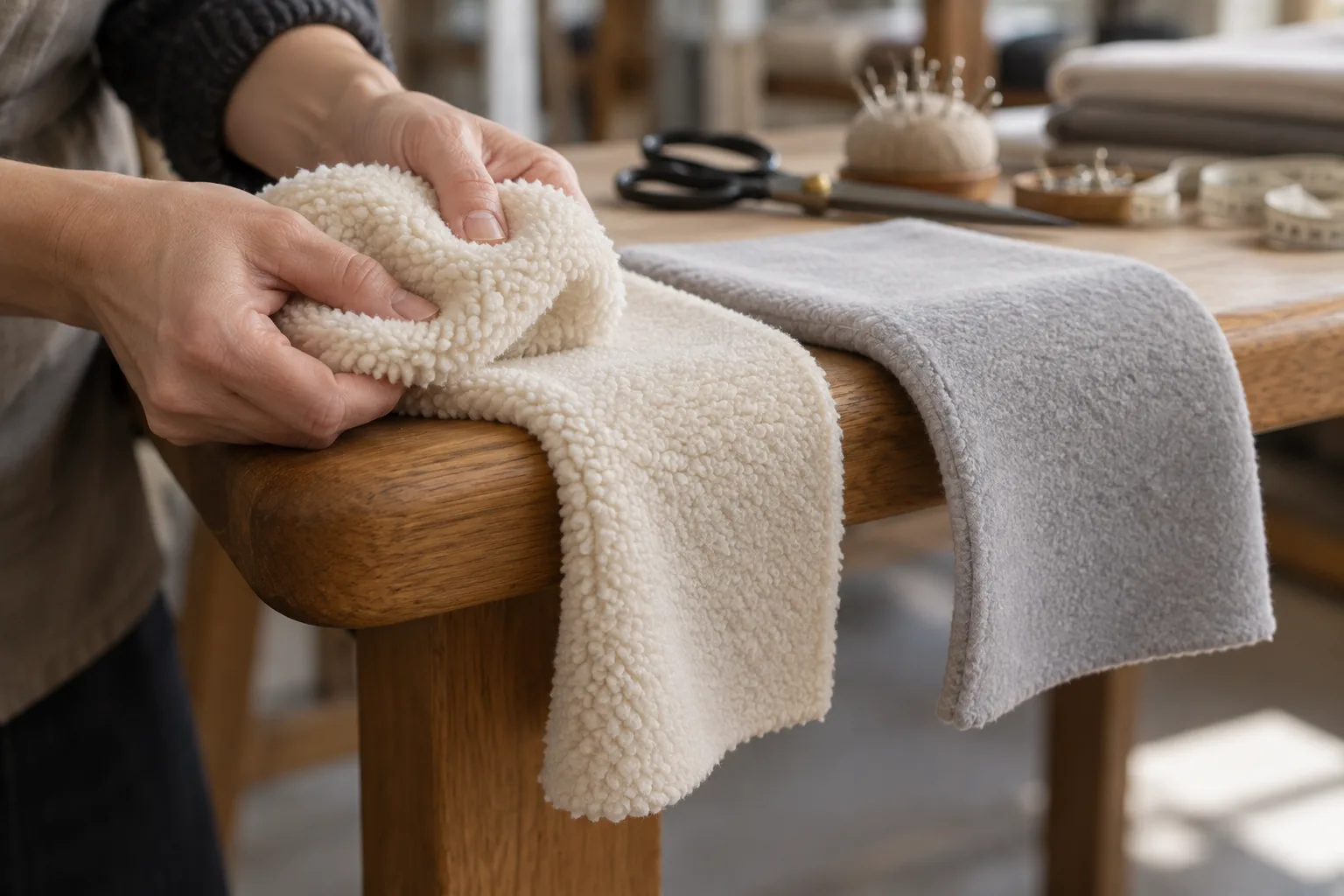
For an internal comparison, drape equal-size swatches over the same rounded table edge with the same overhang. Photograph them from the side, then compress and release each by hand. This is a screening exercise, not a standardized laboratory test. It helps explain why one candidate makes a balloon sleeve and another makes a long vertical fold.
Specify that any change in softener, brushing intensity, or other finishing requires review against the retained standard. Recheck after laundering: an initially slippery touch may diminish, exposing a firmer feel that changes the customer’s experience.
Balance hood weight and rib tension before grading
Build the first fit sample in the shortlisted production fabric, including the intended rib and hood lining. Substituting a convenient fleece can conceal the very behavior the sample should prove. Keep the pattern stable while comparing two fabric candidates; otherwise, a narrower sleeve and a softer cloth can offset each other and hide the cause of improvement.
Pay particular attention to a double-layer hood. Its weight can pull the neckline backward, changing the apparent front length and shoulder position. Before adding length to the front pattern, check neckline stability, hood depth, and the proposed lining. Have the wearer raise both arms, sit, and walk, then observe whether the garment settles back naturally.
Hem rib controls how body volume gathers. A tight rib can turn a relaxed body into a blouson shape; weak recovery can leave it stretched after wear. Record rib composition, construction, finished dimensions, and attachment ratio. For example, a 90 cm rib loop attached to a 110 cm body opening gives roughly an 82% ratio; this illustrates the calculation, not a recommended universal setting.
Once fabric and components are approved, assess the smallest and largest intended sizes as well as the base size. Check shoulder drop, sleeve stacking, and hem position on suitable wearers. Applying the same increment everywhere can exaggerate sleeve length while failing to preserve the intended chest volume.
Make laundering part of the measurement contract
Separate finished-garment measurements before laundering from required results after the agreed care cycle. Define how the garment is laid flat, where each measurement begins, and how long it rests before measuring. For chest width, specify a repeatable distance below the armhole; for body length, identify the exact shoulder or neckline reference point.
Measure the same garments before and after washing and drying under the proposed care instructions. Record length and width changes independently, along with twisting, rib distortion, and hood shape. A hypothetical 70 cm body length losing 4% becomes 67.2 cm. That difference may shift the hem above the intended position even when initial sewing measurements were correct.
Do not enlarge every pattern dimension by one shrinkage percentage. Length and width can respond differently, and rib may respond differently from fleece. Agree compensation using measured results, then resample. Any proposed tolerance, such as ±1 cm for flat chest width, must be reviewed against the silhouette and production method rather than copied into every measurement row.
Check bulk fabric against the approved wearing result
Quality control should connect incoming cloth to the finished silhouette. Use the following checklist when agreeing inspection scope and records. Inspection quantities and acceptance criteria need project-specific agreement; a single attractive garment does not establish lot consistency.
- Fabric identity: Check lot references, composition documentation, construction, finished GSM, and handfeel against the retained swatch. Investigate differences before cutting.
- Relaxation and cutting: Agree how fabric will relax before cutting, and check whether panels distort when released from the cutting surface.
- Assembly: Inspect shoulder and neckline stability, rib attachment, and bulky seam intersections. Look for stretching caused by handling or machine settings.
- Finished measurements: Compare representative sizes and fabric lots using the approved measurement method. Include hood dimensions and hem opening alongside chest and length.
- Care performance: Repeat the agreed laundering check on production garments and compare both dimensions and appearance with the approved washed sample.
StitchQuote provides cut-and-sew, private label, sampling, fabric and trim sourcing, branding, and QC before packing. For this development brief, request separate approval records for fabric, fit, and care performance so a passing measurement report does not obscure a handfeel change.
Questions buyers ask before locking the fabric
Can a lower GSM preserve a substantial silhouette?
Sometimes. A firmer construction may support shape better than a heavier, more pliable fabric. Compare complete samples on the same pattern, including the hood and rib. Check wearing comfort and movement as well as the static photograph.
Should every color use an identical handfeel standard?
Use a common target, but approve each color against it. Dyeing and finishing differences can affect touch and dimensional behavior. If a color needs a different processing route, request its own swatch and laundering results before accepting equivalence.
Does a seven-day sample resolve shrinkage approval?
A seven-day sample is available from StitchQuote for standard styles with confirmed specs and available materials. Complex styles, custom washes, and custom-developed fabric take longer. Confirm whether the proposed schedule includes the agreed wash assessment; sample availability alone does not establish dimensional stability.
What should a small first order lock before production?
Lock the fabric reference, size chart, rib specification, finishing route, and washed sample result. StitchQuote’s MOQ for most categories starts from 50 pieces per style. Confirm material availability and color allocation for the project before assuming a small order can support multiple fabric variants.
Related reading and project support:
- Compare hoodie fabric weights
- Document fabric and measurement requirements in a tech pack
- Review sampling and MOQ planning
- Discuss your fabric and fit brief with StitchQuote
Request a manufacturing quote
Share your product type, quantity range, and destination. We usually reply within one business day.