Custom Streetwear, Casualwear & Denim Manufacturer•MOQ 50 pcs•Denim MOQ 100 pcs•7-Day Sample Available

Distressed Denim vs Clean Denim for a Startup Collection
Use this factory-side guide to compare distressed denim vs clean denim for a startup collection more clearly across supplier fit, quote scope, approvals, and timing.

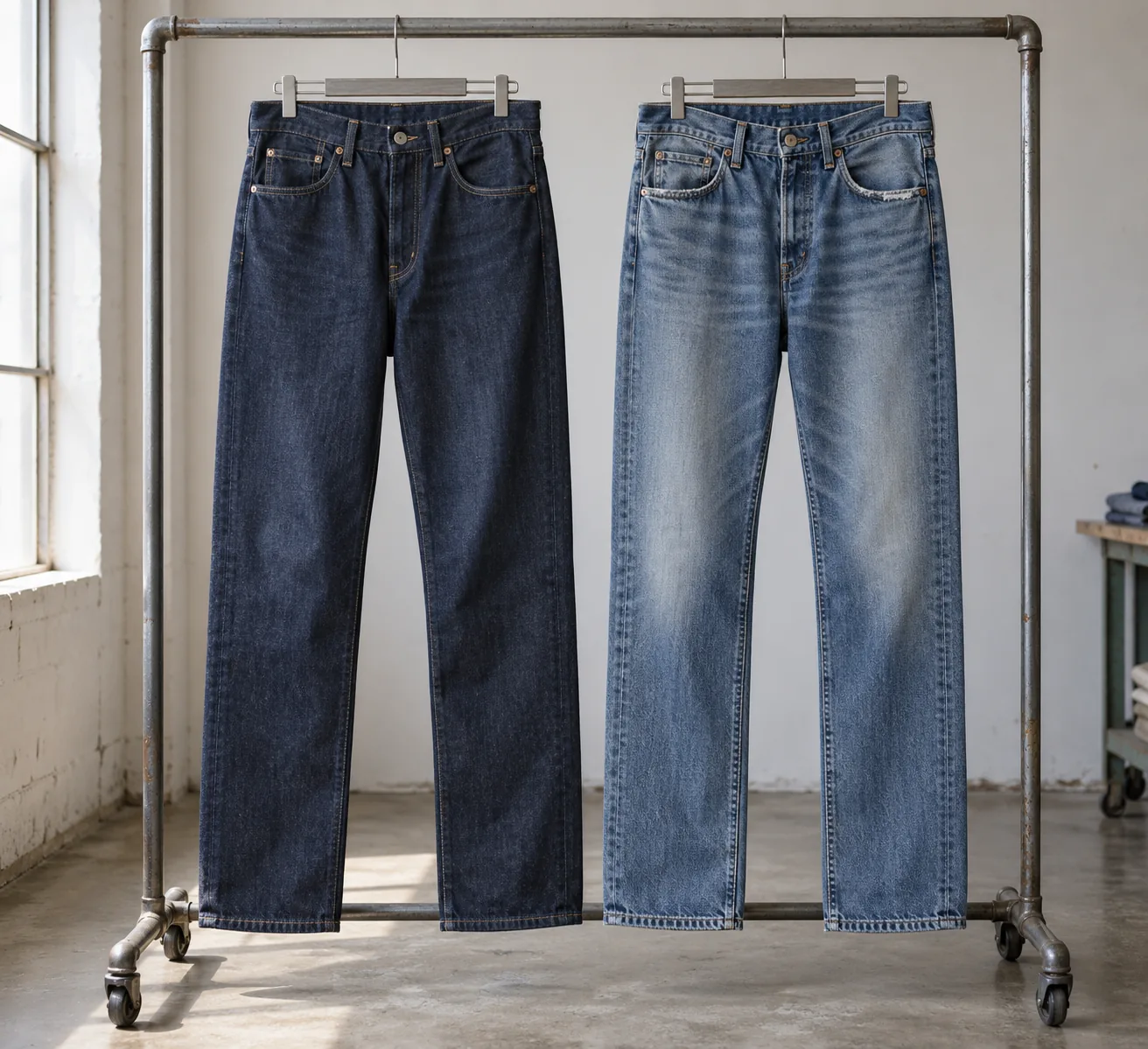
Choosing between distressed and clean denim for a startup collection becomes easier when you treat the wash as a product specification. A dramatic sample can attract attention, but it is only useful if its color, abrasion, strength and finished measurements can be repeated. Clean denim needs the same discipline: an uneven dark rinse or unexpected leg twist can undermine a deliberately restrained design.
Use the first sampling round to approve a wash recipe and its visible limits, rather than simply choosing your favorite photograph. For a small launch, the better direction is the one your team can describe, approve and inspect consistently. The following approach compares both finishes on a shared garment base, then turns the chosen result into a practical production reference.
Give the first wash trial one decision to answer
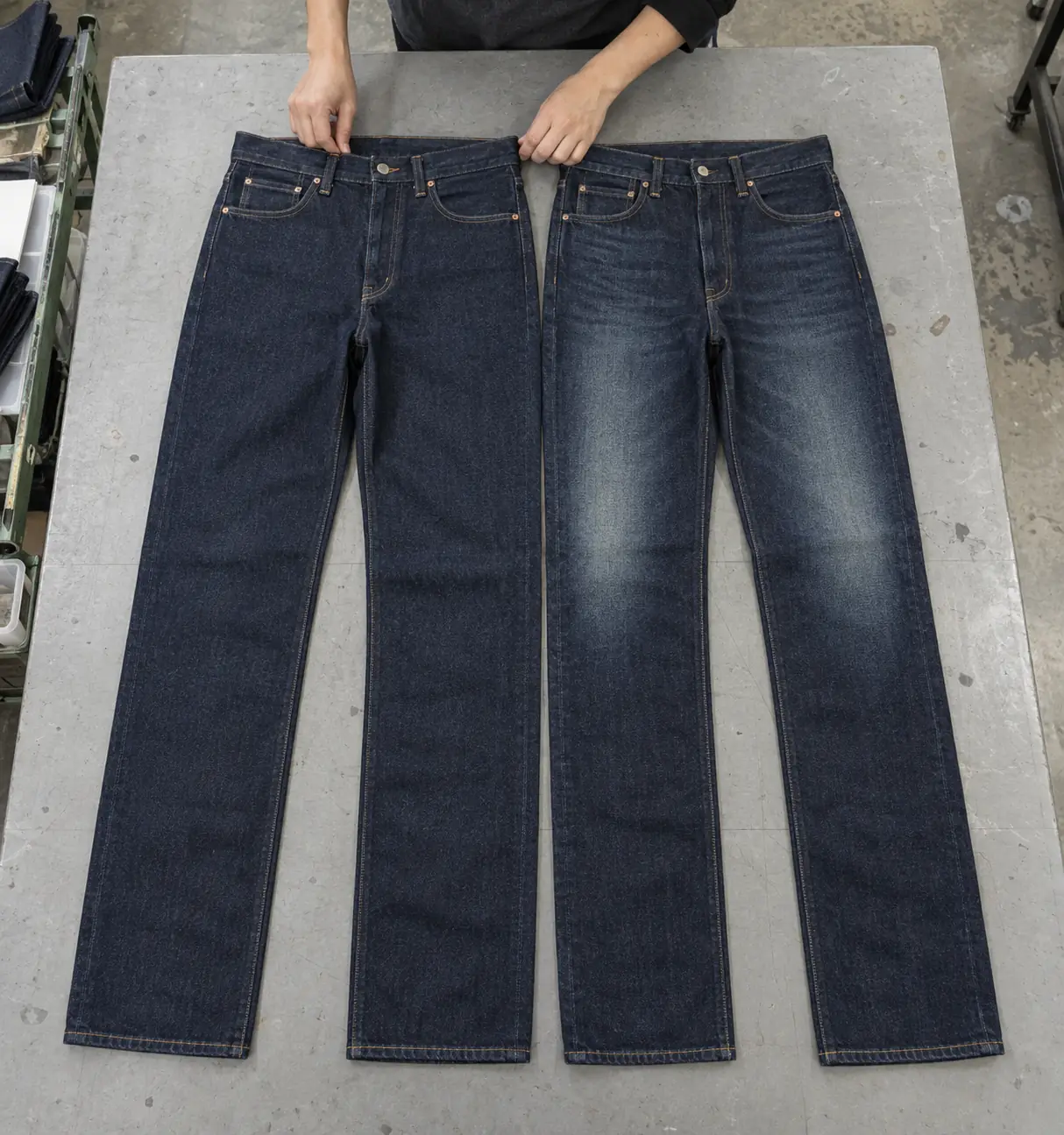
Start with a narrow question: should this launch jean carry its identity through a deep, even surface, or through localized wear? Use one fit block, one fabric specification and matching construction for the comparison. If the distressed sample uses a lighter fabric and a wider leg, you cannot tell whether your preference comes from the wash, the material or the silhouette.
For example, a startup developing a straight-leg jean could request a clean rinse trial and a faded trial with pocket-edge abrasion but no open holes. That comparison tests two saleable identities without immediately introducing torn knees, repairs and multiple shades. Select a direction before expanding the treatment menu.
Write down the customer-facing promise for each option. A clean version might require an even dark face with minimal seam contrast. A distressed version might require soft thigh fading and controlled fraying while retaining covered knees. These statements give the sample reviewer something more precise than “premium vintage.”
Anchor the recipe to the actual fabric and sewn garment
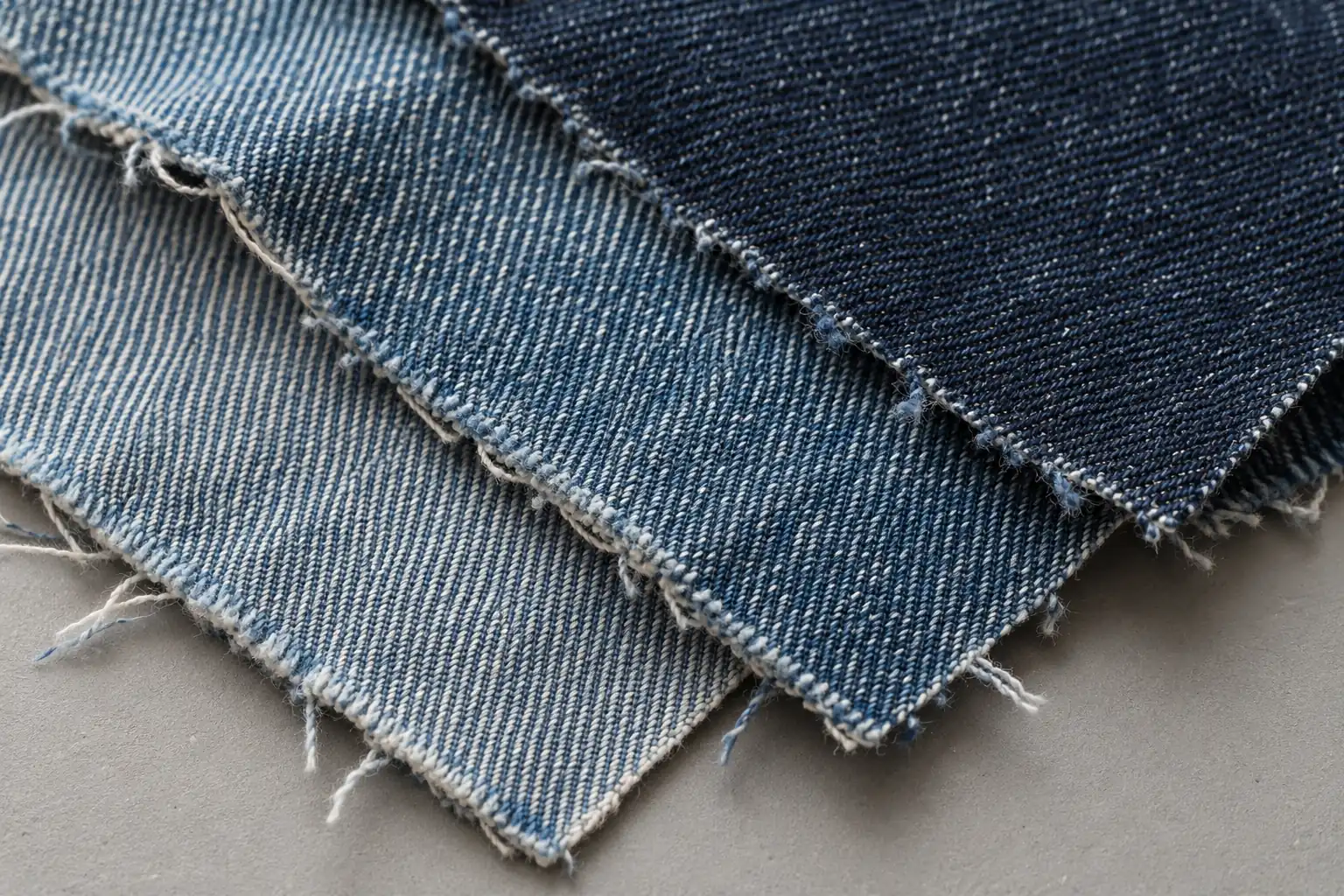
A wash recipe cannot be approved independently of its substrate. Record the fabric reference, fiber composition, nominal weight, weave, stretch characteristics where relevant and incoming shade reference. Two denims with similar weight can expose different undertones after abrasion. A change in dye behavior can turn an approved gray-blue fade into an unwanted bright contrast.
Keep the sewn construction identifiable too. Thread, pocketing, waistband layers and reinforcement influence the finished appearance and how the garment dries. A clean jean may show puckering around a heavy waistband; a distressed jean may lose too much strength where abrasion overlaps a pocket corner. These effects belong in the trial review.
Ask the factory to retain a controlled process record covering treatment sequence, relevant processing conditions, drying method and recipe revision. The buyer needs an agreed output standard and traceable version, even when detailed processing know-how remains with the laundry. Any fabric substitution should trigger a review of whether another trial is necessary.
Turn the desired wear pattern into measurable boundaries
For a clean finish, define what must remain absent: no intentional holes, no isolated pale abrasion patches and no strong whisker pattern unless specifically approved. Also define the allowed seam highlighting. “Clean” does not automatically mean unwashed, rigid or completely uniform at every folded edge.
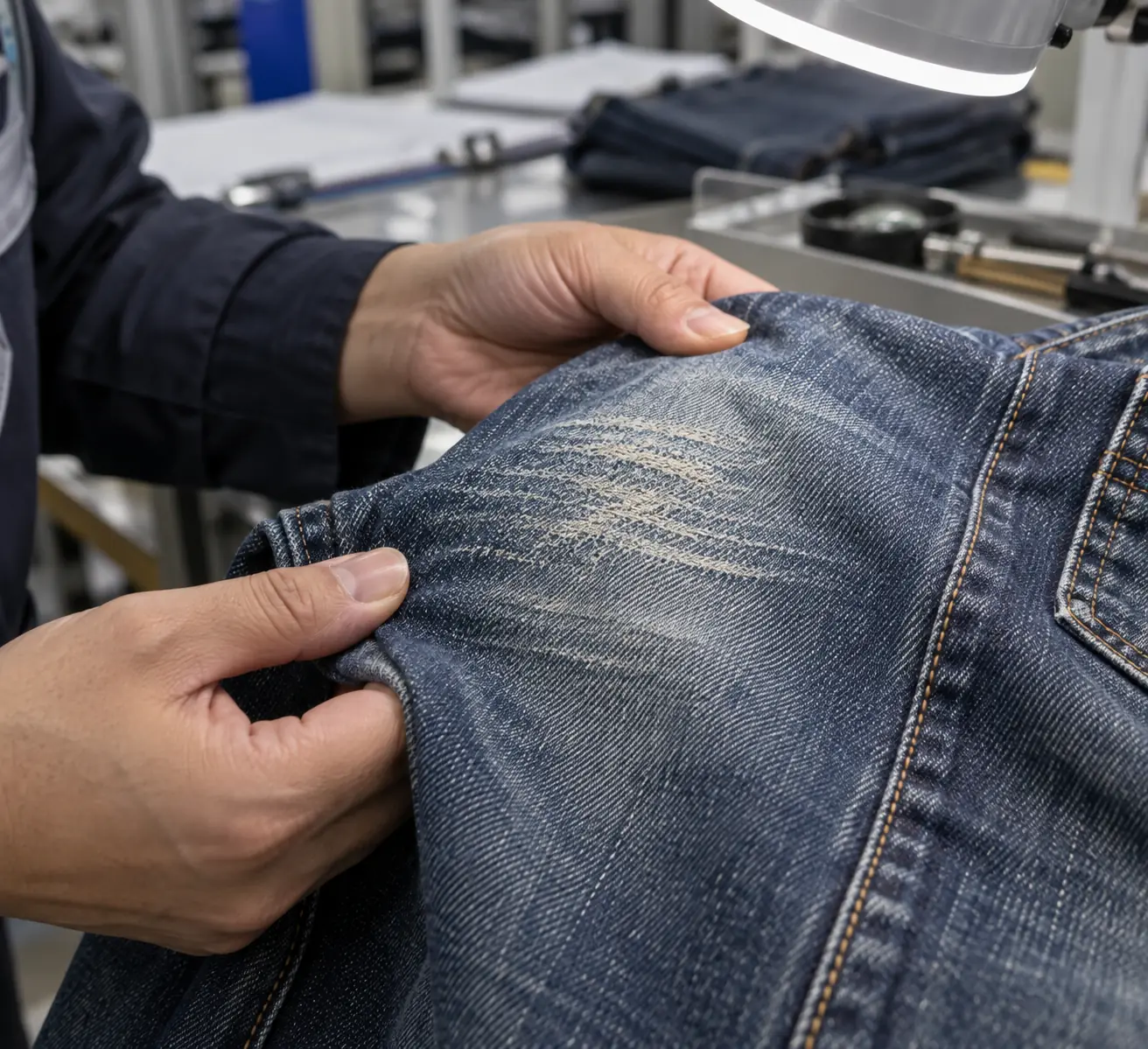
For distressing, separate color removal from physical damage. A pale knee patch, broken surface yarns and an open tear are three different instructions. Mark each zone on front and back diagrams, locating it from stable landmarks such as the inseam junction, pocket edge or hem. Avoid relying only on a model photograph, where pose changes apparent placement.
The following example is a discussion brief, not a universal acceptance standard. Confirm all limits with the factory after reviewing the selected fabric and trial garment.
| Feature | Clean direction | Distressed direction |
|---|---|---|
| Thigh surface | Even shade against approved reference | Fading confined to mapped zone |
| Knee treatment | No intentional yarn breakage | Surface abrasion only; no open hole |
| Pocket edge | Light seam contrast if approved | Example maximum loose fringe: 3 mm |
| Protected areas | All structural seams intact | No distressing through bartacks or seam joins |
Set placement tolerances separately from treatment intensity. An illustrative starting point is a zone center within 10 mm of its specified location on the sample size, subject to factory confirmation. Size grading needs its own rule: a knee effect should follow the intended anatomy rather than remain blindly fixed from the waistband across every size.
Approve a reference set instead of a single attractive sample
Review shade under consistent lighting with garments dry and in comparable condition. Check the front, back, side seams and inside pocket areas. Phone images are useful for locating issues, but exposure and white balance make them unreliable as the sole shade authority. Keep an approved physical garment wherever practical.
Build a small reference set: the target result plus agreed boundary examples where variation matters. For clean denim, these may show the lightest and darkest acceptable overall shade. For distressed denim, they may also show the strongest acceptable seam abrasion and maximum permitted yarn breakage. Label each reference with its purpose so an abrasion limit is not mistaken for a color target.
Return consolidated comments tied to specific locations. “Reduce contrast at the upper left thigh; retain the approved base shade” is actionable. “Make it more authentic” is not. Give each revision a new identifier, and state which earlier sample it replaces. Approve appearance and fit explicitly; acceptance of color should not accidentally authorize a short inseam.
Make repeatability the release gate for a small launch
A successful development sample proves that a finish is possible. It does not by itself establish consistency at production scale. Before bulk release, agree how the factory will verify the recipe under representative loading and handling conditions. Review garments from that verification against the approved reference, including measurements after finishing.
If variation is excessive, identify the unstable feature before adding more instructions. Broad hand-worked thigh fading may need tighter placement guides; aggressive pocket abrasion may need a lighter treatment. A clean rinse may need better shade segregation or drying control. Simplifying one unstable effect can preserve the design while making the result easier to approve.
StitchQuote’s denim MOQ starts from 100 pieces per style. Confirm how separate wash options affect the proposed order before planning two finishes as one allocation. A 7-day sample is available for standard styles with confirmed specifications and available materials; custom washes, complex styles and custom-developed fabric take longer. Build the launch calendar around approval rounds as well as sample making.
Inspect the consequences of the wash before packing
QC should test whether the approved finish survived production without creating a new fit or durability problem. Agree the inspection plan, measurement method and acceptance limits before production. The following checklist focuses on wash-related outcomes; it does not replace the garment’s complete quality specification.
- Shade and placement: compare garments against the physical reference under consistent light. Check both legs, back panels and seam transitions, then verify distressed zones against the placement map.
- Finished dimensions: measure waist, hip, thigh, inseam and leg opening using the agreed method. Record actual deviations rather than accepting a garment because it looks similar on a hanger.
- Structural integrity: inspect pocket corners, belt loops, fly attachment, crotch seams and bartacks. Reject unintended damage according to agreed limits, especially where abrasion approaches reinforcement.
- Trim and surface condition: check zipper operation, button attachment, exposed sharp edges, unwanted residues and trapped debris. Review labels and embroidery for wash-related distortion.
- Wear and care behavior: agree suitable checks for color transfer, dimensional change after care and tear growth where relevant. Compare results with project requirements rather than assuming a visually approved wash has passed performance testing.
StitchQuote provides QC before packing alongside cut-and-sew, private-label, sampling, fabric and trim sourcing, and branding services. Put the wash-specific checkpoints into the order specification so the inspection is tied to the approved product.
Questions buyers ask when closing wash approval
Can a clean wash sample approve the fit for a distressed version?
It can establish a starting block, but approve finished measurements on the distressed version too. Different processing and drying conditions can change dimensions or stretch recovery. Compare both against the same measurement specification before releasing either finish.
Should every distressed garment look identical?
Expect controlled variation where treatment involves manual work. Define which differences are acceptable through reference boundaries and placement limits. A slight fade variation may be acceptable; an unintended hole or abrasion across a structural seam is a separate defect.
What happens if the approved fabric becomes unavailable?
Review the replacement as a material change. Compare its composition, construction, shade and wash response, then determine the required resampling. A similar-looking unwashed swatch is insufficient evidence that the existing recipe will produce the approved result.
When is the wash ready to include in a purchase order?
When the fabric reference, recipe revision, physical appearance standard, placement rules, finished measurements and inspection limits are agreed. Identify outstanding approvals explicitly. A dated reference set makes later reorders easier to assess and helps prevent an old sample from becoming the accidental production target.
Related reading and project support:
- Prepare the technical pack for your wash specification
- Review sampling and minimum order planning
- Follow the denim wash approval process
- Discuss your denim project with StitchQuote
Request a manufacturing quote
Share your product type, quantity range, and destination. We usually reply within one business day.