Custom Streetwear, Casualwear & Denim Manufacturer•MOQ 50 pcs•Denim MOQ 100 pcs•7-Day Sample Available

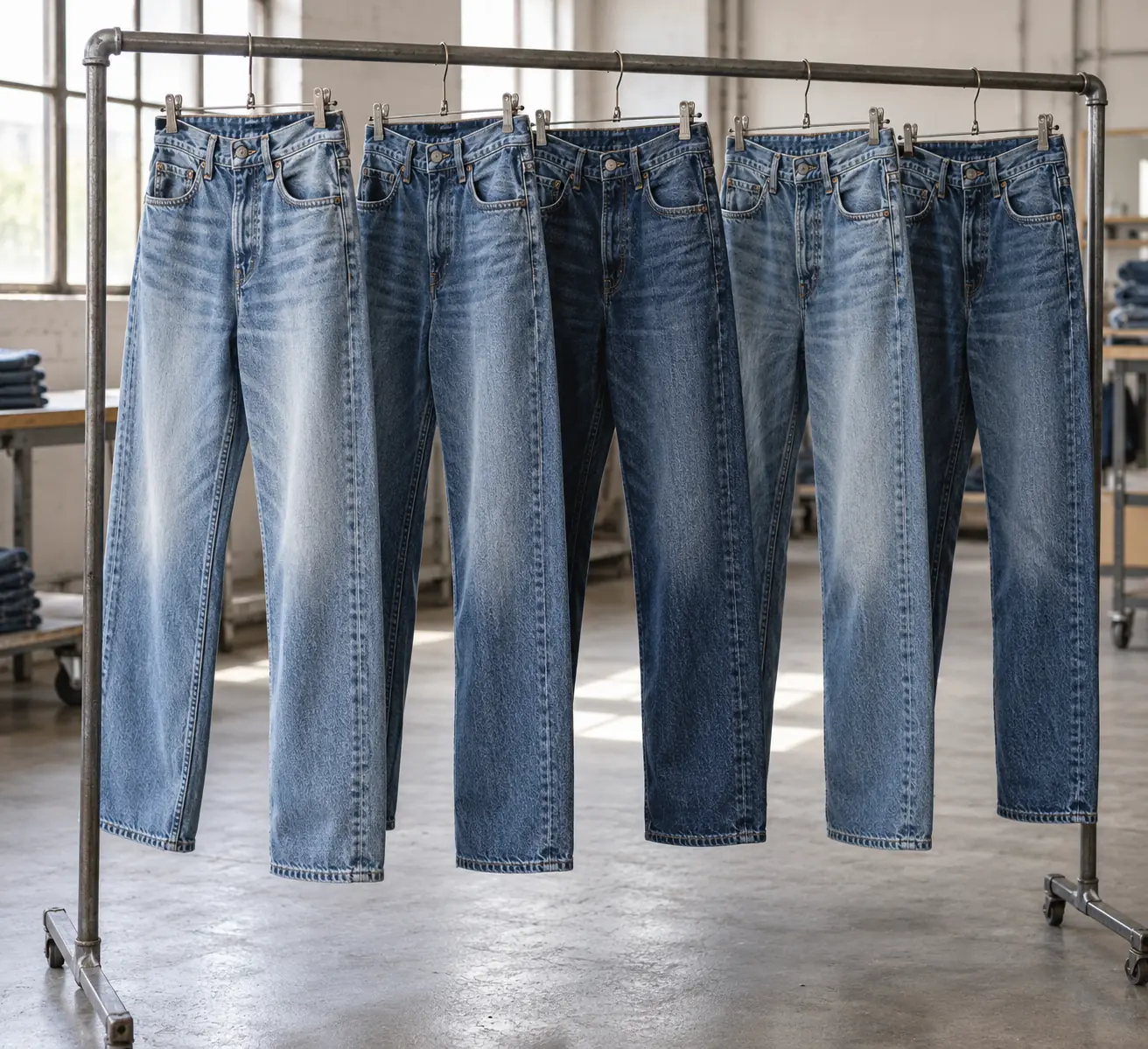
How to Price Small-Batch Denim More Realistically
Use this factory-side guide to compare price small-batch denim more realistically more clearly across supplier fit, quote scope, approvals, and timing before you.

A denim quote can look competitive until the finished jeans come back from washing with a shorter inseam, a tighter seat, or a twisted leg. At that point, the cost discussion changes: someone must adjust the pattern, repeat the sample, inspect more pieces, or accept fewer saleable garments. For a small order, those decisions can move the effective unit cost substantially.
To price small-batch denim more realistically, start with the dimensions the customer will receive. Build the quotation around a defined after-wash measurement standard, then identify what must happen before that standard is reliable. This approach is especially useful when you have selected a silhouette and wash direction but have not yet approved the production pattern.
Make the finished fit the starting point for the quote
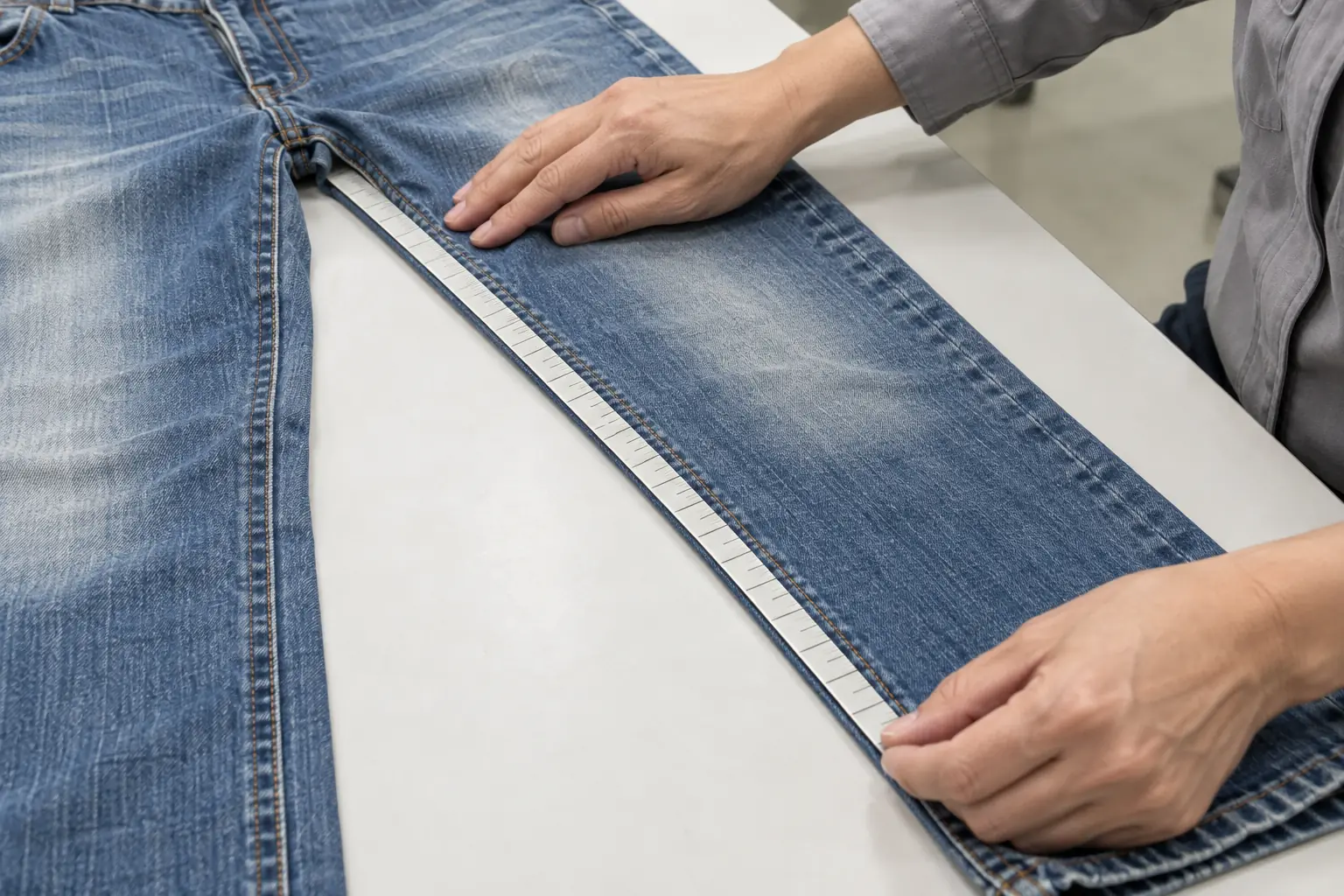
“Size 32 relaxed jeans, medium blue” does not define a repeatable product. Specify whether the waist is measured flat with the waistband aligned, whether the front rise includes the waistband, and where the thigh is measured below the crotch. A change in measuring method can resemble a manufacturing error even when two inspectors handle the same garment.
Separate three states in the specification: sewn before washing, finished after the production wash, and tested after consumer laundering. The second state should govern delivery acceptance unless you explicitly agree otherwise. Consumer-care testing answers a different question: how much additional dimensional change the wearer may experience.
For quotation purposes, prioritize the dimensions that determine whether the silhouette works. On a cropped wide-leg jean, inseam and leg opening may be especially sensitive. On a close-fitting straight leg, waist, hip, thigh, and rise interact. Mark these critical points so a supplier can explain which requirements need sample evidence before a firm price.
Turn wash uncertainty into a cost assumption
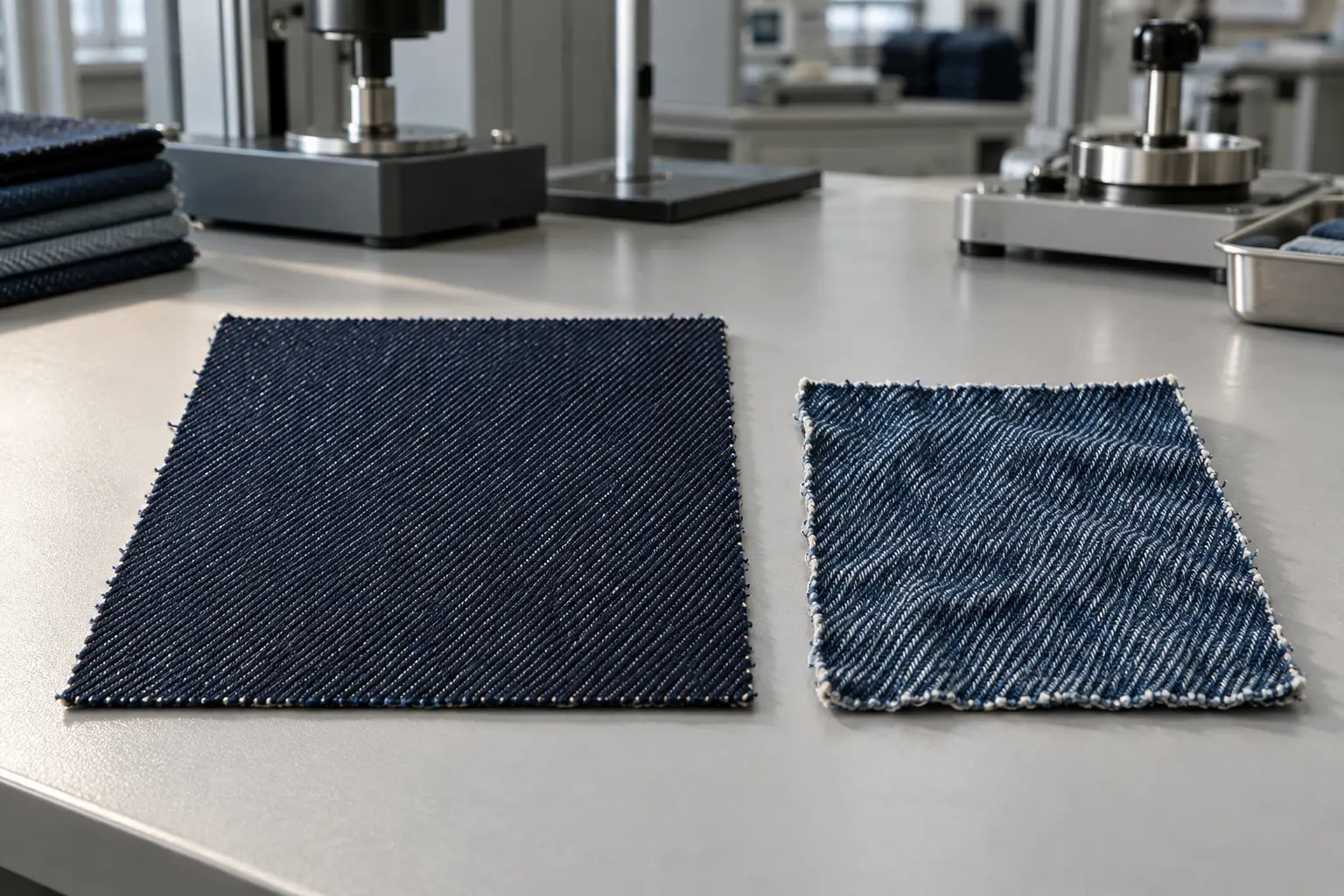
Two fabrics with similar weight and color can behave differently in the same wash. Fiber composition, weave, finishing history, and stretch recovery influence dimensional change. Ask which fabric the quotation assumes and whether the proposed wash has been evaluated on that material. A substitute fabric should reopen the dimensional review, even if its purchase cost is similar.
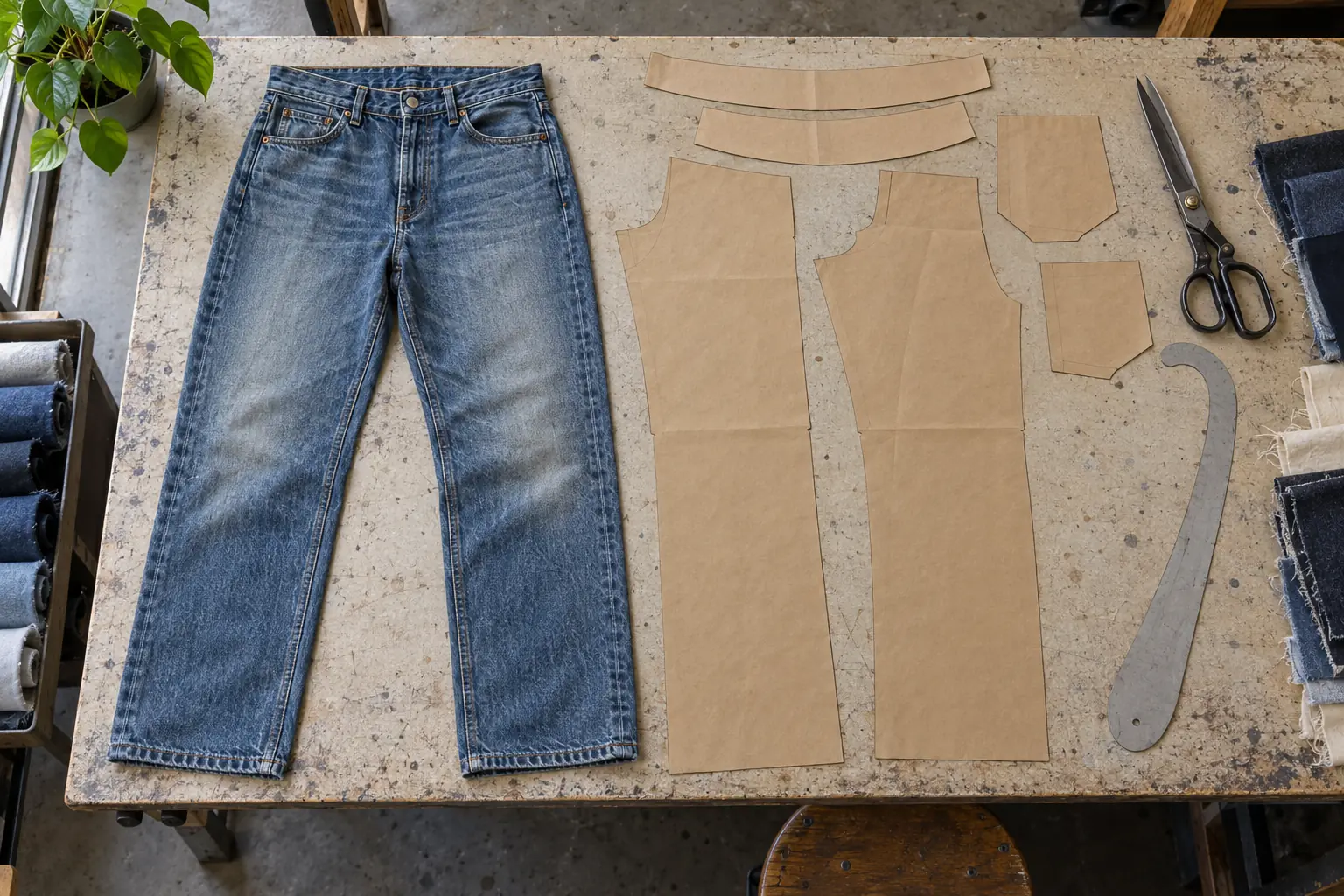
Use an explicit calculation when discussing pattern compensation. If a test shows an illustrative 4% length reduction and the required finished length is 80 cm, the corresponding pre-wash length is approximately 80 divided by 0.96, or 83.3 cm. This is a planning example, not a universal shrinkage allowance; seam construction and garment processing still need validation.
Do not apply one percentage to every measurement. Width and length can change differently, and waistband construction may behave differently from the leg panels. Extra pattern allowance can also affect fabric consumption and marker efficiency. Request a provisional consumption assumption followed by confirmation once the washed sample and adjusted pattern are approved.
Use a measurement sheet that exposes pricing gaps
A concise control sheet helps buyers compare quotations on the same basis. The example below is for a hypothetical base size; its dimensions and tolerances are illustrative, not StitchQuote production guarantees. Agree achievable limits with the supplier after sampling, and state that all values apply to relaxed, finished garments measured by the agreed method.
| Point of measure | Example finished target | Example tolerance | Pricing question |
|---|---|---|---|
| Waist, flat | 41.0 cm | ±0.7 cm | Is waistband adjustment included in development? |
| Front rise, including waistband | 29.0 cm | ±0.5 cm | Will wash movement require a pattern revision? |
| Inseam | 78.0 cm | ±1.0 cm | When is length compensation confirmed? |
| Leg opening, flat | 22.0 cm | ±0.5 cm | Can the hem retain this shape after processing? |
Include diagrams in the working specification, even if the initial quote request uses a table. State whether a flat width or full circumference is being reported. A 0.7 cm difference in flat waist width represents roughly 1.4 cm around the garment; confusing the two conventions can create a costly approval dispute.
Also define measurement conditions. Garments should be fully dry and allowed an agreed relaxation period after finishing. Stretch denim should not be pulled to reach the target. Record the sample identifier, fabric reference, wash version, size, and measurement date so a passing result cannot accidentally be attached to a different development version.
Separate pattern learning from repeat production costs
Ask for development and repeat production to be distinguished in the quotation. Development may involve an initial sewn sample, a wash trial, dimensional recording, pattern correction, and a confirmation sample. Clarify which rounds are included, what triggers another charge, and whether changing the fabric or wash restarts part of the work.
Then identify the recurring operations: cutting from the approved pattern, sewing, washing, drying, finishing, measurement inspection, and packing. Ask whether any proposed shaping or pressing step is needed to achieve the measured result. A garment that reaches its target only through temporary stretching may not deliver the intended fit after the customer washes it.
Small orders have fewer units across which to distribute development costs. StitchQuote denim starts from 100 pieces per style; most other categories start from 50 pieces per style. Confirm how your size split and wash variants affect the specific order. Do not assume that dividing one style into several treatments leaves development effort unchanged.
StitchQuote offers sampling, fabric and trim sourcing, cut-and-sew, private label, branding, and QC before packing. A 7-day sample is available for standard styles with confirmed specifications and available materials; complex styles, custom washes, and custom-developed fabric take longer. Schedule dimensional confirmation around the actual wash work rather than treating every sample as a seven-day commitment.
Approve a repeatable size range before releasing the order
A successful base-size sample does not prove that every size will finish correctly. Grading changes panel proportions, and different garment sizes may respond differently to processing. Agree which sizes need washed confirmation, with attention to the smallest and largest sizes and any point where the grading rules change.
For example, a brand developing a barrel-leg jean might approve the waist on its middle size but discover that the largest size loses the intended knee volume after washing. Correcting only the waist would miss the commercial problem. Request finished measurements at the knee and thigh where they define the design, and inspect the silhouette alongside the numbers.
Retain an approved washed reference and its measurement record. Tie approval to the fabric, pattern revision, wash recipe reference, and finishing method used. If any of those change before bulk production, ask what must be rechecked and how the additional work affects the quote. Written revision control is cheaper than debating which sample represented the order.
Check finished measurements before counting saleable units
The cost that matters commercially is the total agreed order cost divided by the number of acceptable garments available to sell. Do not invent a standard rejection percentage to make this calculation look precise. Instead, ask how the supplier will detect dimensional problems and what remedy applies if finished pieces fall outside the approved limits.
- Check the correct state: measure dry, relaxed garments after the agreed final processing stage.
- Cover the assortment: agree inspection quantities across sizes and wash batches, plus when a failed check triggers wider inspection.
- Record actual values: retain measurements for critical points rather than only a pass mark.
- Inspect symmetry: compare both legs and check twisting, waistband distortion, and uneven hems alongside dimensional results.
- Control corrections: segregate failed pieces and remeasure after any approved rework before packing.
Ask who bears the cost of remeasurement, permitted rework, or replacement under the agreed acceptance terms. Avoid assuming that every dimensional issue can be fixed by another wash: further processing can alter shade, hand feel, and strength. Any proposed correction needs approval against the whole garment standard.
Questions buyers ask when the wash changes the fit
Can I get a quote before shrinkage testing is complete?
Yes, but request a provisional quote with named assumptions for fabric, wash, consumption, and sample rounds. Identify which items remain adjustable and the approval event that fixes them. This makes the early figure useful without implying that dimensional uncertainty has disappeared.
Should I widen tolerances to lower the price?
Only where the resulting variation remains acceptable to your customer. First check whether the target, measuring method, or construction is causing unnecessary difficulty. Wider limits can reduce inspection failures while still producing a size range that feels inconsistent to wearers.
Does an approved shade also approve the measurements?
No. Color approval and dimensional approval should be recorded separately, even when they use the same sample. A wash adjustment that improves shade may change dimensions. Require both checks on the final version before treating the sample as the production reference.
Prepare your finished measurement targets, fabric preference, intended wash, and size quantities before requesting a project quotation. These references support that preparation:
- Prepare the measurement specification in your tech pack
- Review sampling and minimum order planning
- Coordinate denim wash approval
- Discuss your denim quotation with StitchQuote
Request a manufacturing quote
Share your product type, quantity range, and destination. We usually reply within one business day.