Custom Streetwear, Casualwear & Denim Manufacturer•MOQ 50 pcs•Denim MOQ 100 pcs•7-Day Sample Available
Premium Basics Manufacturer in China: What to Clarify About Fabric and Fit
Understand premium basics manufacturer in china with more practical factory-side context around material behavior, product feel, stability, and how the decision.

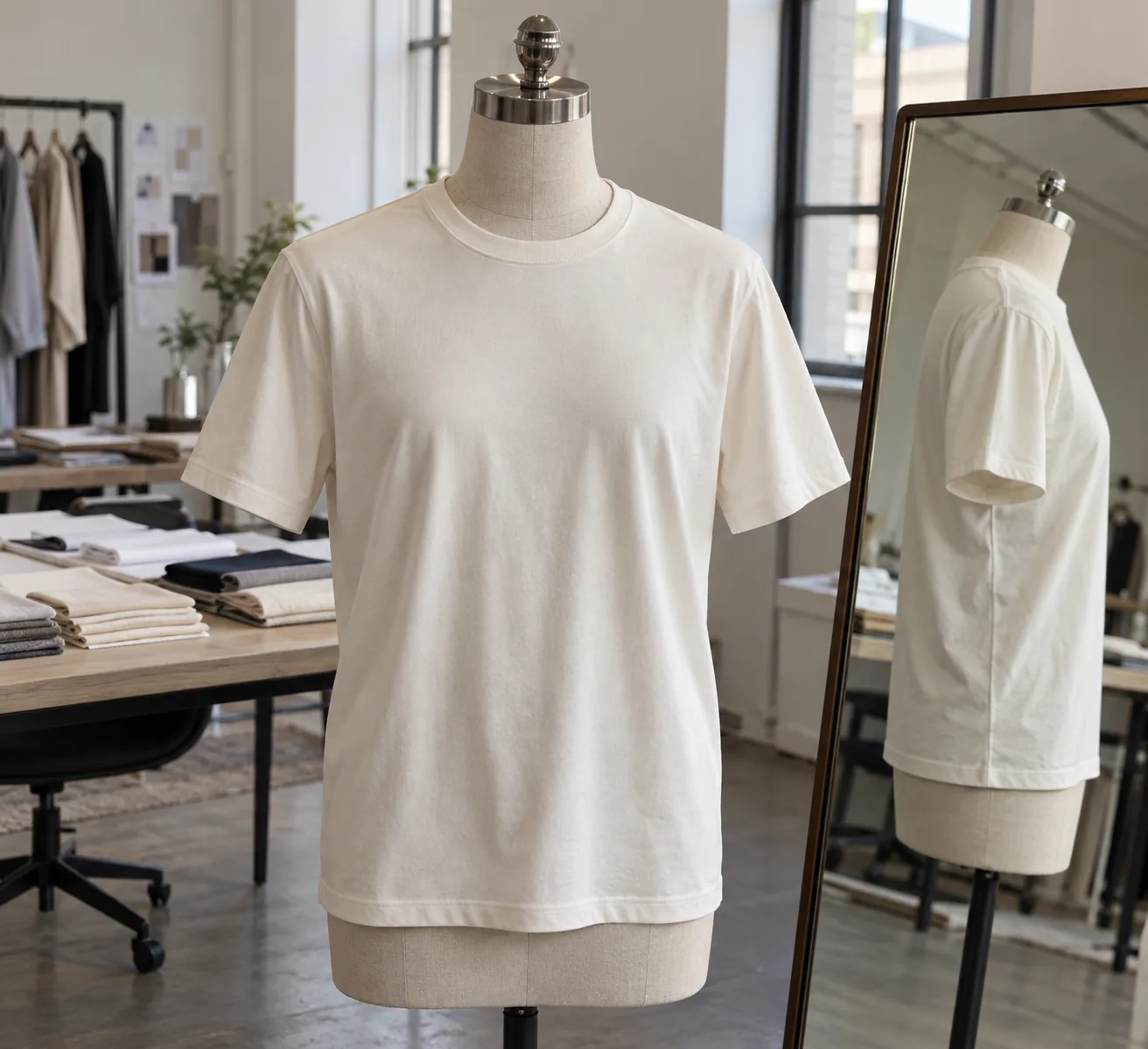
A premium basic earns its place through repeat wear: the collar sits correctly, the shoulder falls where intended, and the body keeps its shape after laundering. When choosing a premium basics manufacturer in China, the useful approval question is whether a defined fabric and a repeatable pattern produce that result together. A soft swatch and an attractive first sample cannot establish that on their own.
Block approval gives buyers a way to separate silhouette decisions from seasonal styling. A block is the controlled base pattern for a particular garment family, fit and material behavior. Approving it means agreeing what the garment should measure, how it should sit on the body, and which changes require another fitting. For a small basics collection, this prevents each new color or neckline from becoming an accidental new fit.
Set the boundaries of the block before sampling
Begin with one intended wearer and one use case. A close-fitting layering tee needs different armhole clearance and body balance from a boxy tee worn alone. Describe where the shoulder seam should land, how much room the chest needs, where the hem ends, and whether the sleeve should stand away from the arm. Pair those statements with front, side and back references.
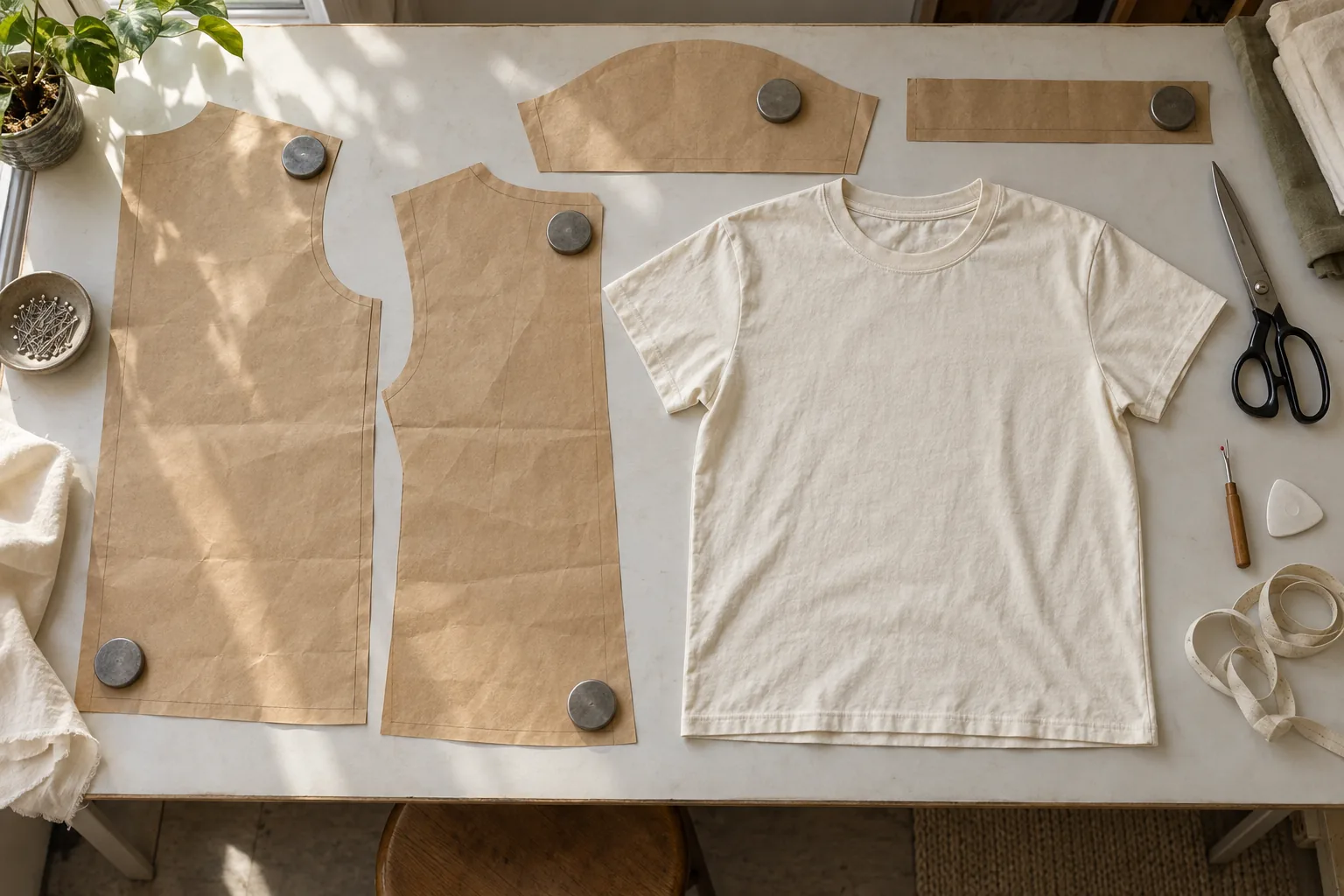
Give the block an identifier, revision number and reference size. For example, a fictional brand might call its relaxed jersey tee block RT-01, revision B, size M. Keep finished garment measurements separate from pattern dimensions: seam allowances and shrinkage compensation belong to pattern development, while the buyer’s measurement sheet describes the garment at an agreed stage.
State what the block covers. A crew-neck tee block may support different colors and simple chest artwork, but converting it into a heavyweight long-sleeve top changes sleeve weight, balance and possibly armhole behavior. Treat that as a proposed derivative requiring review. Likewise, an approved sweatshirt block should not silently become the pattern standard for every hoodie.
Attach a fabric specification to every fit decision
Fabric is part of the block’s operating conditions. Two cotton jerseys can share a nominal weight while differing in density, stretch, recovery and drape. A compact jersey may hold a square silhouette; a softer construction may collapse against the torso. Record composition, knit structure, target finished weight, finishing method and the approved fabric reference alongside the block identifier.
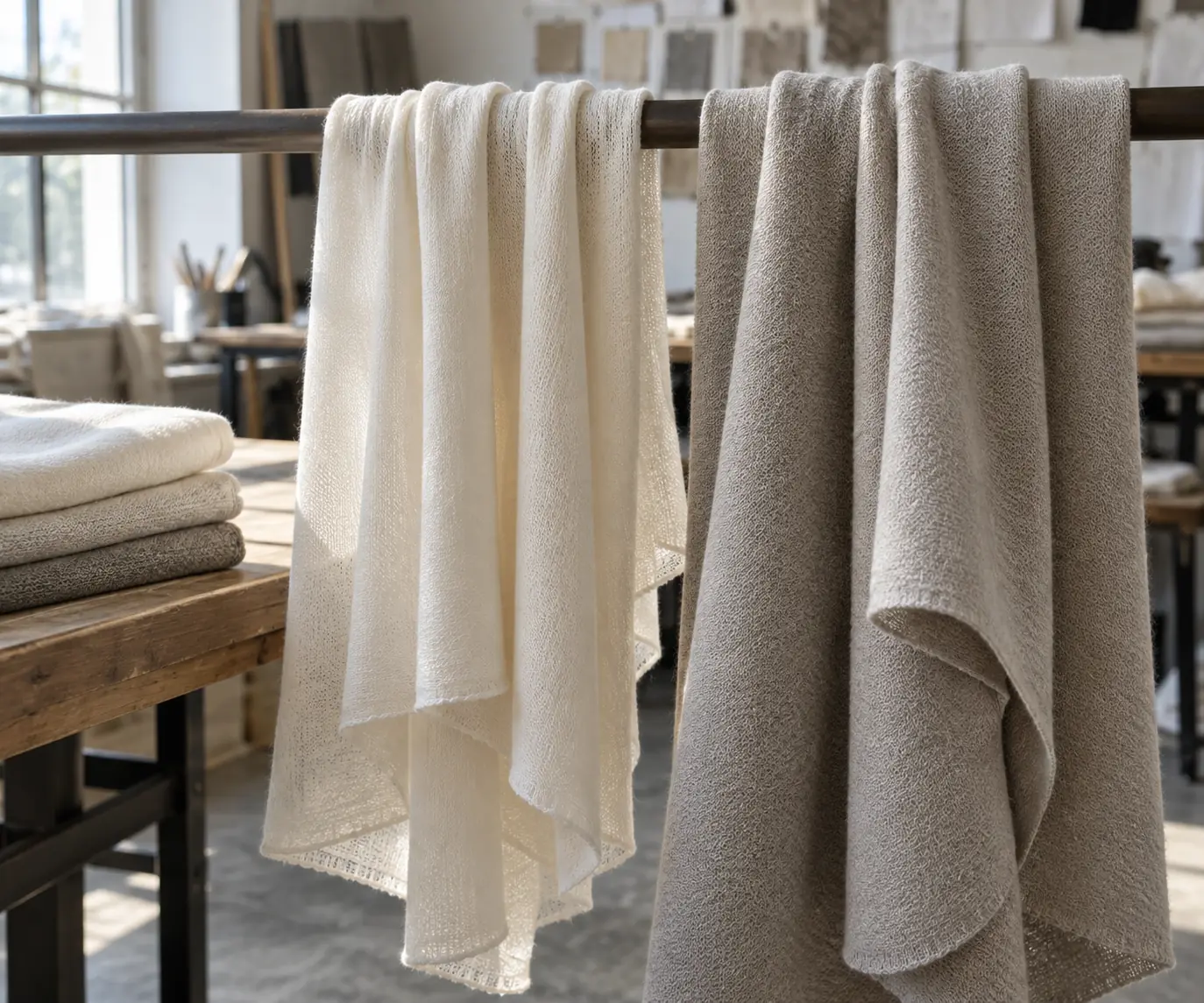
Ask whether the sample uses the proposed bulk fabric or a substitute. If a substitute is necessary, label the resulting approval as provisional and list what remains unverified. A sample in a lighter jersey can help establish neckline placement, but it cannot prove the sleeve shape of a denser material. Reserve final approval for the agreed fabric and finishing route.
Separate fabric shrinkage results from garment fit results. Ask for the test method, wash and drying conditions, measurement points and number of cycles. Length and width can change differently. For illustration, a body measuring 70 cm before washing and 68.6 cm afterward has lost 2% in length; that calculation alone says nothing about neckline recovery or side-seam twisting.
For neck rib, specify construction and recovery expectations too. The shell can remain stable while a poorly matched collar grows or puckers. Review rib width, attachment method and collar shape on the actual garment after laundering, rather than accepting a stretch demonstration on a loose strip.
Run the reference-size fitting as a controlled review
Use a consistent fit model whose relevant body measurements are recorded with consent, and keep the wearing conditions comparable between revisions. Measure the sample first, then photograph its front, side and back without pulling it into shape. A sample outside the requested dimensions should be identified before the team judges the intended silhouette.
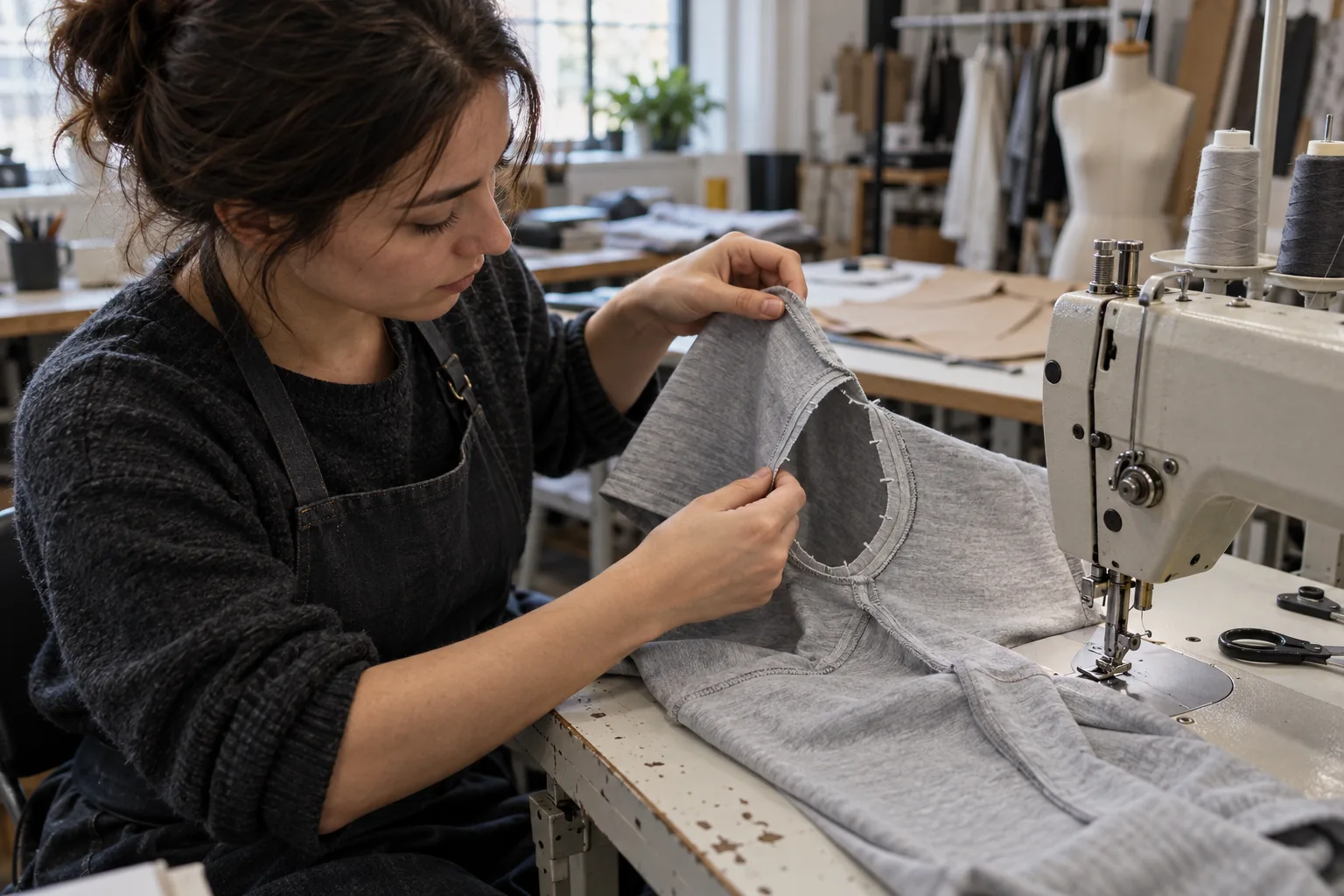
Review standing posture, forward reach, sitting and arm raising. Note whether the neckline pulls backward, the front hem lifts excessively, or the sleeve restricts movement. Describe the observed problem before prescribing a pattern correction. “Front hem rises during forward reach” gives the pattern maker more useful evidence than an unexplained instruction to add body length.
| Review point | Illustrative acceptance note | Evidence to retain |
|---|---|---|
| Shoulder position | Seam lands at the agreed drop on the reference wearer | Front and back fitting photos |
| Body balance | Hem hangs level in relaxed posture | Side photo and length measurements |
| Neck opening | Head passes comfortably; collar returns without rippling | Wear observation and post-wash photo |
| Sleeve mobility | Forward reach causes no unacceptable binding | Movement photos and written comments |
These are example review criteria, not universal pass limits. Agree measurable requirements for the project. Consolidate comments into one dated revision sheet with an owner for each decision. Avoid sending separate corrections through several channels: increasing chest width in one message and narrowing the shoulder in another can create an unintended armhole change.
Approve the washed garment and the size extremes
Keep an unwashed control and assess a second sample after the agreed care procedure. Let garments dry fully and rest under consistent conditions before measuring. Compare body length, half chest, shoulder width, sleeve length and neck opening using the same method. Review seam rotation and surface changes beside the numerical results.
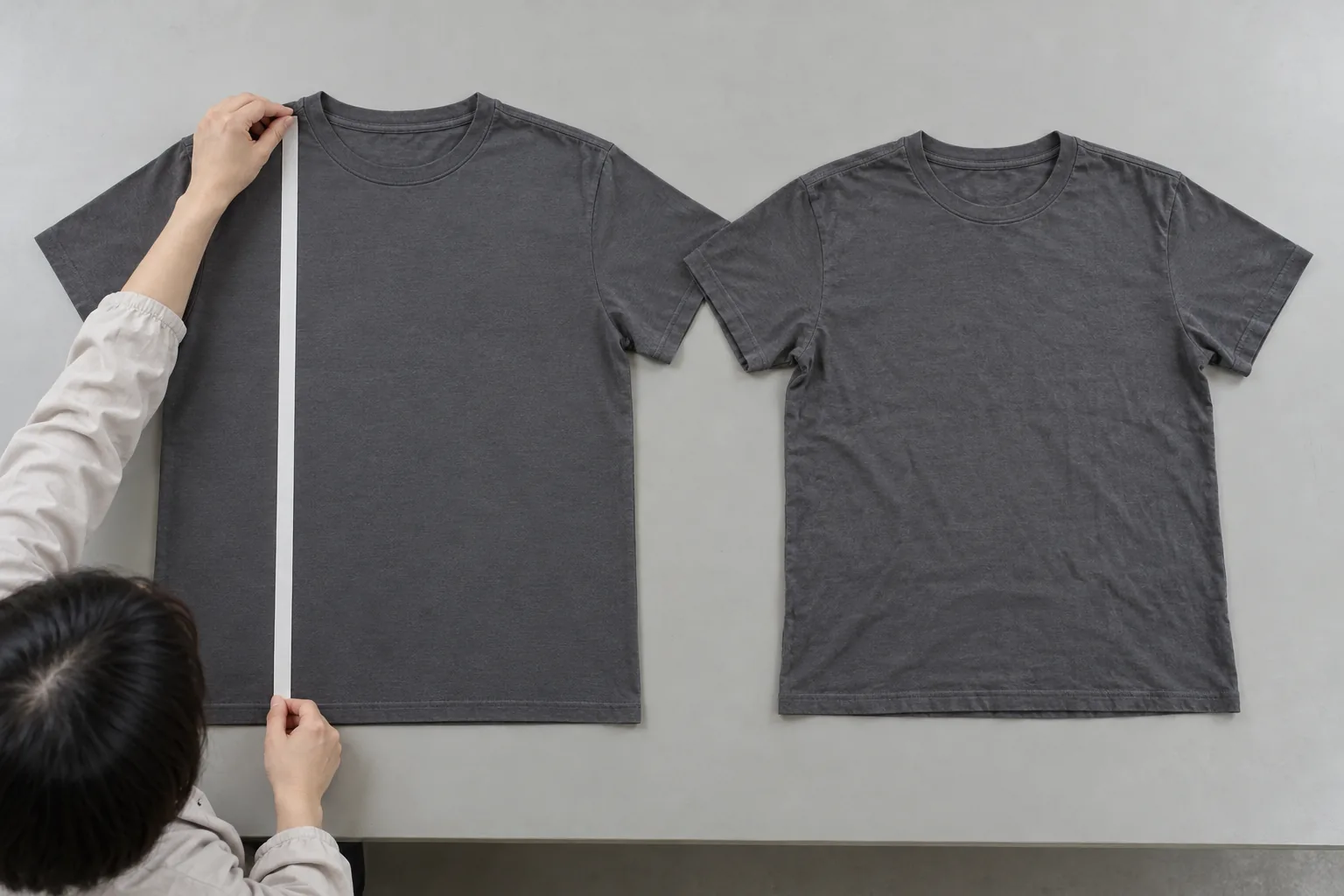
Write tolerances by measurement point and measurement state. As a discussion example only, a buyer might propose ±1 cm for half chest and ±0.5 cm for neck opening on an adult tee. Confirm feasibility per project; those figures are not StitchQuote standards. A production tolerance around a target and a permitted laundering change are different controls and should appear separately.
After the reference size is settled, review the smallest and largest planned sizes before releasing the full range. A constant increment everywhere can leave larger sizes short of armhole depth or smaller sizes with oversized neck openings. Ask for the grade rules, check key dimensions across sizes, and fit representative extremes. Approving size M does not establish that size XS and size XXL preserve the same proportions.
Use a release checklist that production can follow
The approved block should travel with a compact evidence package. Include the signed measurement sheet, pattern revision, fabric reference, fitting comments, wash results and approved sample identification. Record approval status explicitly: conditional approval should name the unresolved point and the evidence needed to close it.
- Measurement method: Define landmarks, whether the garment is laid flat without tension, and how curved openings are measured.
- Material match: Confirm shell fabric, neck rib and relevant trims match the approved specification.
- Construction match: Check seam type, stitch settings and reinforcement details that affect stretch or shape.
- Size coverage: Confirm grade rules and the reviewed size samples correspond to the current pattern revision.
- Bulk checks: Agree inspection coverage across sizes and colors, critical measurements, defect handling and escalation before packing.
- Change control: Require review when a material, finish or construction substitution could alter fit.
StitchQuote offers cut-and-sew, private label, sampling, fabric and trim sourcing, branding through woven labels, prints and embroidery, and QC before packing. Define the block-specific inspection requirements within that scope. A pre-packing inspection needs an agreed reference; it cannot resolve a silhouette decision that the buyer never finalized.
Questions buyers ask when locking a basics block
Can one approved block cover every color?
It can be the shared starting point when construction and material specifications remain consistent. Confirm whether dyeing or finishing differences affect dimensions, hand feel or recovery. Check representative color samples against the approval criteria, and investigate deviations before assuming a pattern correction is necessary.
Does a seven-day sample mean the block is approved in a week?
No. StitchQuote has a seven-day sample option for standard styles with confirmed specs and available materials. Complex styles, custom washes and custom-developed fabrics take longer. Fittings, laundering checks and revisions are separate approval activities. Build the calendar around completion of those checks, not sample availability alone.
Should we approve a separate block for a small first order?
Order size does not remove the need for a defined fit. StitchQuote’s MOQ for most categories starts from 50 pieces per style; denim starts from 100. Confirm the proposed size and color allocation per project. Use the same controlled block documentation for the first order and any subsequent reorder.
What invalidates an earlier fit approval on a reorder?
A changed fabric construction, finish, collar material or fit-sensitive seam method should trigger review. Retain the approved sample and records so the team can compare the reorder against evidence. If nothing has intentionally changed but measurements drift, investigate material behavior and production execution before revising the master pattern.
Keep the approval references together
Use these resources to prepare the measurement package, discuss sampling constraints and align the next fit review.
- Prepare the tech pack for block approval
- Review sampling and minimum order requirements
- Check hoodie-specific fit considerations
- Discuss your block and sample requirements with StitchQuote
Request a manufacturing quote
Share your product type, quantity range, and destination. We usually reply within one business day.