Custom Streetwear, Casualwear & Denim Manufacturer•MOQ 50 pcs•Denim MOQ 100 pcs•7-Day Sample Available

What Buyers Should Lock Before Approving a Zip Hoodie Sample
Understand zip hoodie sample approval through fit, fabric, decoration, and production logic so streetwear and premium basics buyers can make cleaner development.

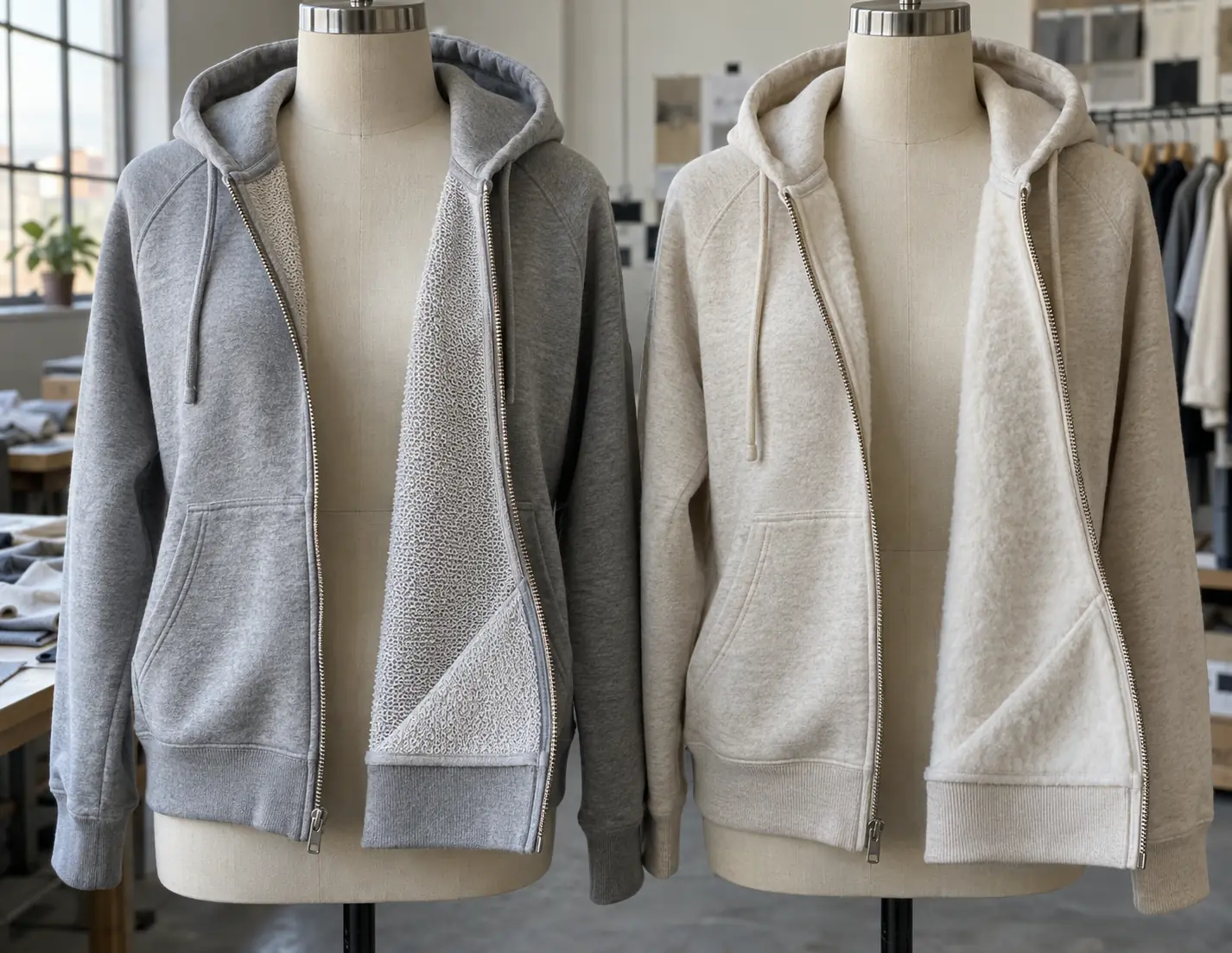
A zip hoodie can fit correctly on arrival and still be the wrong sample to approve. French terry and brushed fleece may share a similar face, but their reverse surfaces change how the garment feels, folds, sheds fibers and behaves around a rigid zipper. Approval should establish which fabric construction the finished product must reproduce, then prove that construction through wear and laundering.
For a brand comparing both options, the useful question is not simply which feels softer. It is which supports the intended use without forcing compromises in front alignment, hood volume or pocket bulk. Treat the sample as a material-and-construction decision: record what was tested, what passed and which substitutions would require another review.
Choose the inside surface for the way customers will wear it
French terry has an unbrushed looped reverse. Brushed fleece has a raised, fuzzy reverse created by brushing the backing yarns. Both descriptions cover many compositions and weights; neither tells you the fiber blend, stretch recovery or shrinkage. A fabric name alone is therefore too loose to serve as an approval standard.
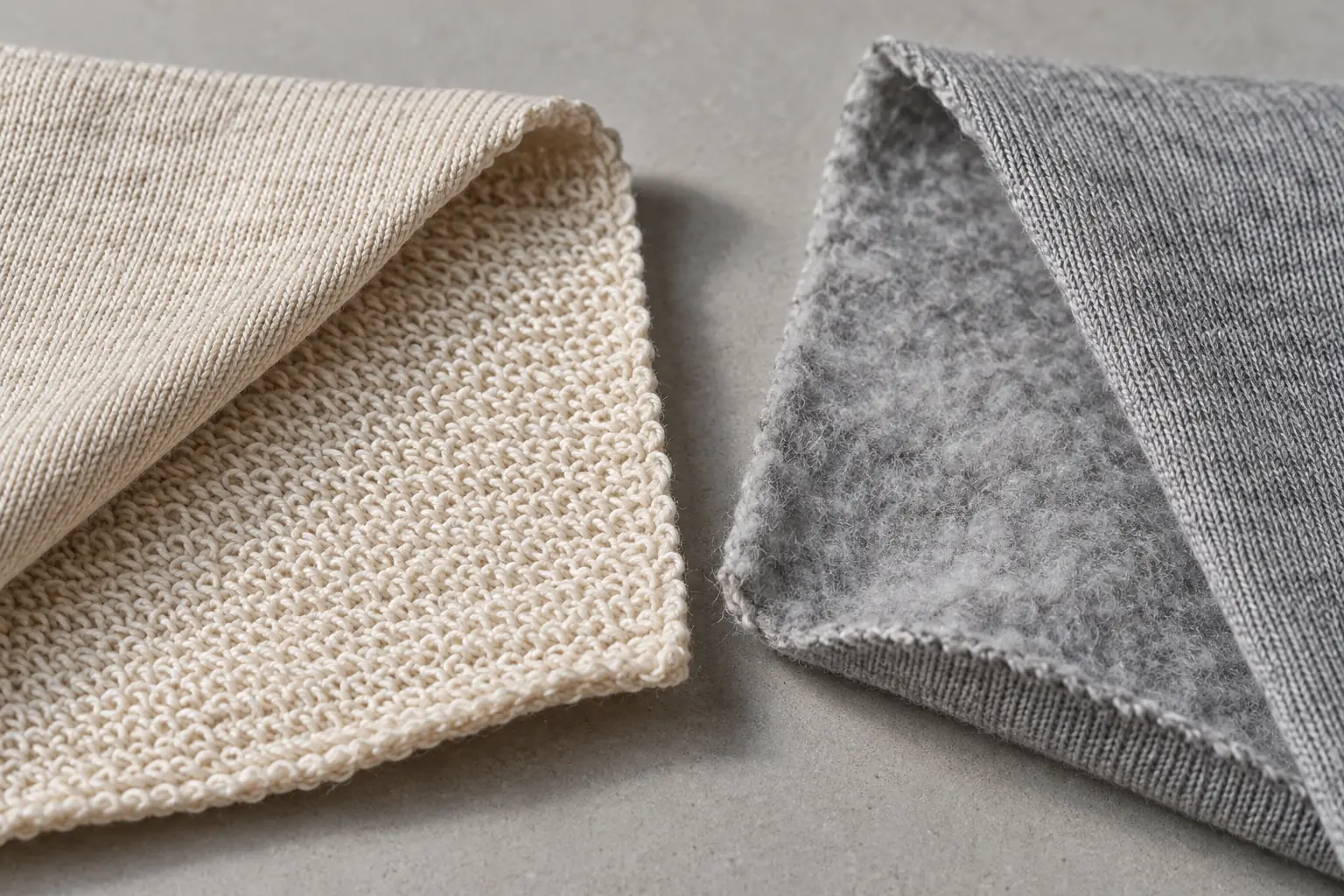
For a lightweight layer worn open over a T-shirt, terry may offer the cleaner, less lofty interior the buyer wants. For a cool-weather hoodie worn close to the body, fleece may provide a warmer-feeling surface. Actual warmth and moisture comfort also depend on weight, thickness, knit density and composition. Compare physical swatches instead of treating these use cases as fixed rules.
Try each option over the intended base layer. Check whether the sleeves slide comfortably, whether the inside catches on the shirt and whether a dark T-shirt collects visible fibers. Include a seated trial with the zipper closed: fabric that looks convincing on a hanger can bunch uncomfortably above the waistband.
Make the terry-versus-fleece trial a controlled comparison
If one candidate is a dense cotton terry and the other a lighter polyester-rich fleece, differences cannot be attributed to brushing alone. Ask for the composition, finished fabric weight, finishing route and stretch behavior of each candidate. Label the sample records with supplier fabric references so that comments remain tied to an identifiable material.
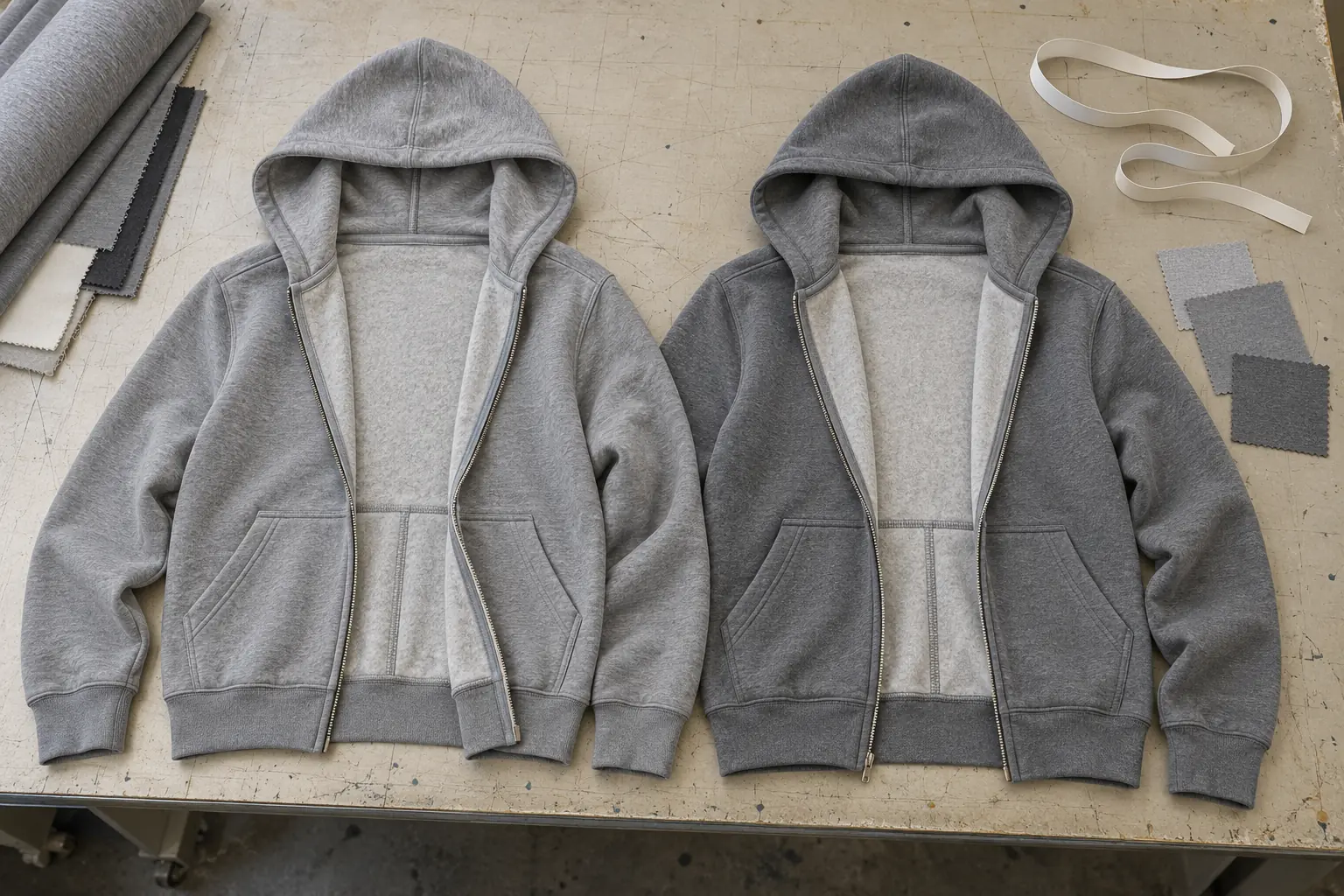
Where practical, build both trials from the same base pattern, with the same zipper type and rib construction. If the fleece needs extra seam allowance trimming or a different hood construction, document that difference. The final choice is a garment system, but the comparison should reveal why each change was necessary.
| Comparison point | What to record | Approval consequence |
|---|---|---|
| Reverse surface | Loop size or brushing level, with a retained swatch | A different handfeel requires review |
| Finished weight | GSM after the agreed finish and conditioning | Weight alone cannot authorize a substitute |
| Stretch and recovery | Direction, test method and residual growth | Recheck cuffs, hem and pocket openings |
| Wash response | Length and width change under the proposed care cycle | Recheck pattern compensation and front balance |
Keep one unwashed reference and one wash-test garment for the selected fabric. Photographs help explain comments, but they cannot preserve loft, loop texture or recovery. Retained physical references make later sourcing discussions much more precise.
Use the zipper to expose differences in fabric movement
The zipper forms a relatively stable line beside a knitted body that can stretch during sewing and contract during washing. Either terry or fleece can develop a rippled front when these movements are mismatched. Fleece loft may hide minor distortion initially; a smooth terry face may make it easier to see. Judge both after the same care treatment.
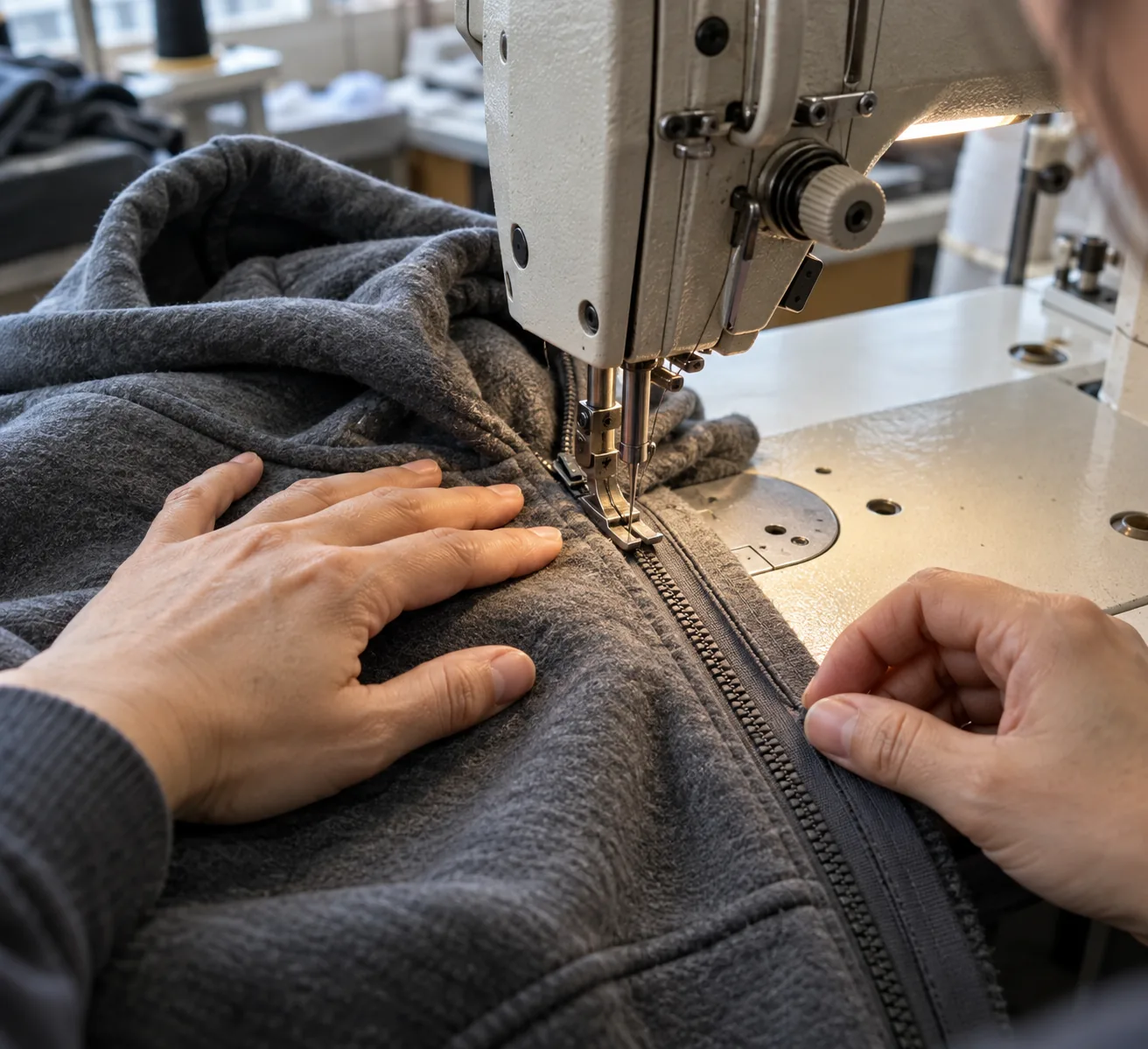
Record zipper type, nominal size, tape material, finished length, slider and any backing or reinforcement. Then inspect the garment zipped on a flat surface without pulling the body straight. Compare left and right front lengths, waistband junctions and the level of the pocket tops. Open the zipper and check whether either front edge curls or hangs longer.
For a development brief, a buyer might propose no more than 5 mm difference between corresponding left and right pocket-top heights on the reference size. This is an illustrative project tolerance, not a universal factory standard. Define the measuring points and agree feasibility before approval; do not apply an unexplained number after production.
If the front waves, investigate feed tension, seam stretch, zipper length and fabric shrinkage together. A longer zipper is not automatically the answer. Ask for a corrected assembly trial in the selected fabric, washed and remeasured, before accepting the front construction.
Rebalance the hood and pockets around thickness
Equal GSM does not mean equal thickness. A lofty fleece can create a fuller hood and thicker pocket corners than a compact terry of comparable weight. Inspect the hood down, up and partially folded. The neckline should not pull backward simply because the approved interior feels plush.
A double-layer fleece hood may need a different treatment from a self-lined terry hood. Consider the intended silhouette before changing the lining: reducing bulk can also change warmth, drape and the visible inside color. If a lighter lining is chosen, approve that material separately and test the assembled hood for differential shrinkage.
At the pocket opening, check the junction where folded fabric, pocket seam and front assembly overlap. Slide a hand in and out, then look for stretching or flaring. On terry, inspect exposed loops near unfinished edges; on fleece, inspect loose fibers and compressed ridges. Neither fabric excuses an unstable opening.
Lock the rib by composition, construction, finished dimensions and recovery, rather than asking for a visual match only. A strongly contracting waistband can pull a soft body into blousing and exaggerate zipper ripples. Review the hem hanging freely and on the wearer, using the actual body fabric and rib combination.
Run a wash-and-wear checklist before signing the sample
The approval record should distinguish measurements before washing from measurements after the proposed care cycle. Follow the same washing, drying and resting procedure for both candidates. Agree the number of cycles and acceptance criteria with the supplier; a single wash is useful screening but does not establish long-term durability.
- Body dimensions: Record chest width, body length and sleeve length at defined points. Calculate change as the difference divided by the original measurement, multiplied by 100.
- Front balance: Photograph the relaxed, closed zipper before and after laundering. Check twisting, waviness, slider movement and the alignment of the lower stops.
- Interior condition: Look for fleece fiber transfer, matting and uneven brushing, or terry loop snagging and distortion. Use the same base layer and handling procedure for comparison.
- High-contact areas: Inspect underarms, side seams and pocket edges for surface change. If pilling resistance is commercially important, specify an agreed test method and rating rather than relying on touch.
- Decoration and trims: Check print distortion, embroidery puckering, label comfort and rib recovery on the washed garment. Include any backing material in the approved construction.
Do not average away a visible failure. A sample can meet overall chest measurements while the front seam twists or the pocket opening grows. Separate dimensional acceptance from appearance and function, and require each to pass. Keep dated photographs under consistent lighting alongside the measurement sheet.
Release a defined fabric package for production
Approval should identify the fabric reference, color, composition, finished weight target, reverse finish, rib, zipper and applicable test results. State whether the sample represents fit approval only or full material-and-construction approval. If the sample used substitute fabric, its fit comments should not silently authorize bulk fabric.
StitchQuote provides cut-and-sew, private label, sampling, fabric and trim sourcing, branding through woven labels, prints and embroidery, and QC before packing. MOQ for most categories starts from 50 pieces per style. Confirm the selected fabric and trim availability for the order rather than assuming every terry or fleece option fits that starting quantity.
A 7-day sample is available for standard styles with confirmed specifications and available materials. Complex styles, custom washes and custom-developed fabric take longer. Resolve the material choice before using that timing in a launch schedule, especially when the decision depends on washed comparison samples.
Questions buyers ask when the two fabrics look alike
Can fleece replace approved terry if the GSM matches?
Matching weight is insufficient. Brushing, thickness, composition and shrinkage can change the result. Require a new material review and an assembly check at the zipper, hood and pockets before accepting the substitution.
Should both versions use the same size specification?
They can share intended finished measurements, but the patterns may need different shrinkage compensation. Compare washed garments against the same agreed fit objective, then record any fabric-specific pattern adjustments.
Does a soft fleece sample prove acceptable shedding?
No. Softness and fiber release are different properties. Review transfer onto a contrasting base layer and the surface after laundering. For a measurable requirement, agree a test procedure and acceptance threshold before placing the order.
What if terry wins on shape but fleece wins on feel?
Choose the property most important to the product brief, or trial another construction. A denser fleece or a different terry finish may help, but treat it as a new candidate. Carrying approval across without testing defeats the comparison.
Related reading and project support:
- Prepare the fabric and construction details in your tech pack
- Review sampling and minimum order planning
- Understand hoodie GSM and fabric weight
- Discuss your terry or fleece sample with StitchQuote
Request a manufacturing quote
Share your product type, quantity range, and destination. We usually reply within one business day.