Custom Streetwear, Casualwear & Denim Manufacturer•MOQ 50 pcs•Denim MOQ 100 pcs•7-Day Sample Available
Drop Shoulder Hoodie vs Regular Shoulder Hoodie for Streetwear
Understand drop shoulder hoodie vs regular shoulder hoodie through fit, fabric, decoration, and production logic so streetwear and premium basics buyers can make.

On This Page
- The short answer for streetwear brands
- Choose the collection role before the shoulder line
- Treat the shoulder as one part of a silhouette system
- Compare drop and regular shoulders in the full lineup
- Three hypothetical collection examples
- Move from creative direction to a sample brief
- When to use the technical comparison guide
- Creative-direction checklist
- Frequently asked questions
A drop shoulder hoodie and a regular shoulder hoodie can both belong in a credible streetwear collection. The useful question is not which construction looks more “streetwear” in isolation. It is which silhouette gives the brand the right visual language, fills the right role in the range, and works with the graphics, layers, bottoms, and styling around it.
This guide is for streetwear founders, creative directors, designers, and merchandisers who have not yet decided what shoulder line the hoodie should use across a collection. It focuses on brand expression and collection silhouette selection. If the creative direction is already chosen and the next questions are shoulder-point measurements, sleeve angle, grading, fabric behavior, MOQ, or bulk consistency, use the technical drop shoulder vs regular hoodie fit comparison.
The short answer for streetwear brands
Creative-direction starting point
Start with a drop shoulder when the hoodie should read relaxed, spacious, graphic-led, or deliberately proportioned away from a conventional athletic basic. The shoulder line can help the garment create a wider visual field and make sleeve volume part of the look.
Start with a regular shoulder when the hoodie should read cleaner, more compact at the upper body, easier to layer, or closer to a refined uniform piece. It can support a quieter core style without preventing an oversized body.
Do not decide from the shoulder label alone. Body width, body length, sleeve volume, hood scale, rib, fabric drape, and styling determine whether either route feels intentional. A controlled or mild drop can also sit between the two extremes.
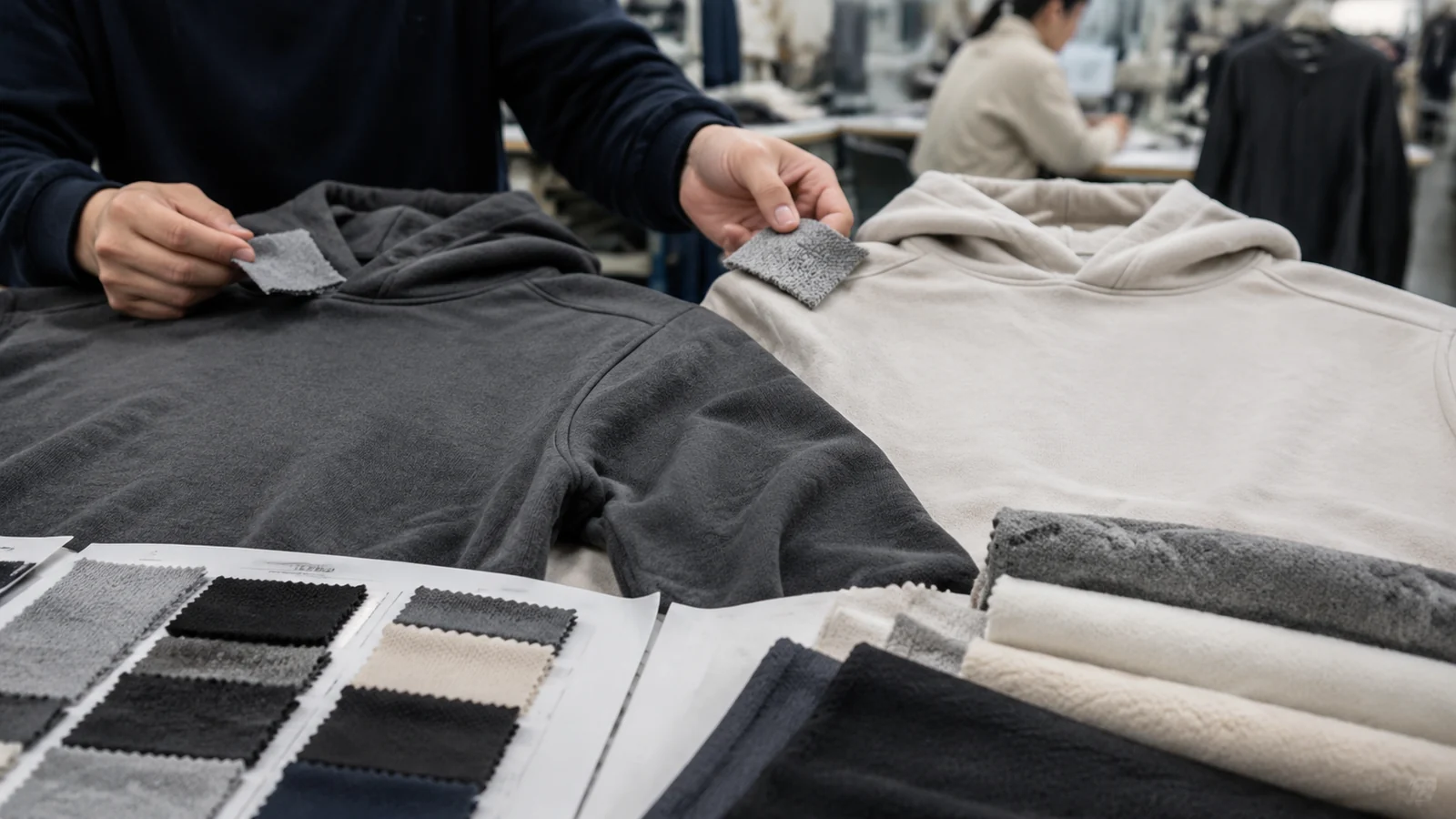
In simple terms, a drop shoulder places the shoulder seam beyond the wearer’s natural shoulder area, while a regular shoulder keeps that transition closer to it. Those names do not define one universal amount of ease or one fixed block. Two suppliers can use the same label for visibly different proportions, so the brand still needs a reference and a clear silhouette brief.
Choose the collection role before the shoulder line
A shoulder decision becomes easier after the team names the hoodie’s job. A hero hoodie, a repeatable core, a layering piece, and the top half of a matching set do not need to make the same visual statement. Choosing the role first prevents the team from copying a dramatic reference that does not belong in the actual assortment.
Hero or campaign hoodie
A hero style needs a recognizable point of view in lookbook images, product pages, and full-body styling. A drop shoulder can be useful when the brand wants sleeve volume, a wider upper silhouette, or a stronger break from a standard blank. A regular shoulder can still work when the concept depends on a precise uniform shape, a compact upper body, or graphic placement that benefits from a quieter garment.
Core logo hoodie
A core hoodie usually needs to work across more outfits and more seasons than a one-off statement piece. A regular shoulder or controlled drop can give the rest of the design—fabric, color, logo scale, wash, or trim—a clearer role. The decision should follow the brand’s established wardrobe, not a rule that core products must be conventional.
Layering hoodie
When the hoodie is designed to sit under denim, workwear, bombers, or overshirts, judge the shoulder together with sleeve volume and the intended outer layer. A large drop and generous sleeve can create the desired stacked silhouette when worn alone but add unwanted bulk under a closer jacket. A regular shoulder may simplify layering, although the full block still matters more than the seam name.
Matching-set hoodie
For a hoodie-and-sweatpants set, the upper and lower volumes should look like one design language. A wide drop-shoulder hoodie may pair naturally with a fuller leg, while a cleaner shoulder can support straighter or more tapered bottoms. These are starting points, not fixed combinations. The streetwear matching-set design guide helps when the top and bottom must be reviewed as one silhouette.
Treat the shoulder as one part of a silhouette system
The shoulder line is easy to notice, but it cannot carry the whole design. Creative teams should review at least seven connected decisions before approving a direction:
- Shoulder placement: subtle, controlled, or pronounced rather than only “drop” or “regular.”
- Body width: narrow, straight, relaxed, or intentionally wide.
- Body length: elongated, conventional, or shortened relative to the width.
- Sleeve shape: clean, roomy, tapered, or stacked at the cuff.
- Hood scale: quiet and compact or visually dominant around the neck and back.
- Rib relationship: whether the hem and cuffs contain the volume or let the garment fall more freely.
- Fabric character: whether the material falls softly, holds a sculpted shape, or changes the intended balance after finishing.
This system explains why a regular-shoulder hoodie can still look oversized and why a drop-shoulder hoodie can still feel weak. Width without a deliberate length decision may look merely large. A pronounced drop with a narrow body can feel disconnected. A large hood can overpower a refined shoulder direction. The creative review should therefore compare whole silhouettes, not crop the moodboard at the armhole.
The same logic applies across product categories. If the collection includes tees, the boxy versus standard oversized T-shirt guide can help the team decide whether the hoodie and T-shirt should repeat one proportion system or intentionally play different roles.
Compare drop and regular shoulders in the full lineup
| Collection question | Drop-shoulder starting point | Regular-shoulder starting point | What to review |
|---|---|---|---|
| Brand signal | Relaxed, volume-led, or visibly directional | Controlled, quiet, uniform, or refined | Does the outline match the brand before logos are added? |
| Graphic role | Can make the garment itself part of the statement | Can give artwork a calmer frame | Front, back, and sleeve artwork on the actual silhouette |
| Range role | Often considered for hero or relaxed-volume styles | Often considered for core, uniform, or layering styles | Whether the range needs contrast or repetition |
| Styling | Can emphasize width, sleeve break, and relaxed bottoms | Can support cleaner layers and more compact outer shapes | Full outfits, intended outerwear, and footwear balance |
| Continuity | Useful when volume is a recurring brand code | Useful when precision or versatility is a recurring code | How the block can evolve across future colors and graphics |
The table is a creative prompt, not a technical specification. A brand can deliberately reverse any of these starting points. What matters is that the team can explain the choice in the language of the collection rather than saying only that one option is trendier.
Three hypothetical collection examples
The following examples are fictional decision scenarios. They are not customer claims or promises about commercial results.
Example 1: a graphic-led launch capsule
Imagine a small capsule built around a large back graphic, washed color, roomy denim, and a hoodie intended to lead campaign styling. A controlled drop shoulder could support the wider outline and make the sleeve part of the image. The team would still need to compare how the graphic sits on the body and whether the length balances the width. Choosing the most extreme drop simply because the piece is “streetwear” would not be enough.
Example 2: a refined everyday uniform
Imagine a tonal collection with small branding, clean trousers, and outerwear that the hoodie should sit under. A regular shoulder or mild drop could keep the upper body quieter while body width and fabric provide ease. The streetwear identity would come from the complete product system—proportion, hand feel, color, styling, and finish—not from forcing one shoulder treatment.
Example 3: a two-look matching-set story
Imagine one campaign look with a fuller sweatpant and another with a straighter bottom. The brand could use a more dropped shoulder for the volume-led set and a cleaner shoulder for the refined set, or keep one shoulder block and create contrast elsewhere. The better choice is the one that makes the relationship between the two looks legible. A lineup board is more useful here than judging two isolated hoodie flats.
Move from creative direction to a sample brief
Once the creative choice is made, translate it into material a pattern and sample team can interpret. A useful handoff can include:
- a front, back, and side reference for the intended silhouette;
- a short sentence naming the hoodie’s role in the collection;
- the intended wearer and styling approach, including important layers;
- the target sample size and a base size chart;
- notes on how pronounced the shoulder shift should look;
- body-width, body-length, sleeve-volume, hood, cuff, and hem priorities;
- artwork files and placement views shown on the intended proportions;
- the related bottoms or outerwear that must be reviewed beside the hoodie; and
- a list of what is fixed, what may be interpreted, and what must be compared in sample.
A reference image is useful, but “make it like this” leaves too much open. Explain what the team is borrowing: the shoulder line, width-to-length balance, sleeve break, hood scale, or overall attitude. Also explain what should not be copied. That gives the supplier a clearer creative target without pretending an image is a complete tech pack.
For brands that need a production partner after the direction is set, the custom streetwear manufacturer hub covers collection development across hoodies, tees, sweats, cut-and-sew fits, private label branding, sampling, and QC. If the project is specifically hoodie-led, use the custom hoodie manufacturer page. For labels, packaging, and a broader branded program, review private label clothing manufacturing.
When to use the technical comparison guide
This page should help the brand answer: What should the hoodie communicate, and what job does it perform in the collection? Use the sibling drop shoulder vs regular shoulder hoodies technical guide when the team needs to answer: How should that direction be measured, sampled, graded, washed, costed, and repeated in bulk?
That technical page is the better next step when any of these questions are active:
- How should the shoulder point and sleeve line be interpreted in the pattern?
- How could fabric weight or drape change the approved silhouette?
- What should the team check across sample sizes or after wash?
- How do decoration, construction, MOQ, and bulk consistency affect the choice?
- What must be locked before final production approval?
If the direction is still unresolved, stay on this page and compare the hoodie within the collection. If the direction is chosen but the specification is vague, move to the technical guide and the sampling and MOQ hub before requesting bulk pricing.
Creative-direction checklist
- Can the team describe the brand signal without using only “oversized,” “premium,” or “streetwear”?
- Has the hoodie been assigned a clear role: hero, core, layer, set, or another defined job?
- Does the shoulder choice work with body width, length, sleeve volume, hood scale, and fabric character?
- Has the team reviewed front, side, and back views rather than only a front flat?
- Have graphics been placed on the intended silhouette rather than a generic mockup?
- Has the hoodie been compared with the collection’s tees, bottoms, and outerwear?
- Does the direction make sense both styled alone and in its intended layers?
- Can the pattern team identify what the reference is meant to communicate?
- Is there a reason to choose a pronounced drop, a mild drop, or a regular shoulder?
- Has the team separated the creative decision from the later technical approval checks?
A strong answer does not need to be dramatic. It needs to be specific enough that design, merchandising, and production are approving the same silhouette.
Frequently Asked Questions
Does choosing a drop shoulder automatically make a hoodie streetwear?
No. A drop shoulder is one silhouette tool, not proof of a streetwear identity. A regular-shoulder hoodie can feel strongly streetwear through width, length, fabric, artwork, finish, and styling. A drop shoulder can feel generic when the rest of the design has no clear point of view.
Can a regular shoulder hoodie still be oversized?
Yes. Oversized is a relationship among the body, length, sleeve, hood, and intended wearer; it is not created by shoulder placement alone. The creative brief should describe the whole outline.
Should every hoodie in one collection use the same shoulder?
Not necessarily. A brand can use one block for continuity or different blocks to separate hero and core styles. The important point is that the difference looks intentional and that the styles still share recognizable collection codes.
What should a creative team send before sampling the shoulder direction?
Send front, side, and back references; the hoodie’s collection role; target sample size; base measurements; intended layers; artwork placement; and notes explaining which proportions matter most. A reference should identify the desired idea rather than stand in for a full specification.
When should I use the technical drop shoulder comparison instead?
Use it after the creative direction is chosen, or whenever the open issue is measurement, sleeve angle, fabric GSM, grading, wash behavior, decoration, MOQ, or bulk consistency rather than collection identity.
Turn the silhouette direction into a project brief
When the collection role, reference views, artwork, target size, and quantity plan are ready, share them through the StitchQuote project inquiry. Keep the first message focused on the desired silhouette and the decisions that still need supplier input.
Request a manufacturing quote
Share your product type, quantity range, and destination. We usually reply within one business day.