Custom Streetwear, Casualwear & Denim Manufacturer•MOQ 50 pcs•Denim MOQ 100 pcs•7-Day Sample Available
How Much Does It Cost to Manufacture a Hoodie?
A real cost breakdown for manufacturing custom hoodies — fabric, labor, printing, MOQ tiers, and what drives price per unit up or down.

If you’re starting a clothing brand, “how much does it cost to manufacture a hoodie?” is usually the first real question — and the honest answer is it depends, but not in a vague way. The cost per hoodie is driven by a handful of specific factors, and once you understand them you can estimate your own number and spot when a quote is fair.
Below is a practical breakdown based on how custom hoodies are actually costed on the factory floor.
Factory buyer decision table
Updated July 23, 2026: A hoodie quote is strongest when the buyer separates true product upgrades from unclear assumptions. The factory needs to know which cost drivers are fixed, which can be adjusted, and which still need sampling evidence before bulk pricing is trusted.
| Cost driver | Factory-side check | Buyer decision risk |
|---|---|---|
| Fleece body | GSM, fiber blend, brushing, shrinkage, dye route, and handfeel target | A cheaper fabric quote can lose the weight, recovery, or wash behavior that made the sample acceptable |
| Construction minutes | Panel count, hood shape, pocket seam route, rib attachment, drawcord exits, and topstitching | Complex sewing details are approved visually but not included in the costed operation route |
| Decoration and trims | Artwork size, stitch count, print setup, label pack, drawcord, eyelet, aglet, and packaging standard | Small branded details are treated as afterthoughts, then raise sample cost, timeline, or reorder risk |
Use this cost page with the custom hoodie manufacturer workflow, the complete hoodie manufacturing guide, and sampling and MOQ planning. When the fabric, construction, decoration, quantity, and delivery assumptions are ready, send the brief through contact for a quote review.
The short answer
For a custom, mid-weight pullover hoodie (around 320–350 GSM cotton-blend fleece) at a small-batch quantity of 50–100 pieces, the manufacturing cost typically lands in a low-to-mid double-digit dollar figure per unit. Push the order into the hundreds or thousands of pieces and that per-unit cost drops significantly. Add heavyweight fabric (400–500 GSM), complex embroidery, or premium finishing, and it climbs. The price you pay is the sum of five things.
1. Fabric — usually the biggest single cost
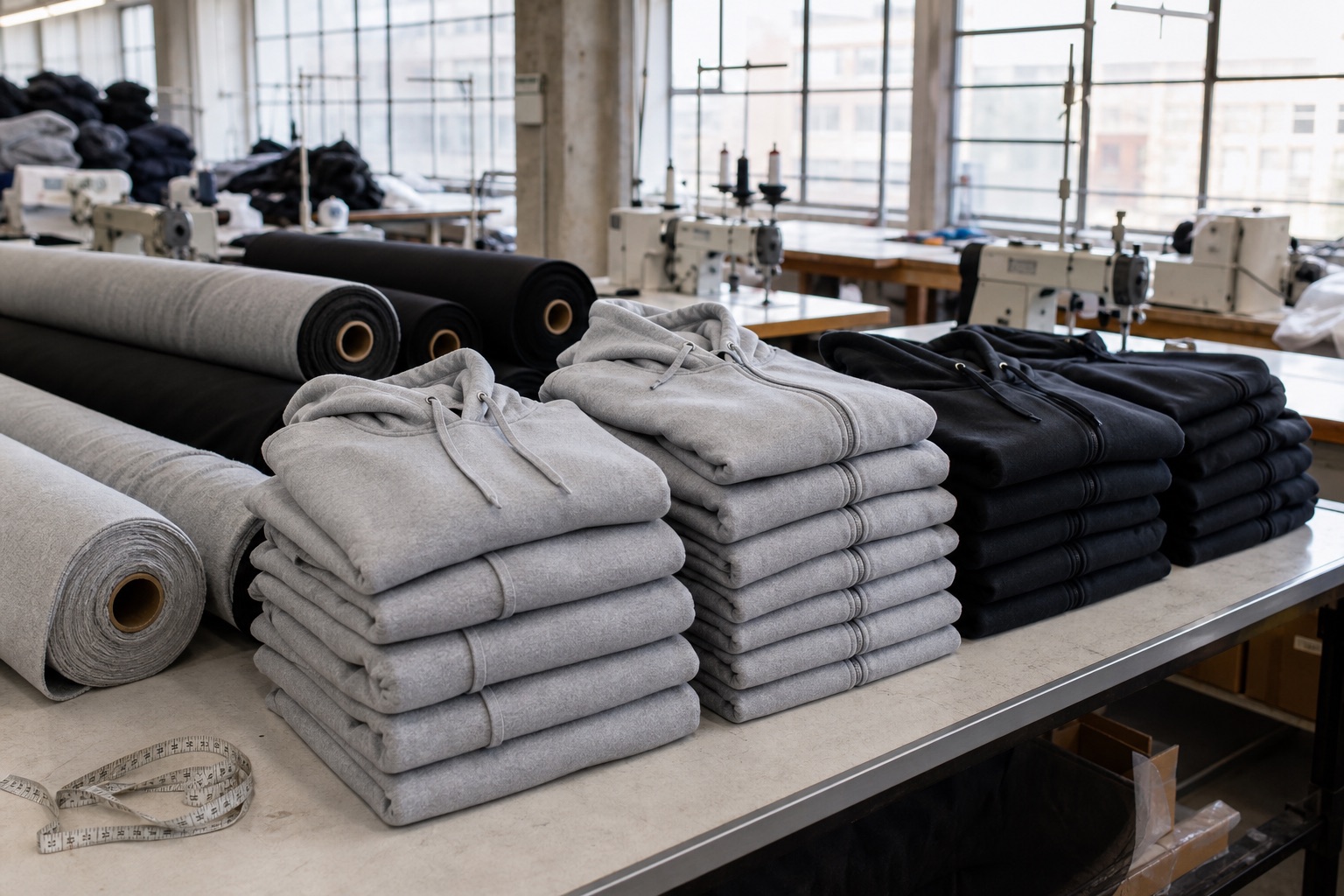
Fabric is normally the largest line item in a hoodie. What moves it:
- Weight (GSM): a 320 GSM fleece uses less material than a 480 GSM heavyweight. Heavier hoodies feel premium but cost more per unit.
- Composition: 100% combed cotton costs more than a cotton/poly blend. Organic or recycled cotton adds a premium.
- Dyeing: stock colors are cheapest; custom Pantone-matched dye lots cost more and usually carry their own minimum.
A heavyweight 100% cotton hoodie can use roughly double the fabric cost of a lightweight blended one — before a single stitch is sewn.
2. Labor (cut & sew)
This covers cutting the fabric, sewing the panels, attaching the hood, ribbing, cuffs, drawcords, and finishing. A hoodie has more pieces and operations than a t-shirt, so cut-and-sew labor per unit is higher. Construction details — double-needle topstitching, kangaroo pocket shaping, paneling, hidden zippers — each add labor minutes, and minutes are money.
3. Decoration (print / embroidery)
How you brand the hoodie matters a lot:
- Screen printing is cheap per unit at volume but has setup/screen fees, so it’s expensive in small runs.
- Embroidery is priced by stitch count — a small left-chest logo is modest; a large back design is not.
- Heat transfer / DTG is flexible for small quantities and complex artwork but costs more per piece.
- Custom labels, woven tags, drawcord tips, and hardware are small per-unit costs that add up across an order.
4. MOQ and order quantity — the biggest lever you control
This is where most new brands are surprised. The same hoodie costs very different amounts at 50 pieces versus 1,000 pieces, because fixed costs (pattern making, marker making, screen setup, machine setup, dye minimums) get spread across more units.
- Very low quantities (under 50): highest cost per unit; many factories won’t take them at all.
- Small batch (50–300): workable with a low-MOQ manufacturer, moderate per-unit cost — ideal for testing a brand.
- Bulk (500+): per-unit cost drops sharply; this is where margins get healthy.
If a quote feels high, the fastest way to lower per-unit cost is usually to consolidate styles and colors and raise quantity per variant — not to cut quality.
5. Sampling, shipping, and the costs people forget
Before bulk production you’ll pay for samples — typically a one-time cost per style that’s higher than the bulk unit price, because the factory makes them one at a time. This is normal and worth it: approving a correct sample is what protects your whole order. See our guide to apparel sampling for how that process works.
Then add shipping (air is fast and pricey, sea is slow and cheap), duties and taxes for your country, and any mid-production QC. These don’t change the factory unit price, but they change your landed cost — the number that actually matters for pricing your product. For the full picture beyond the garment itself, see how much it costs to start a streetwear brand.
A simple way to estimate your hoodie cost
Add these up for a per-unit estimate:
- Fabric (driven by GSM + composition)
- Cut & sew labor (driven by construction complexity)
- Decoration (driven by method + logo size / stitch count)
- Trims & packaging (labels, tags, polybags)
- Amortized setup (fixed fees ÷ order quantity)
Then add sampling, freight, and duties on top to get your landed cost.
How to get an accurate quote
The more specific your brief, the more accurate — and often lower — your quote will be. A factory can’t price guesswork. Give them target GSM and fabric composition, a reference hoodie or tech pack, logo and print details (method, size, placement, colors), quantity per color and size, and your target delivery date. If you don’t have a full tech pack yet, a clear reference garment and good photos go a long way.
Get a real number for your hoodie
Ballpark ranges are useful for planning, but the only number that counts is a quote on your hoodie at your quantity. As a custom hoodie manufacturer set up for small-batch and growing brands, we’ll cost it out line by line — fabric, construction, decoration, and MOQ options — so you can see exactly what drives your price and where you can flex it.
Send us your hoodie details for a no-obligation quote, and we’ll come back with a clear breakdown and sample plan.
Frequently Asked Questions
What information makes a hoodie manufacturing quote more accurate?
A factory needs the target fleece GSM and composition, construction details, decoration method, trim pack, quantity split, sample status, packing requirement, and delivery assumption. Without those details, the quote is usually a planning estimate, not a production-ready cost.
Why can two hoodie factories quote different prices for the same idea?
They may be costing different fabric quality, sewing operations, decoration setup, trims, inspection scope, or order split assumptions. Buyers should compare the included scope before judging only the unit price.
How much does it cost to manufacture a hoodie in China?
China cut-and-sew quotes for streetwear hoodies still turn on the same drivers above—GSM, construction, decoration, and order split—plus freight and sampling. A midweight blank-style hoodie without heavy decoration will price differently from a boxy heavyweight with embroidery and a custom rib. For planning, start with fabric and fit assumptions, then ask for a line-item quote that separates fabric, CMT, decoration, and sample fees.
If you need a factory path rather than a cost theory page, see our custom hoodie manufacturer hub and low MOQ clothing manufacturer page (typical knit MOQ 50; denim 100).
For fabric and fit choices while costing a hoodie, also compare our French terry hoodie manufacturer and boxy hoodie manufacturer routes, or the main custom hoodie manufacturer hub.
Request a manufacturing quote
Share your product type, quantity range, and destination. We usually reply within one business day.