Custom Streetwear, Casualwear & Denim Manufacturer•MOQ 50 pcs•Denim MOQ 100 pcs•7-Day Sample Available

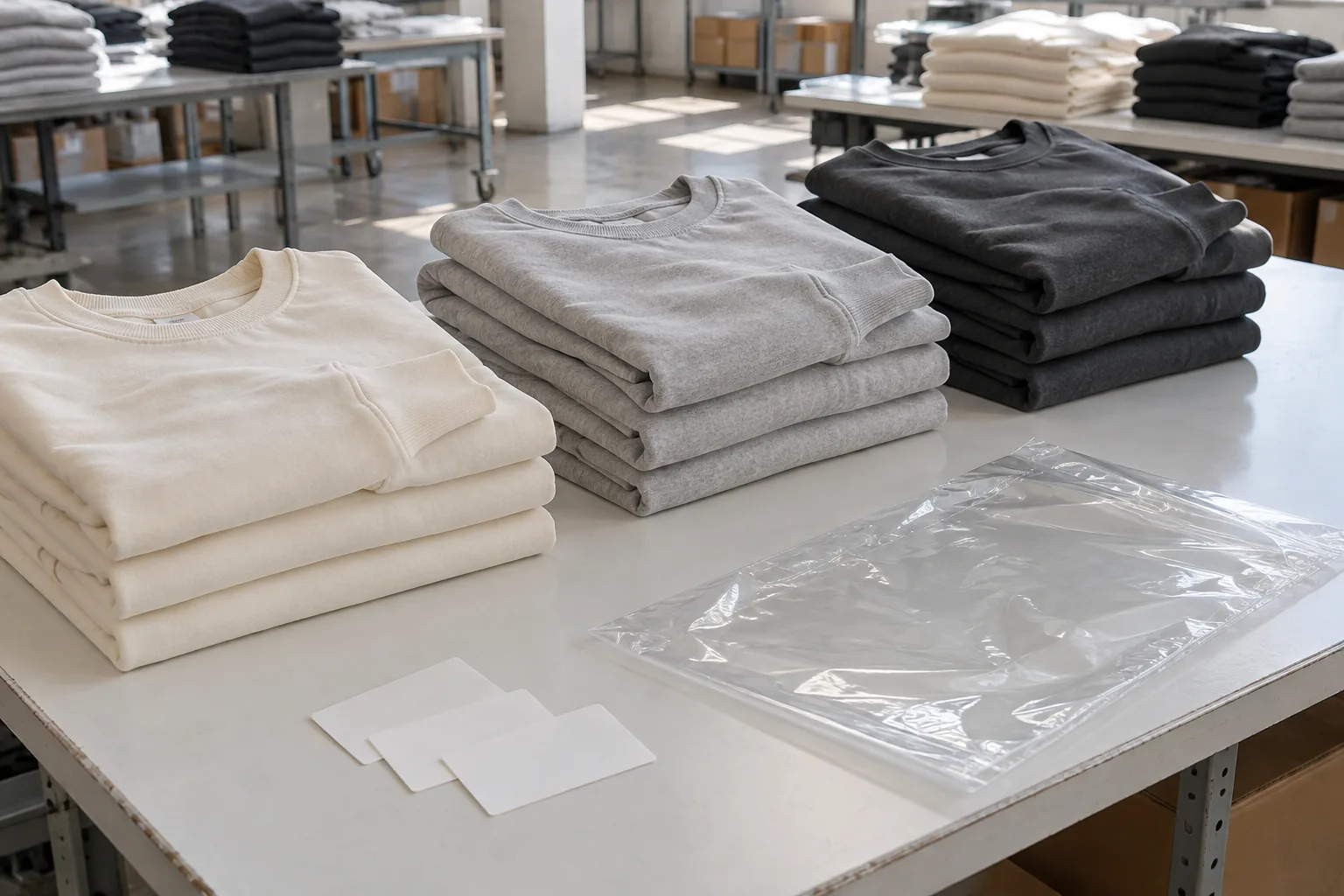
When Size Stickers, Barcode Labels, and Folding Instructions Actually Matter
Use size stickers barcode labels apparel to compare private label decisions more clearly, protect brand consistency, and keep product, trims, and commercial scope.

A finished sweatshirt can pass its measurement inspection and still arrive unready for sale. A warehouse may scan it into the wrong variant, a shop may need to replace every size sticker, or a fulfillment team may unfold each unit to find the label. These problems begin when packing details receive informal approval while the garment receives a formal one.
Size stickers, barcode labels, and folding instructions need their own release decision whenever goods must enter a defined retail or fulfillment system. The useful question is not whether packaging looks tidy. It is whether the approved garment, its identity, and its presentation remain connected through packing and receiving. Treat that connection as an approval gate with evidence, an owner, and a clear stop condition.
Set the release boundary before anyone orders packing materials
Start with the destination. A brand shipping directly to its own studio may need only readable variant identification and a protective fold. A collection going to a third-party warehouse may require an externally accessible barcode, specific bag dimensions, and a defined carton assortment. A wholesale customer may specify a ticket location that conflicts with the brand’s preferred presentation. Collect these requirements before approving label quantities.
Separate garment approval from packout approval in the order record. An accepted fit sample authorizes only the decisions explicitly covered by that approval; it should not silently approve sticker adhesive, barcode data, or folding dimensions. Name one buyer-side owner who consolidates instructions from merchandising, operations, and the receiving destination. Otherwise, two individually reasonable instructions can create an impossible packing standard.
Use three statuses: pending evidence, approved at a stated revision, and held for correction. Avoid an unqualified “looks good” attached to a photograph. A release should identify the style, applicable colors and sizes, destination, document revision, and accepted exceptions. If a destination is unresolved, record that as a hold on the affected packaging decisions.
Freeze the variant map before approving barcode artwork
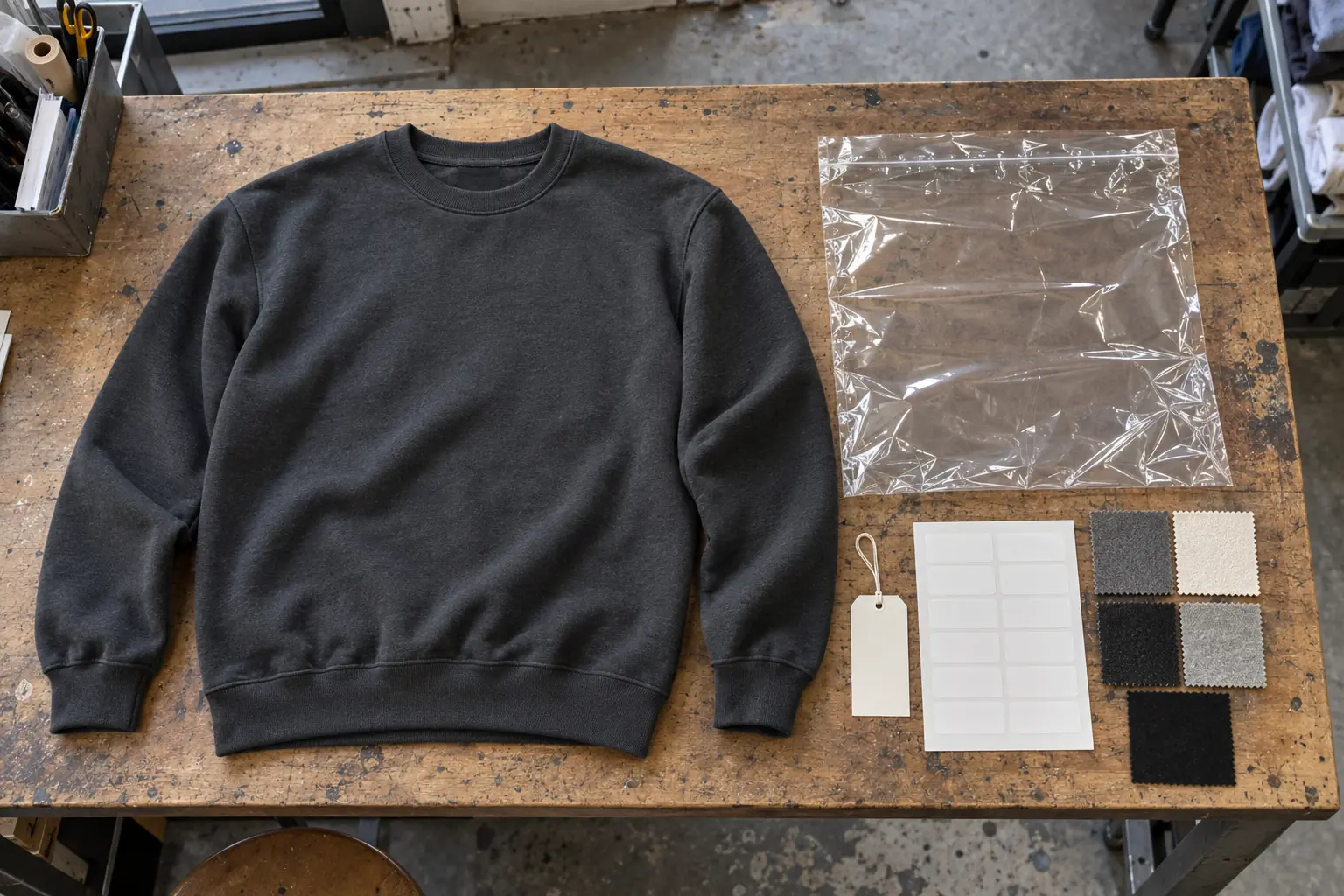
Build one controlled variant map linking the buyer’s item identifier to style, color, size, and the exact encoded value. Include the human-readable size wording separately: “XL” on a sticker and “Extra Large” in an inventory system may be acceptable, but the mapping must be intentional. Preserve leading zeros by treating barcode values as text when exchanging spreadsheets.
For example, a washed navy tee in medium and a solid navy tee in medium can look nearly identical when folded. A shortened color description such as “NAV” is insufficient if both use it. Give each sellable variant its authorized identifier and check for accidental duplicate assignments. Where a receiving system requires a particular identifier scheme, the buyer must supply or authorize compliant values; a factory should not improvise them.
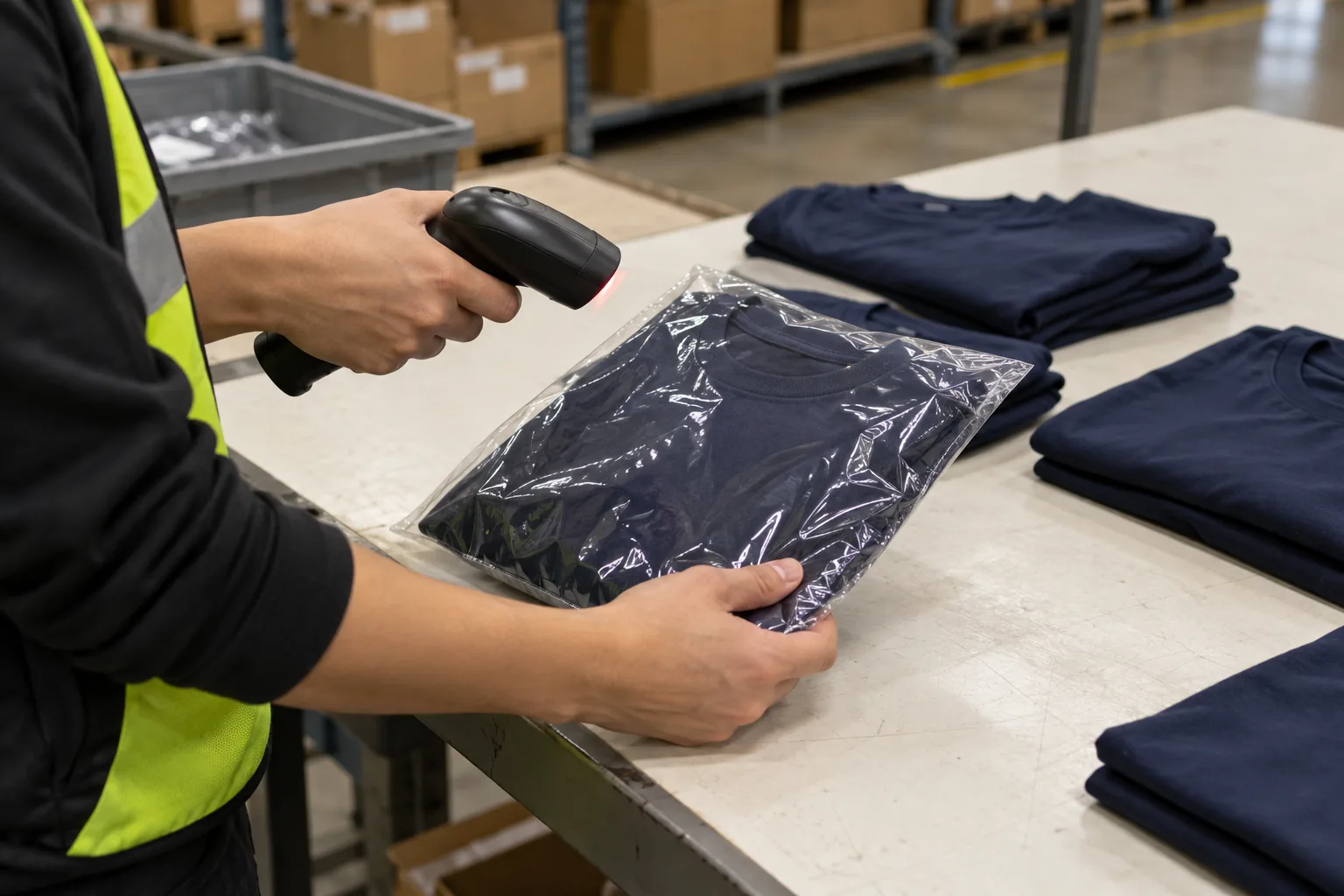
Approve actual print size and placement as well as data. Specify the required barcode format, label dimensions, contrast, and clear space around the symbol according to the destination’s requirements. Do not squeeze the artwork to fit a smaller label without another scan check. A phone recognizing a code is useful feedback, but it does not prove the warehouse system will accept the item.
Make the packed sample prove handling, not just appearance
Request a representative garment packed with the proposed materials. Test the sticker on the actual contact surface: a bag, hangtag, or garment face behaves differently. A removable sticker suitable for smooth plastic may lift fibers or leave residue on brushed fleece. Agree where it belongs and check removal after a dwell period that reflects expected storage conditions. Record the period and conditions instead of declaring an adhesive universally safe.
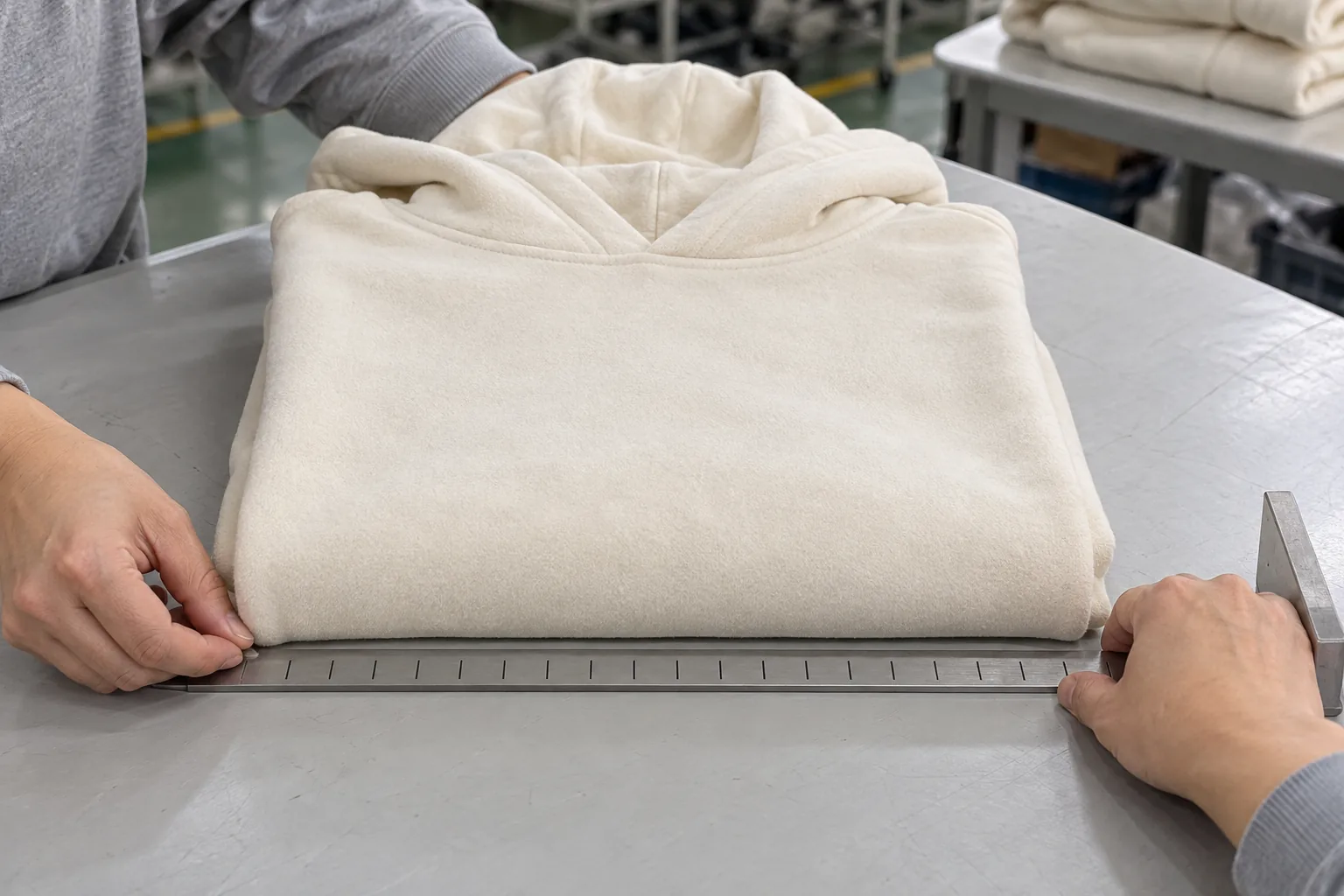
Define the fold with measurable references. For a sweatshirt, an illustrative instruction could specify a finished footprint of 30 by 36 cm, with an agreed tolerance of plus or minus 1 cm, sleeves turned inward, and the hood laid flat behind the body. These are example project values, not a universal standard. Check the smallest and largest sizes before applying one footprint to the whole run.
Show the packed front, back, and opening sequence. Confirm that the size indicator remains visible, the barcode stays flat, and the bag closes without compressing a raised print or embroidery. A fold line through a thick chest decoration may look acceptable immediately but distort presentation after storage. Use an alternative fold or suitable protection when the sample demonstrates that need.
Release each dependency with a specific piece of evidence
A short release register prevents a packaging approval from becoming a long email search. The following gates can sit within the production file. They need not require separate meetings, but each must have an explicit outcome before the dependent operation begins.
| Gate | Evidence required | Hold if |
|---|---|---|
| Label production | Authorized variant map and final artwork proof | Identifiers or destination rules are unresolved |
| Bulk packing | Accepted packed sample and current fold instructions | Materials or placement differ from approval |
| Shipment release | Completed packout checks and reconciled quantities | Wrong variants or unexplained discrepancies remain |
Match approval timing to irreversible commitments. Buying printed labels before the variant map is settled risks scrap; packing before adhesive acceptance risks reopening every unit. Allow time for correcting the relevant component rather than hiding that work inside the shipment date.
StitchQuote provides sampling, fabric and trim sourcing, cut-and-sew, private label, branding, and QC before packing. Confirm the scope of packing checks for the project explicitly. A standard-style sample can be available in seven days with confirmed specifications and available materials; complex styles, custom washes, and custom-developed fabric take longer. That sampling condition does not automatically establish a deadline for approving custom packaging.
Check the first packed units before repetition multiplies errors
Start inspection with the first units from each distinct packing setup, then use an agreed inspection plan during the run. Cover every variant’s data mapping and the physical extremes that challenge the fold. Randomly inspecting several medium sizes will not reveal a large-size bag that cannot close or a small-size sticker hidden behind a fold.
- Identity: Compare the garment’s sewn size label, external size indicator, encoded value, and order variant. All must refer to the same unit.
- Scan result: Scan through the final packaging in its normal receiving orientation. Verify the decoded value against the approved map and check destination acceptance separately.
- Placement: Measure against the specified edge or seam reference. Check that folds, bag seams, glare, or overlapping stickers do not obstruct reading.
- Surface condition: Remove trial stickers where applicable and inspect for adhesive residue, fiber lifting, discoloration, or decoration damage.
- Fold and protection: Check the agreed footprint, garment orientation, closure, and protection of raised trims or prints.
- Quantity reconciliation: Compare packed counts by variant with the packing record and investigate shortages, substitutions, and mixed units.
Classify wrong-item barcode mapping as a release blocker in the agreed plan. If a mismatch appears, hold the affected units and identify the last verified setup. Correct the cause, inspect the potentially affected population, and document the recheck before release. A photograph of one corrected label does not establish that the rest of the batch is correct.
Reopen approval when a change affects the accepted pack
Changes after signoff need a defined scope. Moving a barcode to another face of the bag calls for a new accessibility and scan check. Changing the bag size calls for a fit and fold check. Substituting adhesive requires another contact-surface trial. Changing encoded values requires renewed mapping validation and control of obsolete labels.
Keep superseded files out of the active packing instructions and separate outdated label stock. Record which packed units require rework and reconcile replacement labels against affected quantities. For split destinations, maintain distinct packing revisions and clearly segregate the units. One destination’s acceptance should never be assumed to cover another’s receiving process.
Questions buyers ask at the packing approval gate
Can we approve folding from photographs alone?
Photographs can confirm orientation and visible placement, especially when they include measurements. They cannot establish sticker removability, packing pressure, or reliable scanning through the final bag. Use a physical packed sample for those unresolved properties and record which evidence supports each acceptance.
Does every size need a separate packed sample?
Every variant needs correct data validation. Physical samples should cover different packing methods and challenging sizes or decorations. If one fold and bag serve the range, test the size extremes first; expand coverage when those checks reveal inconsistent fit or presentation.
What if the warehouse changes its rules after packing starts?
Hold the affected destination’s units, obtain the revised requirement, and approve a corrected example. Establish the rework quantity and timing before restarting. Keep unaffected units traceable so the correction does not create new variant or destination mix-ups.
Related reading and project support:
- Document packing specifications in your tech pack
- Review sampling and MOQ planning
- Discuss your packing approval requirements with StitchQuote
Request a manufacturing quote
Share your product type, quantity range, and destination. We usually reply within one business day.