Custom Streetwear, Casualwear & Denim Manufacturer•MOQ 50 pcs•Denim MOQ 100 pcs•7-Day Sample Available

Why Collar Recovery Matters in Premium Basics Programs
Understand collar recovery premium basics through fit, fabric, decoration, and production logic so streetwear and premium basics buyers can make cleaner development.

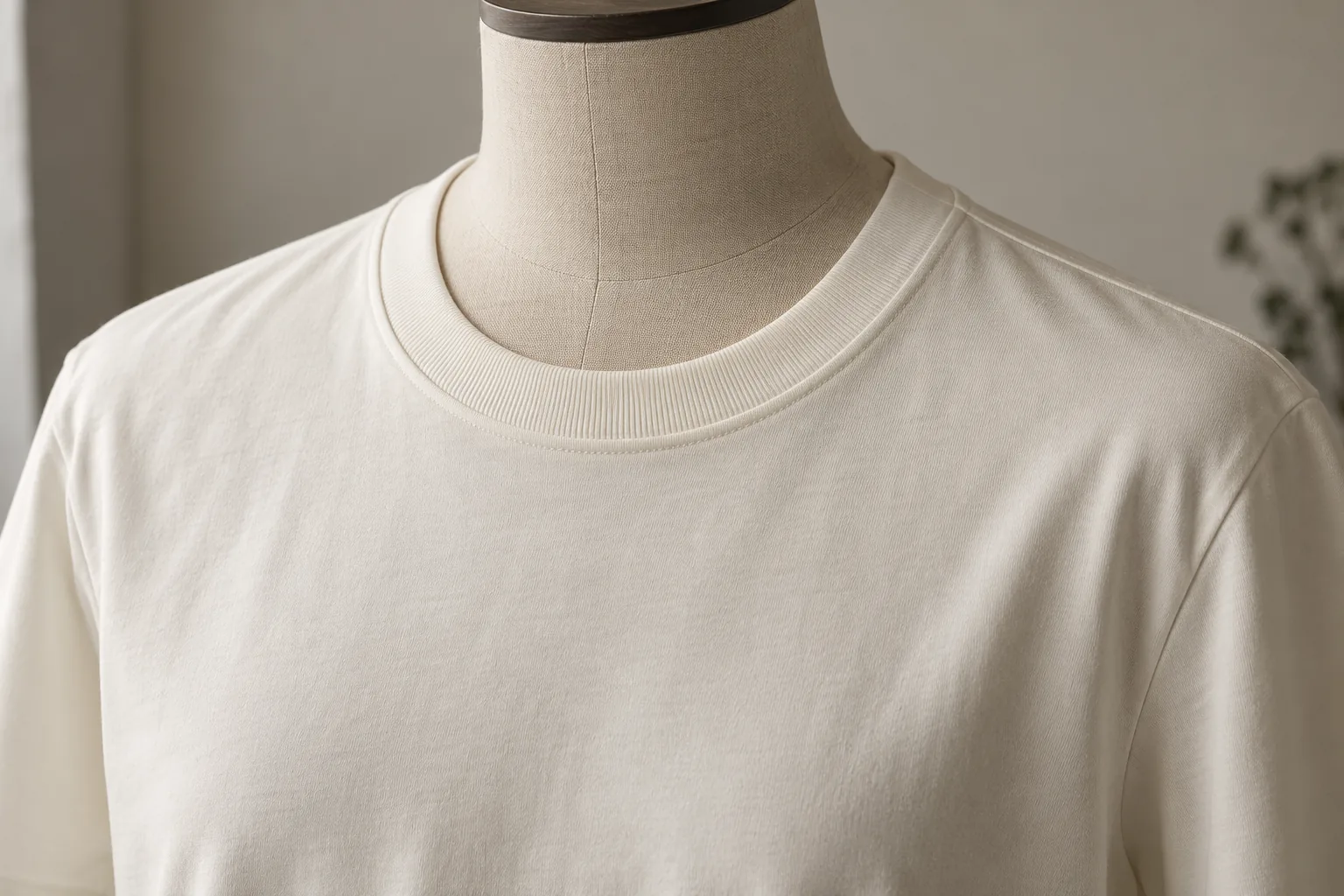
A premium T-shirt can pass a fitting and still disappoint after wear. The neckline may sit neatly when steamed, then remain stretched after dressing or develop ripples after washing. Collar recovery is the ability of the neckband to return toward its intended shape after extension. For a brand buyer, that performance needs its own approval decision.
Treat the neck opening as a release gate within your basics program: define the expected behavior, test the actual construction, and record who can approve it. This keeps a good-looking sample from becoming permission to produce an unproven neckline across an entire order.
Gate one: agree on what the neckline must do
Start with the wearer and the silhouette. A close-fitting crewneck must allow comfortable dressing without remaining enlarged afterward. A wider, relaxed neckline has a different visual target, but it should still return consistently rather than sag at the front. Neither brief is adequately described by “premium rib.”
Specify the neck opening measurement method, finished band width, acceptable appearance, and intended care instructions. Include a recovery observation after an agreed extension and rest period. The extension amount, number of repetitions, and rest time should be agreed per project; an arbitrary hand pull cannot establish a repeatable pass.
The first gate closes when design and technical reviewers share the same acceptance criteria. If one person expects a firm opening and another expects effortless stretch, material selection will keep moving between incompatible targets.
Gate two: qualify the rib and body as a pair
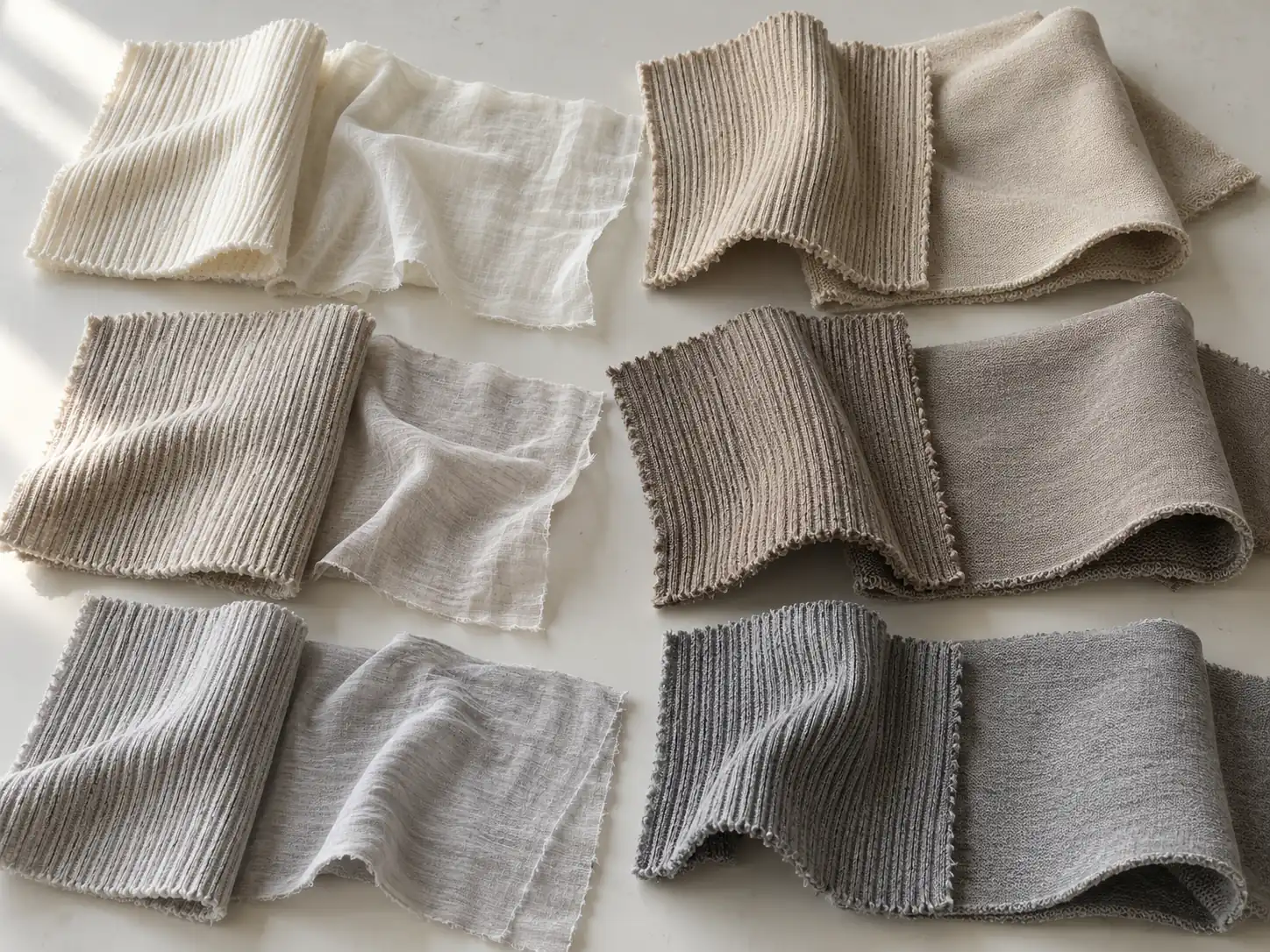
A rib swatch that springs back on its own is useful evidence, but it does not prove the sewn neckline will behave well. Knit structure, yarn, elastane content where present, finishing, and dimensional change all affect the result. The body jersey also matters: a light jersey can show distortion under a band tension that a heavier fabric supports.
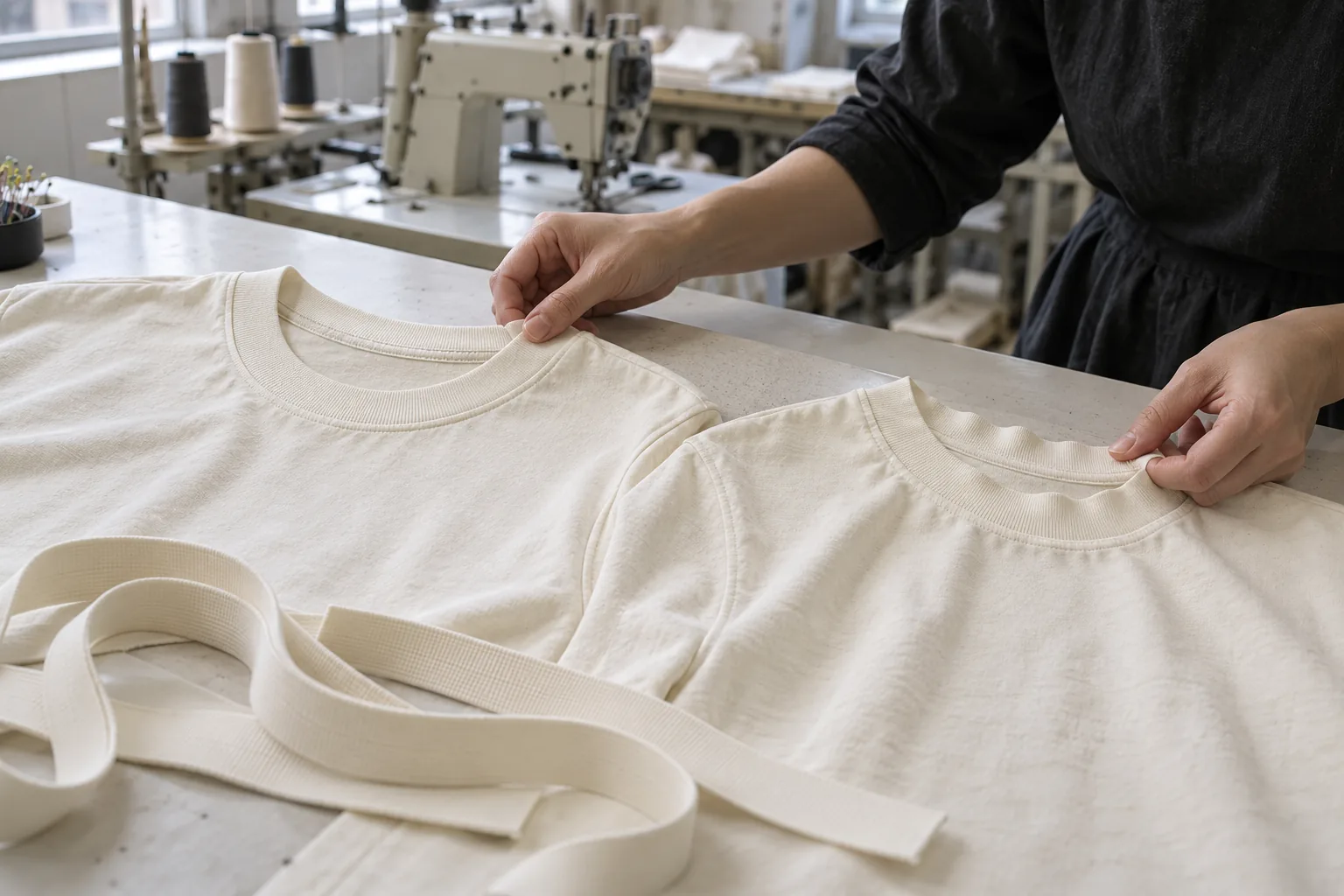
Request a neck assembly trial using the proposed body fabric, rib, seam construction, and finishing route. Compare its relaxed appearance before and after the agreed care process. Watch for a band that contracts more than the body, a neckline that grows, or uneven behavior around the front curve.
Record material references against the trial. If the approved rib is unavailable later, a visually similar replacement needs review. Matching color and width alone does not establish equivalent stretch or recovery.
Gate three: test the garment without hiding the result
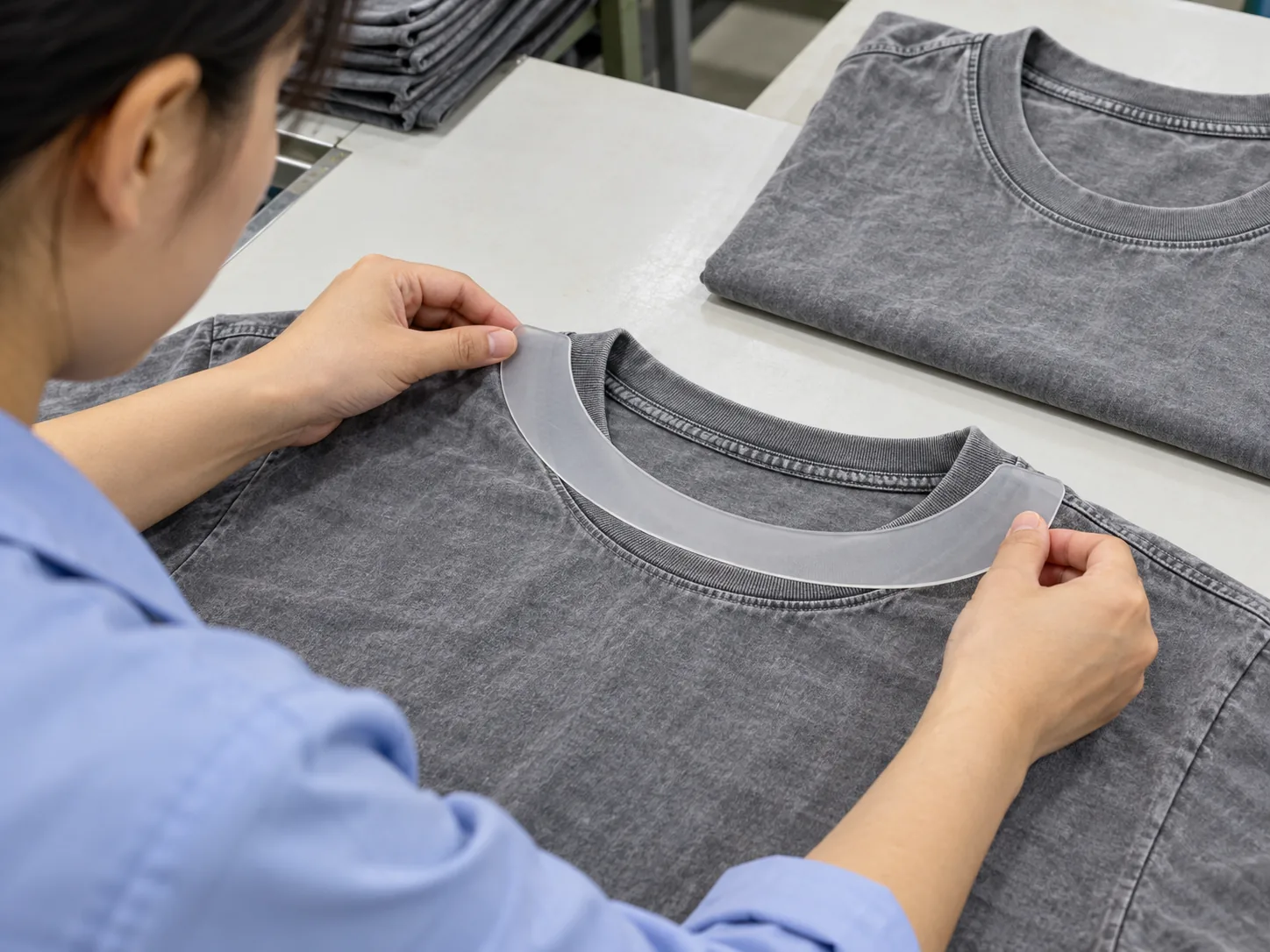
Use a simple written procedure that the buyer and sample room can repeat. Establish the initial condition after an agreed relaxation period. Measure on a flat surface without pulling the opening into shape, and photograph the neckline from consistent positions.
- Capture the baseline: identify the sample, size, materials, measurement points, and initial appearance.
- Apply the agreed challenge: complete the specified extension repetitions and care cycles using the documented method.
- Allow the agreed rest: avoid corrective pressing or manual reshaping unless it is explicitly part of the procedure.
- Compare and decide: review residual growth, waviness, seam behavior, and dressing comfort against the acceptance criteria.
Separate recovery from shrinkage in the comments. A neck opening that becomes smaller after laundering has not necessarily demonstrated good recovery; it may now be uncomfortable. Likewise, a flat measurement can look acceptable while a twisted seam or flared front edge fails the appearance requirement. Review both measurements and photographs.
Gate four: issue a release that production can follow
Approval should identify the exact sample and the conditions it passed. “Looks good” in a message leaves too much room for interpretation. State whether approval covers appearance only, tested performance, or permission to begin bulk production. Name the person responsible for the release.
Keep the approved material references, neckband cut dimensions, attachment method, seam settings, and finishing instructions together. These are controlled development decisions, not universal recipes. Copying a band-to-neckline ratio from an unrelated tee can create a different tension balance and a different result.
If a change is required, write a narrow correction: for example, reduce front-edge waviness while maintaining the agreed opening and dressing comfort. Ask for a revised sample and repeat the affected checks. A correction that improves appearance may alter stretch behavior, so approval must follow the revised construction.
The bulk QC gate: catch drift before packing
The approved sample is a reference for production checks, not proof that every garment will match. Before packing, inspect against the agreed sampling plan and acceptance rules. Set aside units selected for washing or extension trials so their results remain traceable to the production batch.
- Confirm that rib and body fabric match the released material references.
- Check opening dimensions and band width without stretching the garment during measurement.
- Inspect the front curve, shoulder transitions, and back neck for ripples, twisting, or uneven attachment.
- Look for broken stitches or restricted stretch at the neck seam.
- Repeat agreed performance checks on selected production garments and record the results.
- Hold affected goods when results fail the agreed criteria, then define correction and reinspection.
Include relevant sizes and material batches in the plan. An approved middle size does not automatically resolve a tight opening in the smallest size. If a production check fails, investigate material variation, cutting, sewing tension, and finishing before choosing a correction.
Put measurement points and tolerances on the approval sheet
Define neck width as a straight-line measurement between the specified left and right neck seam points with the garment laid flat and relaxed. Define front neck drop separately, using a diagram to show the reference line between the high shoulder points and the center-front neck seam. Measure finished band width from the attachment seam to the folded edge at center front, center back, and both shoulders. Specify whether each measurement includes the band; otherwise, two inspectors can report different results from the same garment.
Set dimensional tolerances independently from recovery limits. For a development discussion, a buyer might propose a neck-width tolerance of plus or minus 0.5 cm and a finished-band-width tolerance of plus or minus 0.2 cm. These are illustrative starting points, not universal limits or StitchQuote specifications. Confirm that the selected construction and measurement method can support them, and review whether the smallest size needs a different acceptance limit for dressing comfort.
Use a separate record for each challenge. If a relaxed neck width starts at 18.0 cm and measures 18.6 cm after the agreed extension and rest, residual growth is 0.6 cm, or approximately 3.3 percent: divide the change by the original measurement and multiply by 100. That calculation describes this width measurement, not the full opening circumference. Decide the acceptable percentage before testing. Record a new baseline for a separate wash trial so that laundering changes are not confused with extension recovery.
Connect fabric selection to order cost and repeatability
Request body and rib specifications separately: fiber composition, knit structure, finished GSM, usable width, color reference, and finishing route. GSM means grams per square meter; it describes fabric mass, not recovery performance. A hypothetical 220 GSM jersey body paired with a 280 GSM rib still needs a sewn trial. Rib thickness, extension force, and dimensional change can make that combination unsuitable even when both fabrics feel substantial.
For a worked planning example, consider 100 crewneck T-shirts in one style, with a proposed split of 20 small, 40 medium, and 40 large. Submit the size breakdown with the enquiry and confirm any color or material minimums separately. Prepare the first trial in the base size, then check the smallest opening for dressing comfort and the largest for appearance. Identify the body and rib batches on the approval record, and reserve production garments for the agreed destructive or wash checks before calculating the quantity available to pack.
Compare quotations using the same construction and inspection scope. Custom-dyed rib, additional color matching, a special neck finish, extra sample revisions, and repeated wash trials can each affect cost or lead time. Ask which activities are included and which require a separate allowance. A lower fabric rate is not necessarily a lower finished-garment cost if the usable width increases cutting waste or a difficult rib requires slower attachment and more rework.
Build approval time into the order decision
Keep sample availability separate from performance approval. StitchQuote offers a 7-day sample for standard styles with confirmed specifications and available materials; complex styles, custom washes, and custom-developed fabrics take longer. Repeated care checks and revisions also need space in the buyer’s approval calendar.
For most categories, StitchQuote’s MOQ starts from 50 pieces per style. A smaller run still benefits from a documented neckline release because a defect repeated across one style affects the whole launch. StitchQuote services include sampling, fabric and trim sourcing, cut-and-sew, private label, branding, and QC before packing. Confirm the specific neck testing procedure and acceptance criteria for your project before relying on them as release conditions.
Questions buyers ask before signing off
Can a photograph close the performance gate?
A photograph can support appearance approval, but it cannot establish recovery after extension or care. Pair images with the test conditions and recorded results, and arrange a physical review when comfort remains uncertain.
Does adding elastane automatically solve a loose neckline?
No. Elastane can contribute to recovery, but knit structure, processing, neckband dimensions, and attachment all matter. Evaluate the finished assembly before accepting a composition change as the solution.
Must every color repeat the entire approval process?
Agree on a risk-based plan. Differences in dyeing or finishing can affect behavior. Use the material and processing information to decide which colors need additional validation, rather than assuming one color represents all others.
What should happen when the sample passes but bulk fails?
Keep the affected goods on hold, compare production inputs and settings with the approved record, and agree on corrective action. Release should follow acceptable reinspection results under the documented criteria.
Related reading and project support
- Prepare a tech pack with clear approval requirements
- Review sampling and minimum order planning
- Discuss your neckline specifications with StitchQuote
Request a manufacturing quote
Share your product type, quantity range, and destination. We usually reply within one business day.