Custom Streetwear, Casualwear & Denim Manufacturer•MOQ 50 pcs•Denim MOQ 100 pcs•7-Day Sample Available

Why Denim Sampling Needs More Technical Review Than Standard Knitwear
Learn denim sampling technical review through a clearer factory-side view that helps brands reduce rework, align sample goals, and move toward approval with better.

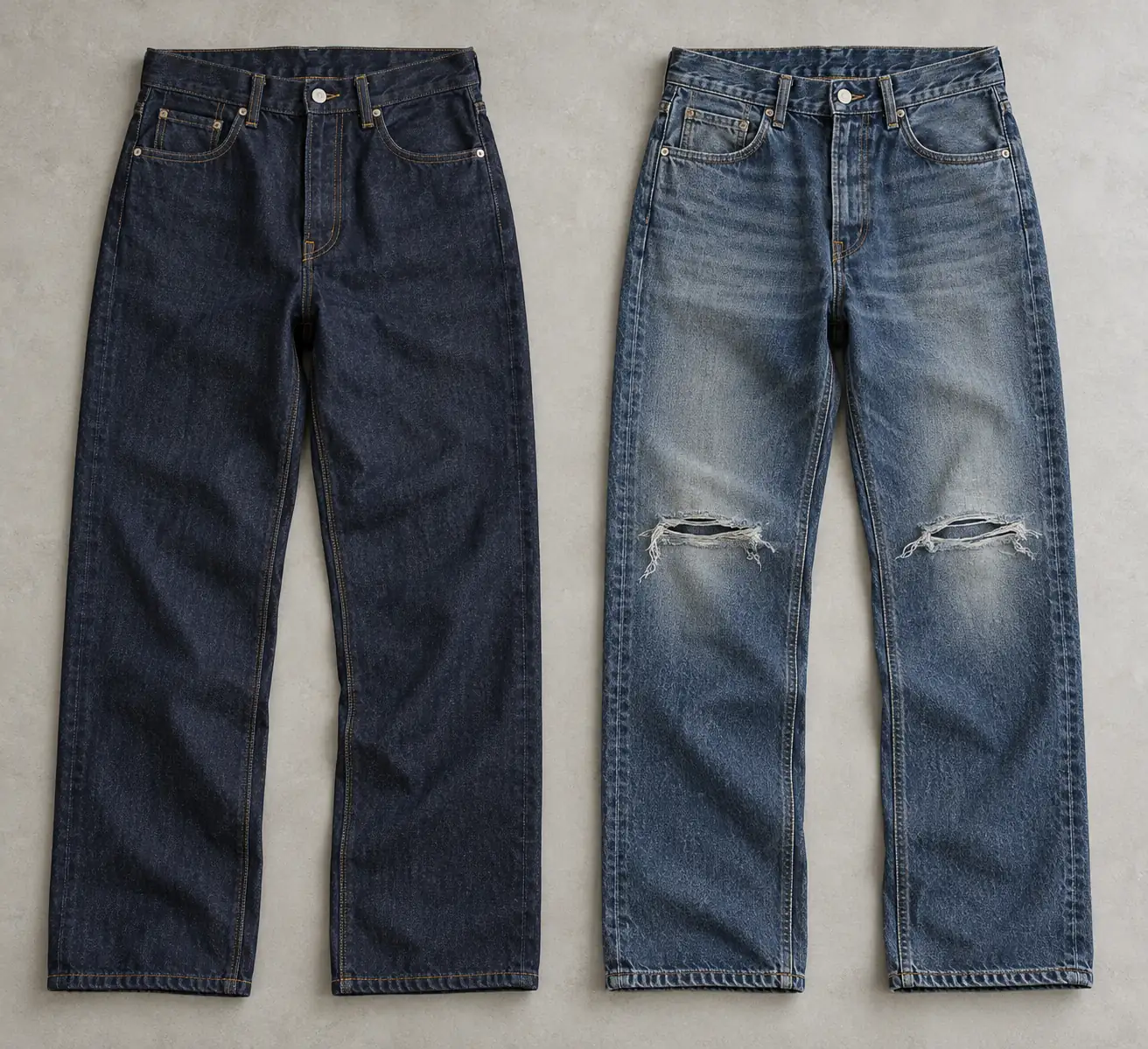
A clean dark jean and a heavily distressed jean may begin with similar patterns, yet they need different approval evidence. For a brand buyer choosing between those directions, a good-looking sample is only the starting point. The review must establish what finishing changed, which details can vary, and whether the garment still performs as intended.
Compared with a straightforward jersey T-shirt, denim often puts more of the final result into garment finishing: shade, abrasion, dimensional change, and the condition of seams can interact. Knitwear also needs technical checks, especially with special treatments. The extra challenge here is deciding how much change the denim design invites—and where that change must stop.
Choose the wear story before choosing the damage
“Clean” does not necessarily mean untreated. A rinsed straight-leg jean can look restrained while still depending on washing for its final hand and dimensions. “Distressed” can mean anything from softened pocket edges to open knee holes. Those are different development briefs, even when a mood board places them together.
For a minimal five-pocket jean, define the intended uniformity of the face, seam shading, and acceptable creasing. For a worn-in skate jean, separate color fading from actual yarn removal. A pale knee patch and an open knee require different controls; one changes appearance, while the other also changes coverage and local strength.
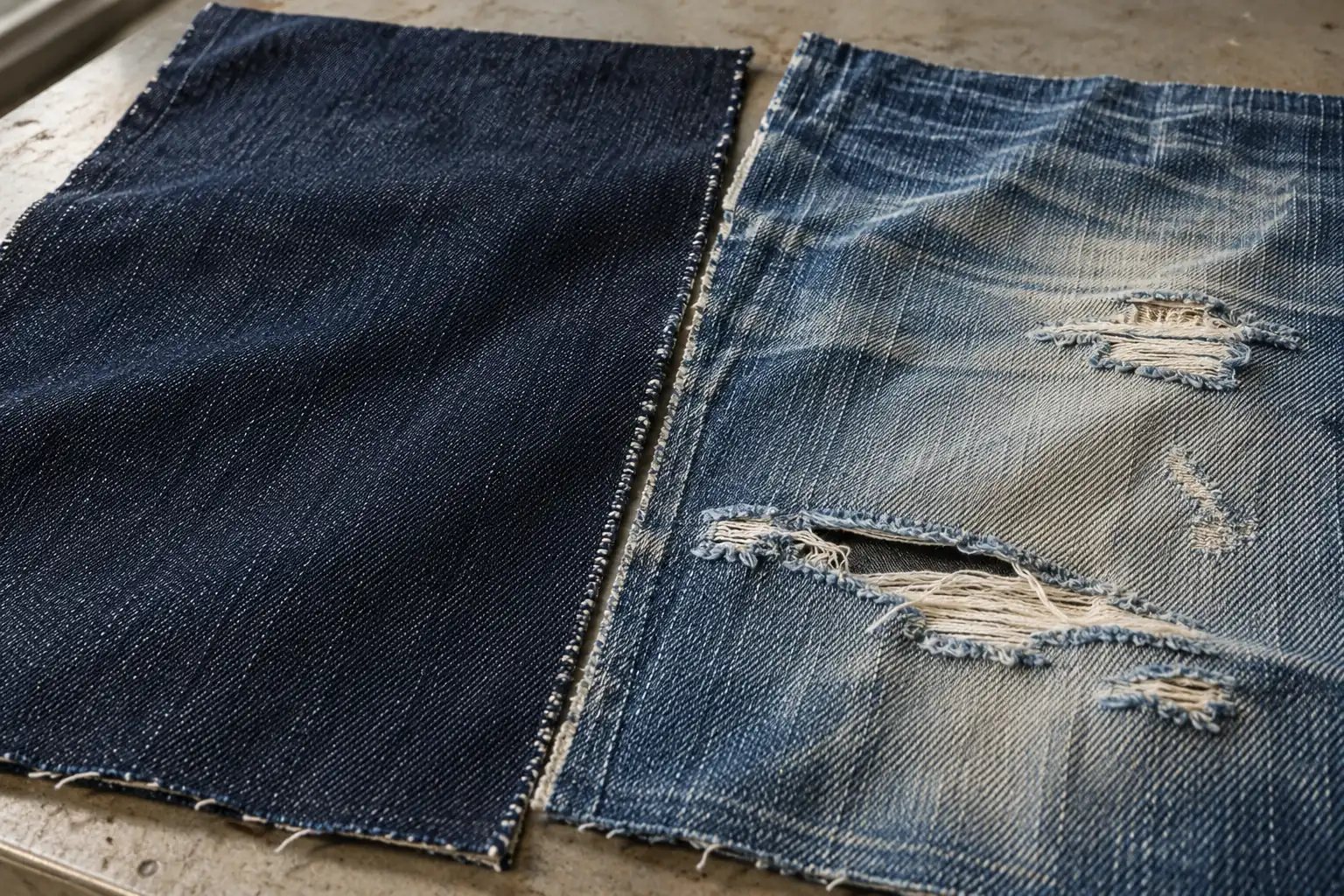
Make this choice before approving a finish direction. Otherwise, a request for “more vintage” can quietly turn a clean product into a damaged one without anyone revisiting durability expectations.
Build two approval standards from one silhouette
If a range includes both clean and distressed versions of the same jean, give each version its own finish reference. Sharing a silhouette does not prove that the finished measurements or fabric condition will match. Use the same measurement method, but evaluate each treatment independently.
| Review point | Clean version | Distressed version |
|---|---|---|
| Surface appearance | Define shade consistency and permitted seam contrast. | Map fading, abrasion, and openings separately. |
| Finished fit | Check dimensions after the intended rinse or wash. | Check dimensions and distortion around treated areas. |
| Fabric integrity | Look for unintended scuffing or weakened edges. | Define where damage ends and intact fabric must remain. |
| Variation | Set acceptable shade and crease boundaries. | Set boundaries for placement, hole size, and exposed yarns. |
Do not describe the distressed option as simply “the clean sample with holes.” The finishing sequence may affect both its shade and its shape. Record fabric identity and finish version so comments remain attached to the correct development route.
Place distressing on a body, not just a flat photograph
A knee opening can look balanced on a table and sit too high when worn. Check it on the intended fit body in standing and seated positions. Record its location from repeatable garment landmarks, such as the inseam junction or hem, rather than from a temporary fold.
Consider a relaxed jean with a narrow horizontal slit. When the wearer bends, that slit may open much wider than the flat sample suggests. Review the maximum intended exposure, the surrounding intact fabric, and whether remaining crosswise yarns are decorative or expected to stay in place during use.
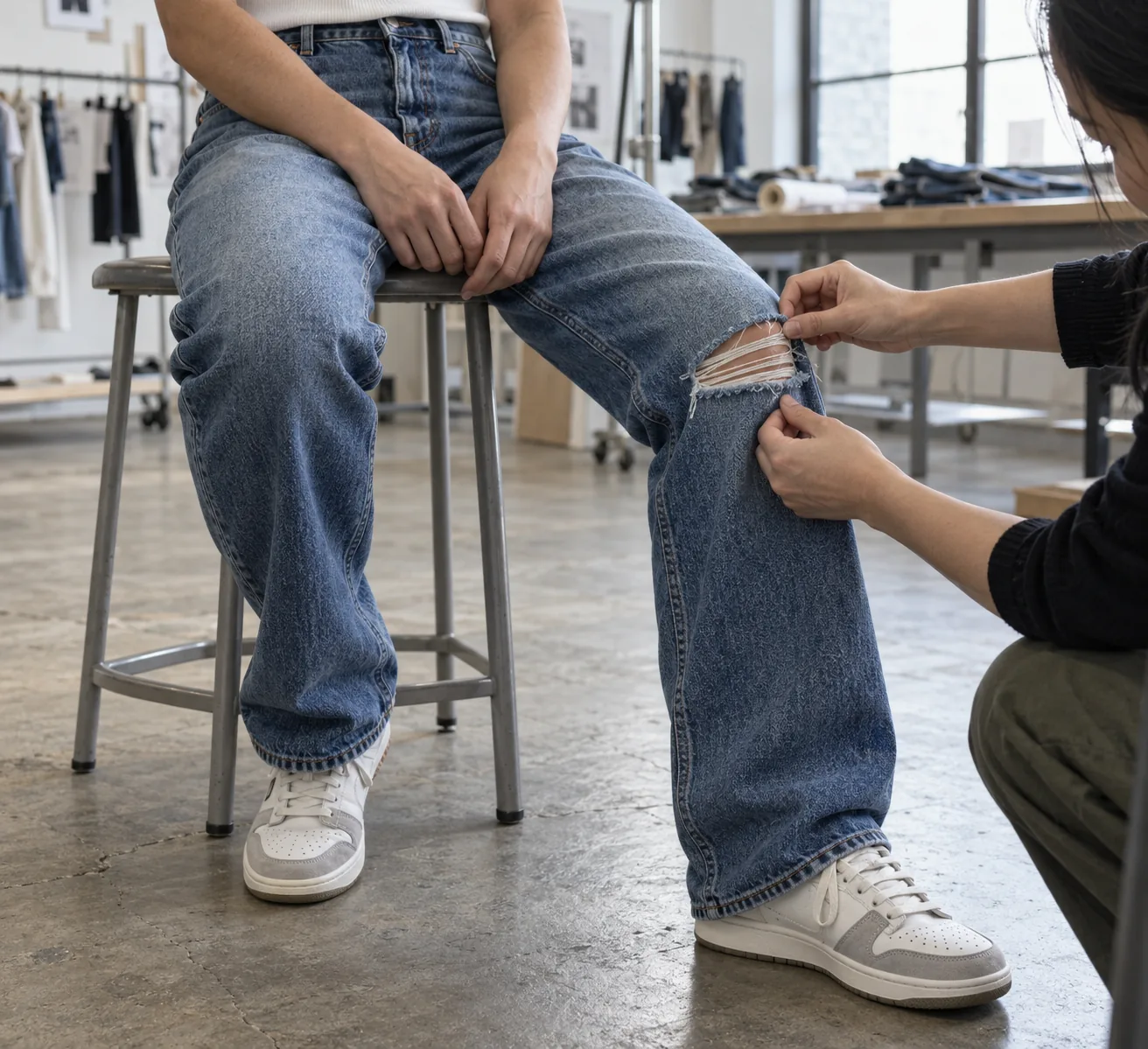
Ask how placement will translate across sizes. A fixed distance from the hem may not preserve the intended knee position throughout a size range. Agree on placement rules and confirm representative sizes where the proportions change noticeably.
Read clean denim for defects that texture can conceal
Clean denim leaves fewer visual distractions. Uneven shade, an unexpected pale seam, or a twisted leg may stand out more strongly on a uniform dark surface than on an intentionally faded one. Inspect front and back under consistent lighting, then compare the garment with the agreed physical shade reference.
Review the actual finished sample for leg alignment, waistband shape, pocket symmetry, and seam puckering. Record measurements after consistent conditioning rather than comparing a freshly processed garment with one that has rested under different conditions. Agree on measurement tolerances before deciding whether a difference is acceptable.
A dark clean finish also deserves a discussion about color transfer and care. Ask which rubbing and laundering checks suit the intended use, and agree on acceptance criteria. A visually rich indigo sample does not, by itself, demonstrate satisfactory colorfastness.
Release the finish only when appearance and strength agree
For distressed denim, intentional damage needs a defined boundary. For clean denim, the same abrasion could be a reject. Give QC a version-specific checklist so inspectors can distinguish the design from an unintended defect.
- Reference control: identify the approved garment, fabric, finish revision, and dated comments.
- Dimensions: check agreed points after finishing, including any areas distorted by localized treatment.
- Damage boundaries: compare opening size, placement, fraying, and retained yarns with agreed limits.
- Construction: inspect belt loops, pocket corners, fly seams, and hems for unintended weakening.
- Use and care: assess movement and agreed laundering checks for hole growth, seam failure, shade change, and dimensional change.
- Repeatability: review additional finished examples where needed to judge whether variation stays within the accepted range.
Photograph both acceptable and unacceptable details when establishing limits. Images help explain a boundary, but retain a physical reference for shade and hand. Any durability testing method and pass criteria should be agreed for the project rather than inferred from the sample’s appearance.
Turn finished fit into a measurable approval sheet
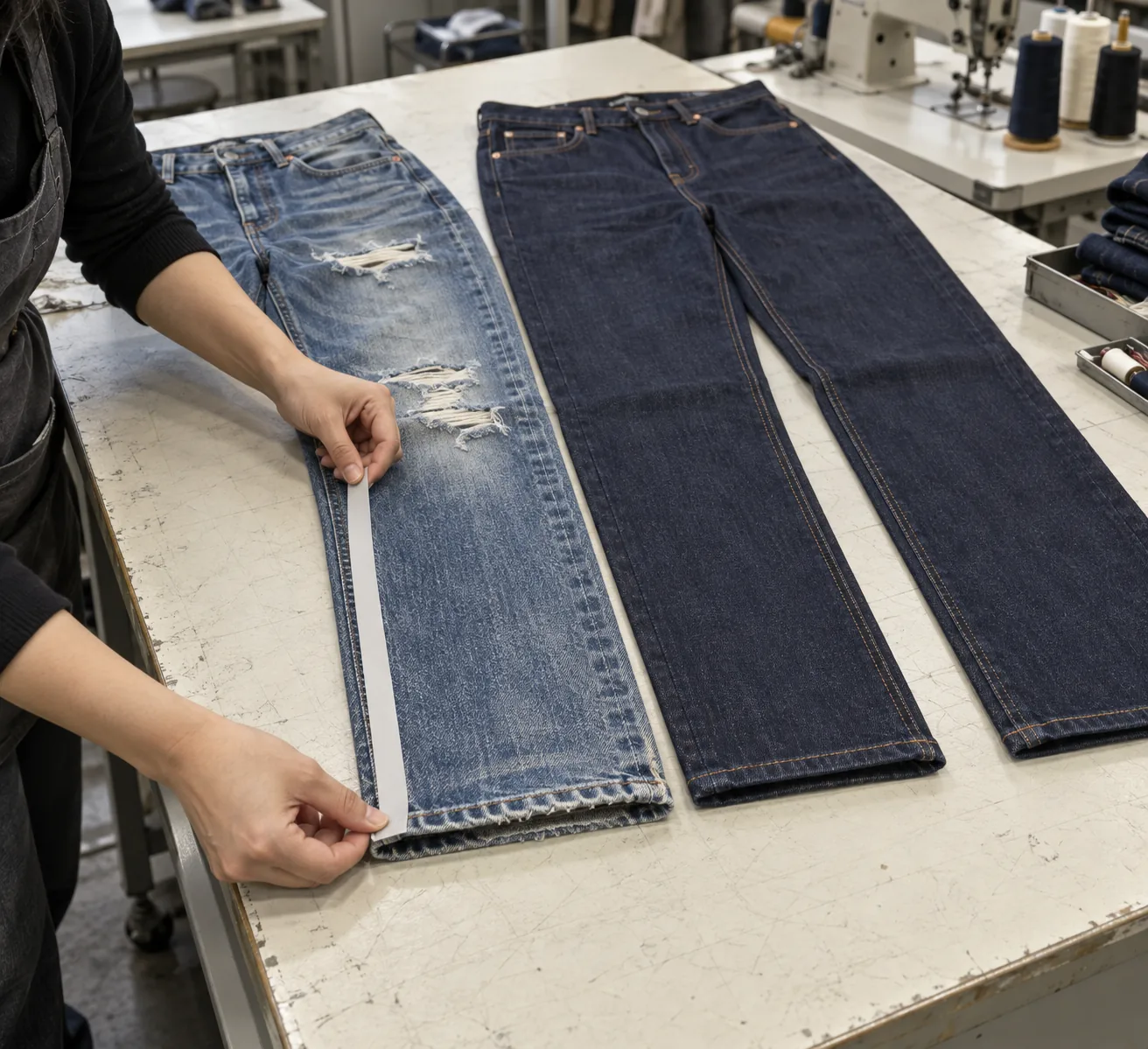
Define each measurement point with a sketch and a written method. For a flat half-waist measurement, close the waistband and state whether its curved top edge is aligned or measured in its natural position. Measure the inseam from the crotch seam intersection to the hem along the inner leg seam. Specify front rise along the rise seam, including or excluding the waistband explicitly. Locate thigh and knee widths at stated distances below the crotch; “thigh width” alone leaves room for inconsistent readings.
Assign a target and tolerance to each point instead of using one tolerance for the whole garment. As an illustrative buyer specification, a 40 cm flat half-waist might allow plus or minus 0.5 cm, while a 78 cm inseam might allow plus or minus 1 cm. These are proposed limits to discuss against the fabric and process, not StitchQuote production guarantees. A 0.5 cm deviation in a flat half-waist corresponds to approximately 1 cm around the waist, so distinguish flat measurements from circumference in every comment.
Measure the finished sample before and after the agreed care trial using the same method and resting conditions. If an inseam changes from 78 cm to 76.5 cm, the reduction is approximately 1.9 percent: divide the 1.5 cm loss by the original 78 cm. Record that result separately from the original finished-measurement tolerance. Passing the initial fit check does not establish acceptable behavior after laundering.
Specify the cloth and separate the finishing cost drivers
Include composition, fabric weight, weave, stretch direction, and supplier fabric reference in the development brief. Denim weight may be quoted in ounces per square yard or GSM; 12 oz per square yard is approximately 407 GSM. State whether the quoted weight describes the supplied cloth or a finished reference, because processing can change the relationship between area and weight. Equal GSM does not establish equal softness, stretch recovery, or resistance to tearing around an opening.
For stretch denim, assess recovery as well as initial stretch: check whether the seat and knees retain the intended shape after wear and rest. For rigid denim, review seated comfort and movement without assuming that a wash will provide the missing ease. Keep a labeled swatch with the approved garment so a later cloth substitution prompts a deliberate review of fit, shade, and distress behavior.
Ask the quotation to identify the work behind each finish: base washing, localized abrasion, opening placement, any reinforcement, and extra inspection. A restrained finish can still require careful shade control, while a distressed finish may add handling at each marked location. Compare versions using the same fabric, size breakdown, trims, branding, and packing requirements so the cost difference reflects the intended change. Before bulk release, reconcile the approved measurement sheet, wash reference, distress map, and quotation revision into one consistent production brief.
Budget sampling around the finish decision
Resolve the clean-versus-distressed direction before requesting repeated cosmetic revisions. If fit is still changing, identify which finish conclusions remain provisional: moving a knee line or changing leg width can invalidate earlier distress placement approval.
StitchQuote offers cut-and-sew, private label, sampling, fabric and trim sourcing, branding, and QC before packing. Denim starts from 100 pieces per style; most other categories start from 50. Confirm how separate finish versions affect the order plan. A 7-day sample is available for standard styles with confirmed specs and available materials; complex styles, custom washes, and custom-developed fabric take longer.
Questions buyers ask when comparing the two finishes
Can the clean sample approve fit for the distressed version?
It can establish a starting point. Confirm fit again after the distressed treatment because finishing and localized fabric removal can change dimensions, drape, or behavior in movement.
Should every distressed opening look identical?
Define an acceptable range instead of relying on “each piece is unique.” Specify the limits that matter, including location, exposure, and intact fabric near seams.
What if a knee hole grows after laundering?
Compare the result with the agreed care procedure and growth limits. If it exceeds them, revise the treatment or construction and reassess before approval.
Related reading and project support
- Prepare the technical brief
- Review sampling and order minimums
- Follow the denim wash approval process
- Discuss your denim project with StitchQuote
Request a manufacturing quote
Share your product type, quantity range, and destination. We usually reply within one business day.