Custom Streetwear, Casualwear & Denim Manufacturer•MOQ 50 pcs•Denim MOQ 100 pcs•7-Day Sample Available

Heavyweight Hoodie Manufacturer for Private Label Brands: What Buyers Should Compare
Compare heavyweight hoodie manufacturers for private label brands across fabric body, fit control, rib quality, decoration execution, and bulk consistency.

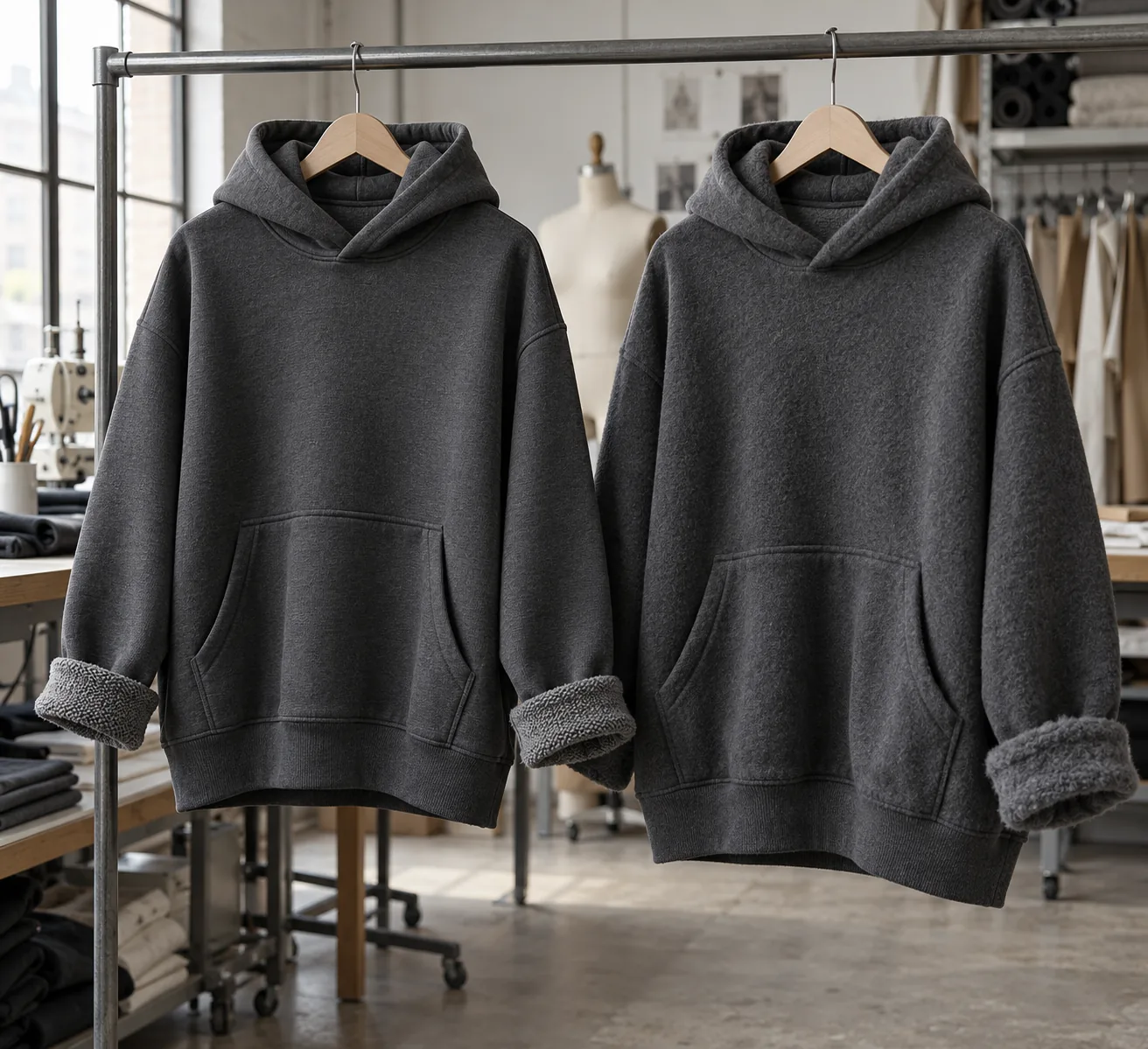
Two hoodies can carry the same fabric weight and deliver very different products. One has a dry, looped interior and a compact drape; the other feels soft and insulated because its reverse has been brushed. For a private label buyer comparing a heavyweight hoodie manufacturer, that difference should shape the sample request before supplier quotes become the deciding factor.
French terry versus fleece is a construction and finishing decision, not simply a choice between summer and winter. Compare both against the same intended fit, care routine, decoration and selling proposition. The useful question is which fabric keeps the promised experience after sewing, washing and wear—and which supplier can document that result clearly enough to repeat it.
Start with the inside surface your customer will wear
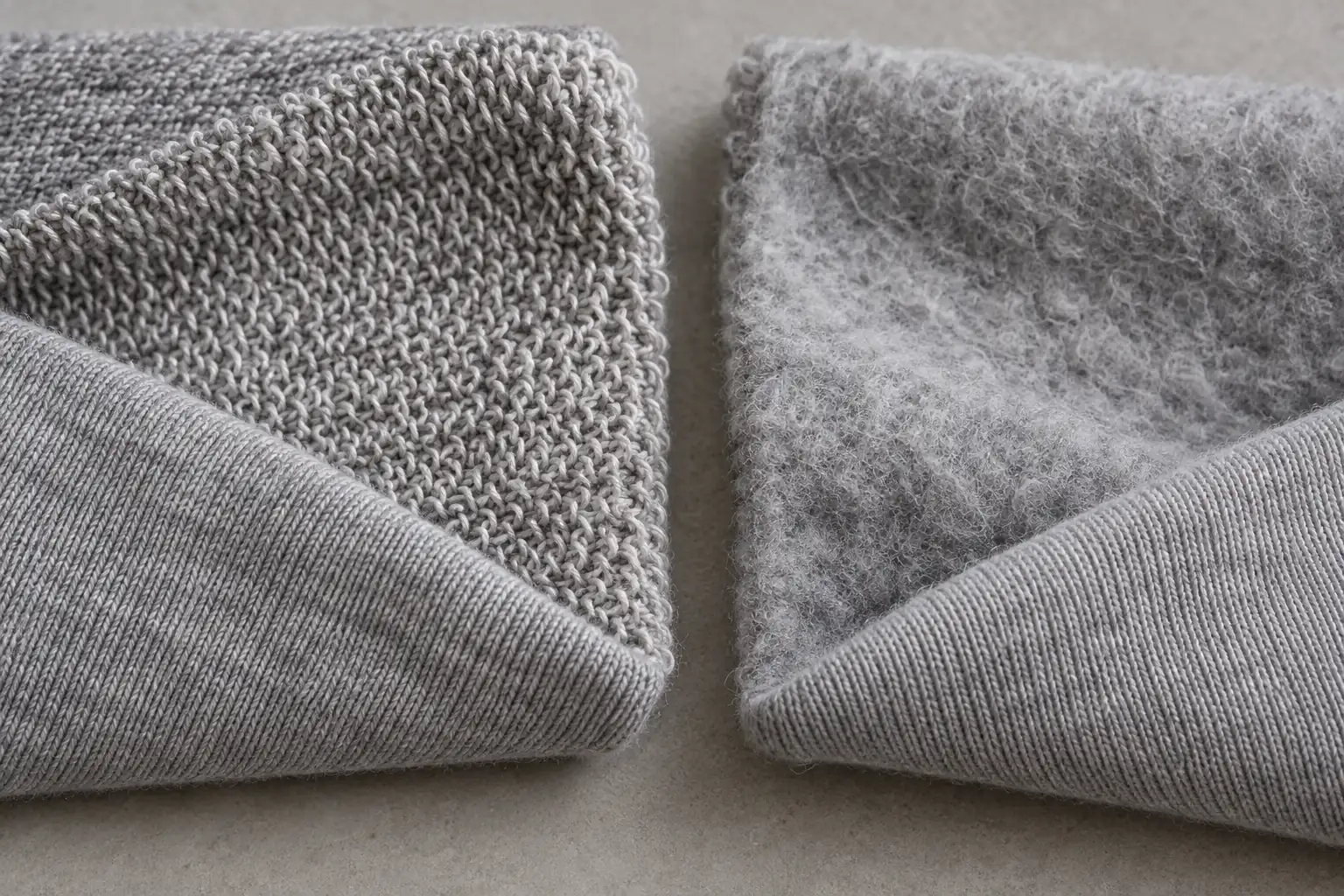
French terry has visible loops on its reverse. Sweatshirt fleece generally uses a knitted base whose reverse is brushed to raise fibers into a soft pile. Both can have a smooth outer face, and both can be heavy. Ask suppliers to identify the actual construction rather than relying on terms such as “premium cotton” or “winter quality.” Those descriptions do not define the interior.
For a commuter hoodie worn under a jacket, dense loopback may provide the substantial hand you want without a highly raised interior. For a relaxed hoodie intended for cool indoor spaces, brushed fleece may better match expectations of immediate softness. Neither outcome follows from the fabric name alone: yarn, knit density, composition and finishing all influence comfort and bulk.
Request face-and-reverse swatches large enough to fold, stretch and rub against an undershirt. Record whether the reverse catches, sheds or feels slick. If softness is central to the product promise, evaluate it after laundering as well as on arrival; the first touch can reflect a finishing treatment that changes with care.
Make equal-weight comparisons genuinely comparable
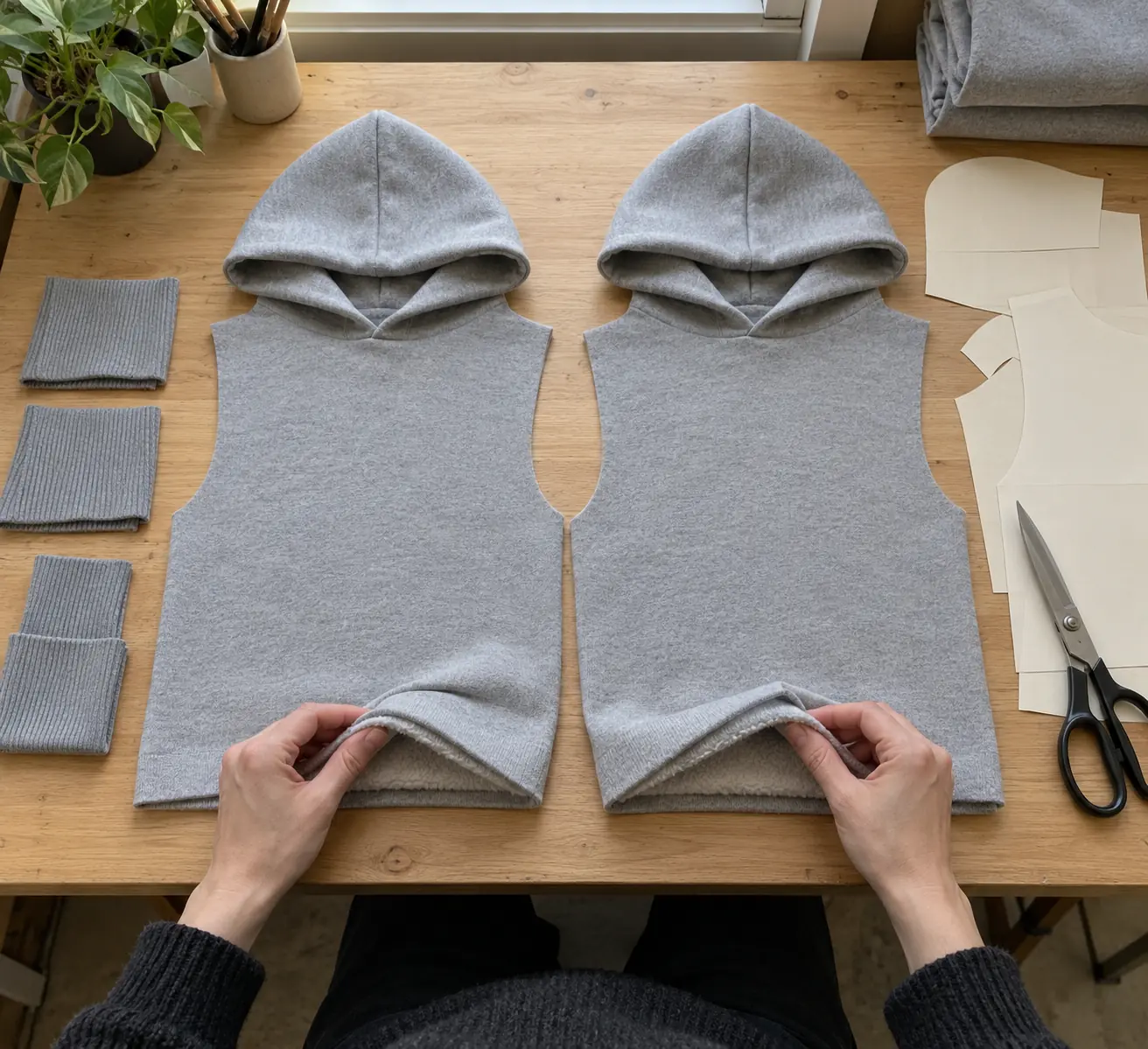
A 420 GSM loopback and a 420 GSM brushed fleece are a useful starting pair, but equal mass per square meter does not mean equal thickness or warmth. Raised fibers can trap air, while a tightly knitted loopback may feel heavier in the hand because it is more compact. Treat 420 GSM here as an illustrative development target, not a universal definition of heavyweight.
Specify whether quoted GSM describes fabric before or after finishing. Brushing, washing and dimensional relaxation can change the measured result. Compare conditioned samples using the same measurement method and agree an acceptance band with the supplier. For example, a proposed finished-weight tolerance of ±5% needs project approval; it should not silently become the factory’s obligation.
| Comparison point | French terry candidate | Brushed fleece candidate |
|---|---|---|
| Reverse specification | Loop size, density and snag tendency | Pile height, brushing consistency and shedding |
| Composition detail | Overall blend and face yarn where available | Overall blend plus face and backing yarn details |
| After-care assessment | Loop condition, twist and dimensional change | Matting, lint transfer and dimensional change |
| Garment behavior | Drape, hood collapse and seam bulk | Loft, hood volume and compressed seam thickness |
Use the same color where possible. A pale swatch can conceal loose fibers that become obvious on a dark garment. If one candidate uses a different blend or finishing route, record that difference explicitly instead of attributing every result to terry versus fleece.
Use one silhouette to expose construction differences
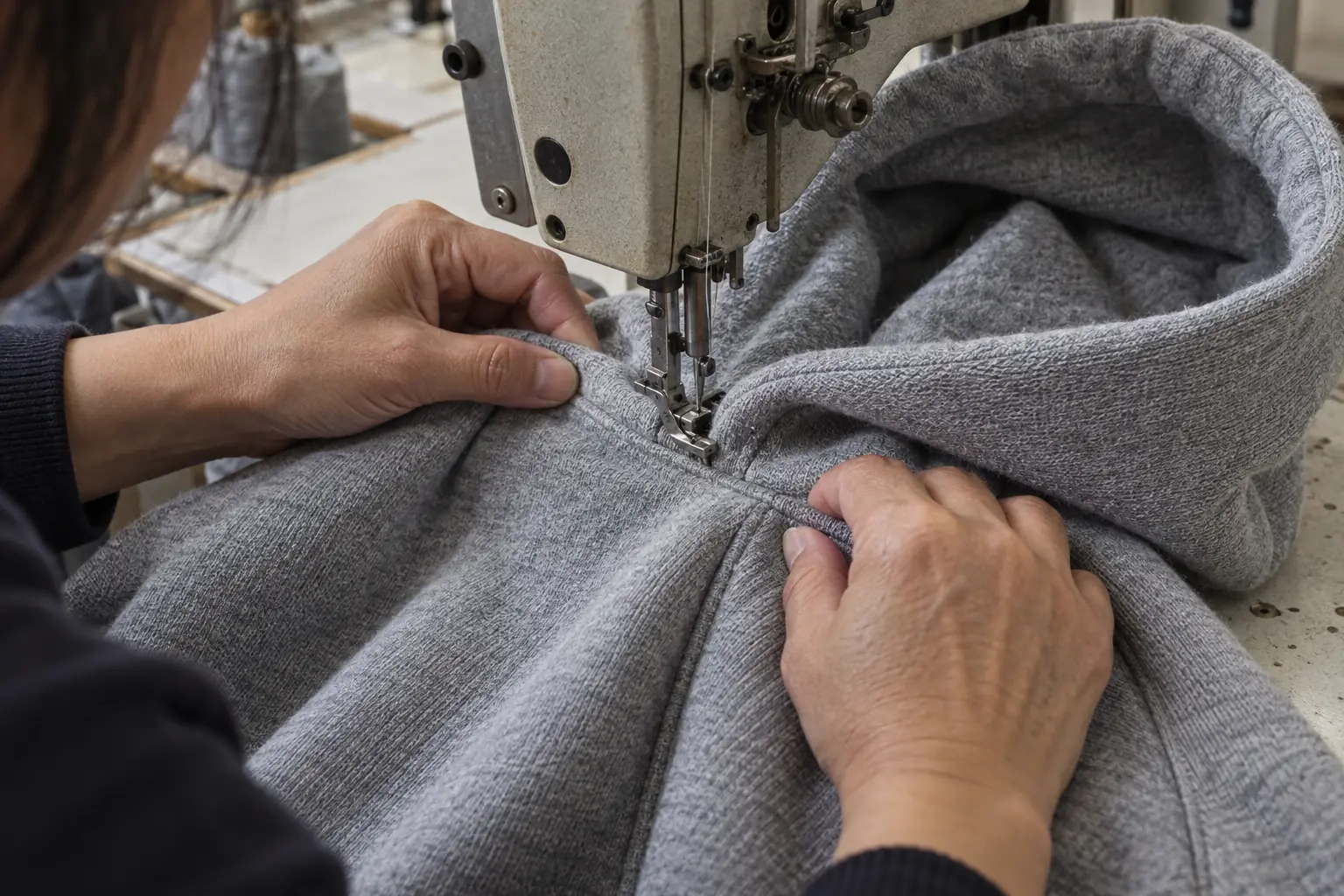
Develop a matched sample pair using one measurement specification, the same hood construction and equivalent rib. A dropped-shoulder pullover with a double-layer hood is a revealing example: terry may fold close to the neck, while lofty fleece may push the hood outward. That difference can change the side profile even when the flat measurements match.
Ask the sample room to flag any adjustments needed for assembly. At the hood-to-neck join, overlapping seam allowances can create a rigid ridge. At pocket corners, multiple layers may produce skipped stitches or uneven feeding. The answer may involve seam construction, machine setup or a revised detail; it should not be an undocumented change to the approved pattern.
Check rib performance separately. A heavy body fabric can pull a weak waistband out of shape, while excessive rib contraction can make the hem balloon. Record relaxed cuff and hem openings, rib composition, attachment ratio and recovery expectations. Photograph both samples hanging and worn in the same size before choosing the fabric direction.
Approve the surface your branding actually needs
Printing happens on the face, so the reverse construction alone cannot establish print suitability. A compact, even face can support a cleaner edge than a hairy or irregular surface. Give the supplier the actual artwork dimensions, placement and intended print process; a small chest graphic does not test the same handling demands as a large back print.
Run the proposed decoration on the selected fabric and evaluate it through the intended care cycle. Look for distortion, cracking, unwanted show-through and changes in hand. For embroidery, inspect puckering and stiffness around the design, including how backing feels against the wearer. Fleece loft may compress beneath stitching, altering the appearance around dense embroidered areas.
Branding approvals should include woven-label placement and skin contact. A neck label sewn across a thick hood seam can create an uncomfortable stack. Keep a decorated, washed reference sample alongside the clean approval sample so bulk inspection has evidence of both the intended appearance and expected after-care behavior.
Build a wash-and-wear QC gate before bulk approval
The strongest comparison is a repeatable check, not a vote on which fresh sample feels nicer. Agree the wash temperature, drying method and number of cycles before testing. Measure garments after the same resting period, laid flat without stretching. Keep pre-wash measurements so shrinkage and growth can be calculated rather than estimated from photographs.
- Dimensional stability: Record chest width, body length, sleeve length and hood opening before and after care. Calculate change as the measurement difference divided by the original measurement, multiplied by 100.
- Shape retention: Inspect side-seam rotation, pocket alignment and hem balance. Distinguish a cutting or sewing issue from fabric distortion by examining both sample candidates.
- Interior durability: Check terry for pulled loops and fleece for matting, loose lint and uneven pile. Use an agreed assessment method for pilling rather than treating hand rubbing as a formal test.
- Assembly quality: Stretch seam junctions gently to reveal broken stitches or openings. Inspect the neckline, underarms, pocket corners and cuff joins for inconsistent stitching.
- Acceptance records: Attach measured results, photographs and agreed limits to the approval. A proposed ±1 cm tolerance for a named flat measurement is an example for discussion, not an appropriate limit for every dimension.
Ask how production fabric and finished garments will be checked against the references. StitchQuote provides QC before packing; buyers should still confirm the inspection scope, sampling approach and handling of nonconforming pieces for their project. A signed sample is most useful when its measurable requirements are also written down.
Request a quote that preserves the fabric decision
Once one candidate wins, issue a single specification covering construction, composition, finished GSM, color, reverse finish, rib, measurements, decoration and care expectations. Request that alternatives be identified separately. Otherwise, a lower quote may quietly introduce a different backing yarn or lighter brushing that changes the approved wearing experience.
StitchQuote offers cut-and-sew, private label, sampling, fabric and trim sourcing, and branding through woven labels, prints and embroidery. MOQ for most categories starts from 50 pieces per style. Confirm how your selected fabric, colors and size breakdown affect the hoodie order; a style-level minimum does not establish every material’s availability.
A 7-day sample is available for standard styles with confirmed specifications and available materials. Complex styles and custom-developed fabrics take longer. If your comparison requires sourcing two unusual fabric constructions, establish availability first and agree the sampling schedule around those inputs.
Questions buyers ask when choosing between loops and pile
Can French terry deliver a convincing winter hoodie?
It can deliver substantial weight and structure, but weight alone does not establish insulation. Assess the finished garment in its intended layering context. If warmth is a specific performance claim, agree an appropriate test rather than inferring it from GSM.
Does a brushed reverse guarantee lint problems?
No. Yarn and finishing quality matter. Examine the actual candidate after washing and check transfer onto a contrasting base layer. Agree what is acceptable before ordering; a generic fleece swatch cannot validate a different production fabric.
Can the same pattern serve both fabric options?
It can start the comparison, but each option needs garment validation. Thickness, stretch and shrinkage may require different allowances or construction details. Keep separate approved specifications if both versions enter production.
Should every reorder repeat the full comparison?
Retain the selected reference and verify new material against it. Revisit development when construction, yarn blend or finishing changes. Even an unchanged fabric name should not replace a check of the incoming lot.
Related reading and project support
- Prepare a tech pack for your approved hoodie
- Review sampling and MOQ planning
- Understand hoodie GSM and fabric weight
- Discuss your fabric comparison with StitchQuote
Request a manufacturing quote
Share your product type, quantity range, and destination. We usually reply within one business day.