Custom Streetwear, Casualwear & Denim Manufacturer•MOQ 50 pcs•Denim MOQ 100 pcs•7-Day Sample Available

How to Approve Denim Measurements After Washing
Learn approve denim measurements after washing through a clearer factory-side view that helps brands reduce rework, align sample goals, and move toward approval with.

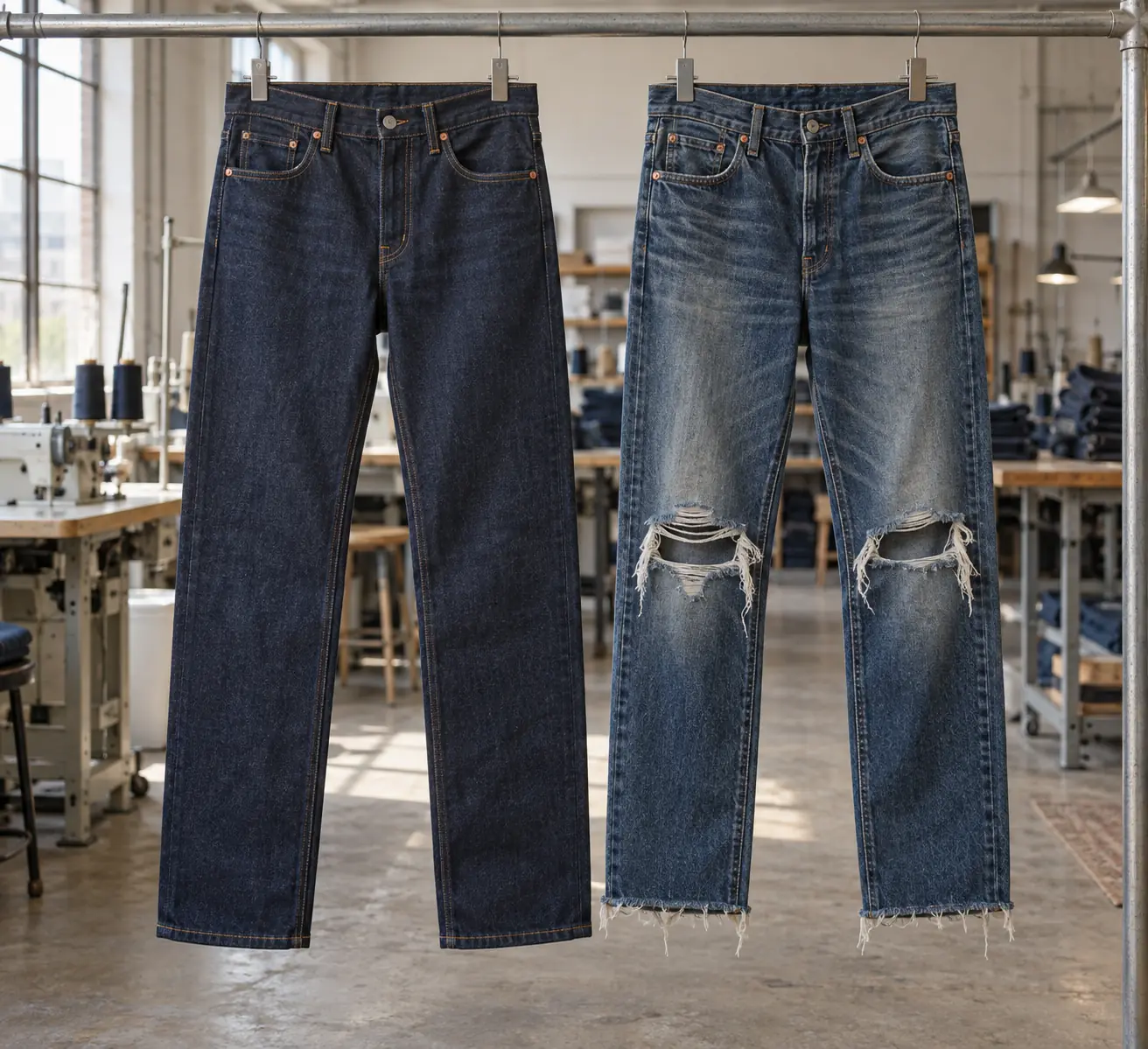
A clean rinse and a heavily distressed finish can start from the same denim pattern yet require different measurement decisions after washing. A clean leg gives the inspector a continuous surface to align; a torn knee or frayed hem introduces edges that can move, stretch, or disappear. Approving both against an undefined measuring method can hide a fit problem or reject an intentional design feature.
For a brand buyer reviewing washed samples, the useful question is whether each finish preserves the intended fit and its own approved appearance. Establish shared body dimensions, then define separate rules for damaged areas. This lets you approve a clean and distressed version as related products without pretending their finishing risks are identical.
Separate the fit envelope from the distress map
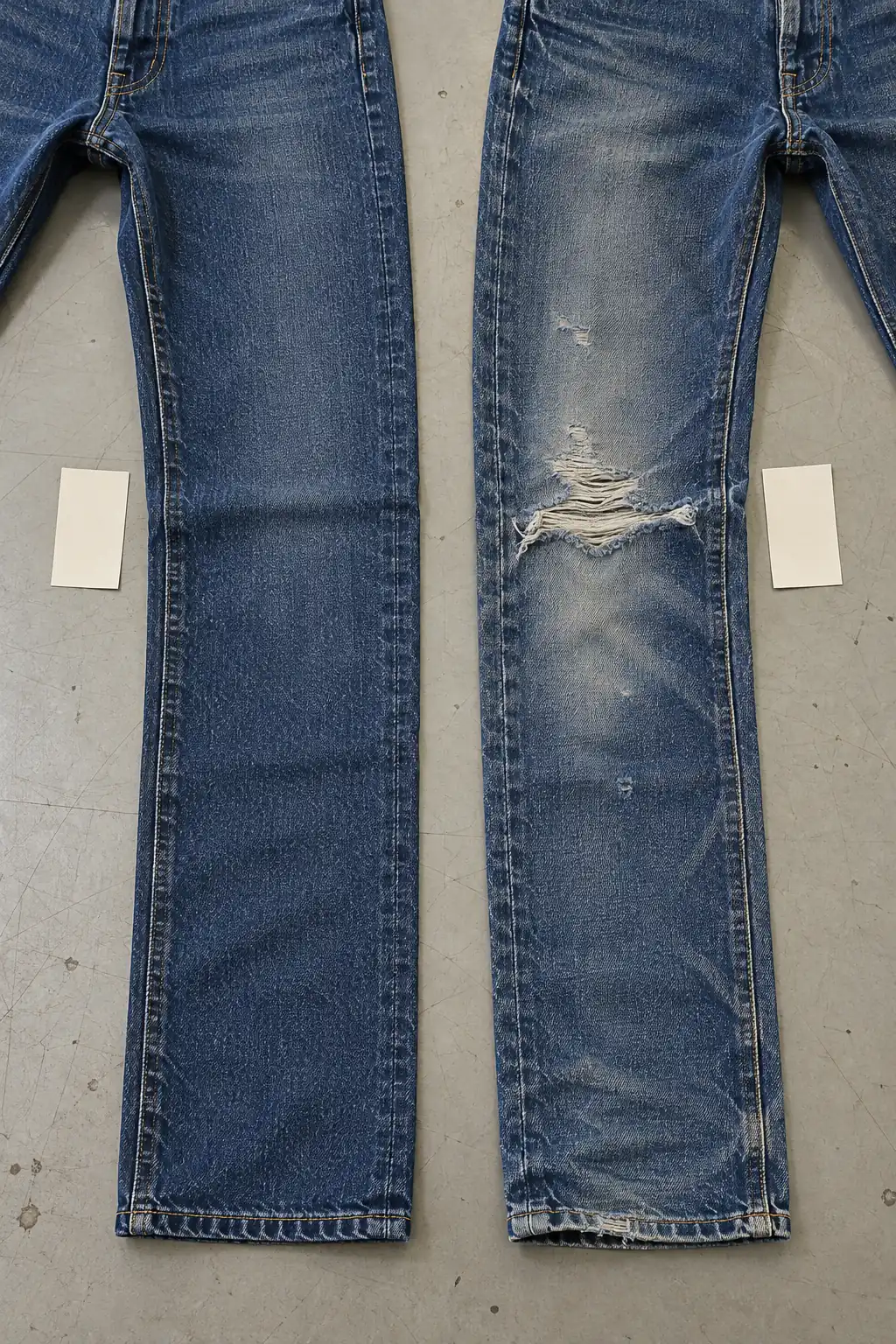
Start with two documents: a finished-garment measurement sheet and a distress placement map. The measurement sheet controls dimensions such as waistband, hip, thigh, rise, inseam, and leg opening. The map controls abrasion zones, hole boundaries, retained threads, and frayed edges. A pair can pass one document and fail the other: correct knee placement does not excuse a tight thigh, and correct thigh width does not excuse a hole extending into the side seam.
For clean denim, specify which seams and finished edges anchor each measurement. For distressed denim, retain those anchors wherever possible. Locate a knee opening from a stable reference, such as the crotch intersection down the inseam, and record its position relative to the side seam. Do not use the moving tip of a torn thread as a landmark.
Distress maps should identify protected zones around pocket corners, belt-loop attachments, the fly, and structural seams. Set their boundaries for the actual construction. There is no universal safe clearance that covers every fabric weight, tear shape, and reinforcement method.
Make the measuring condition part of the approval
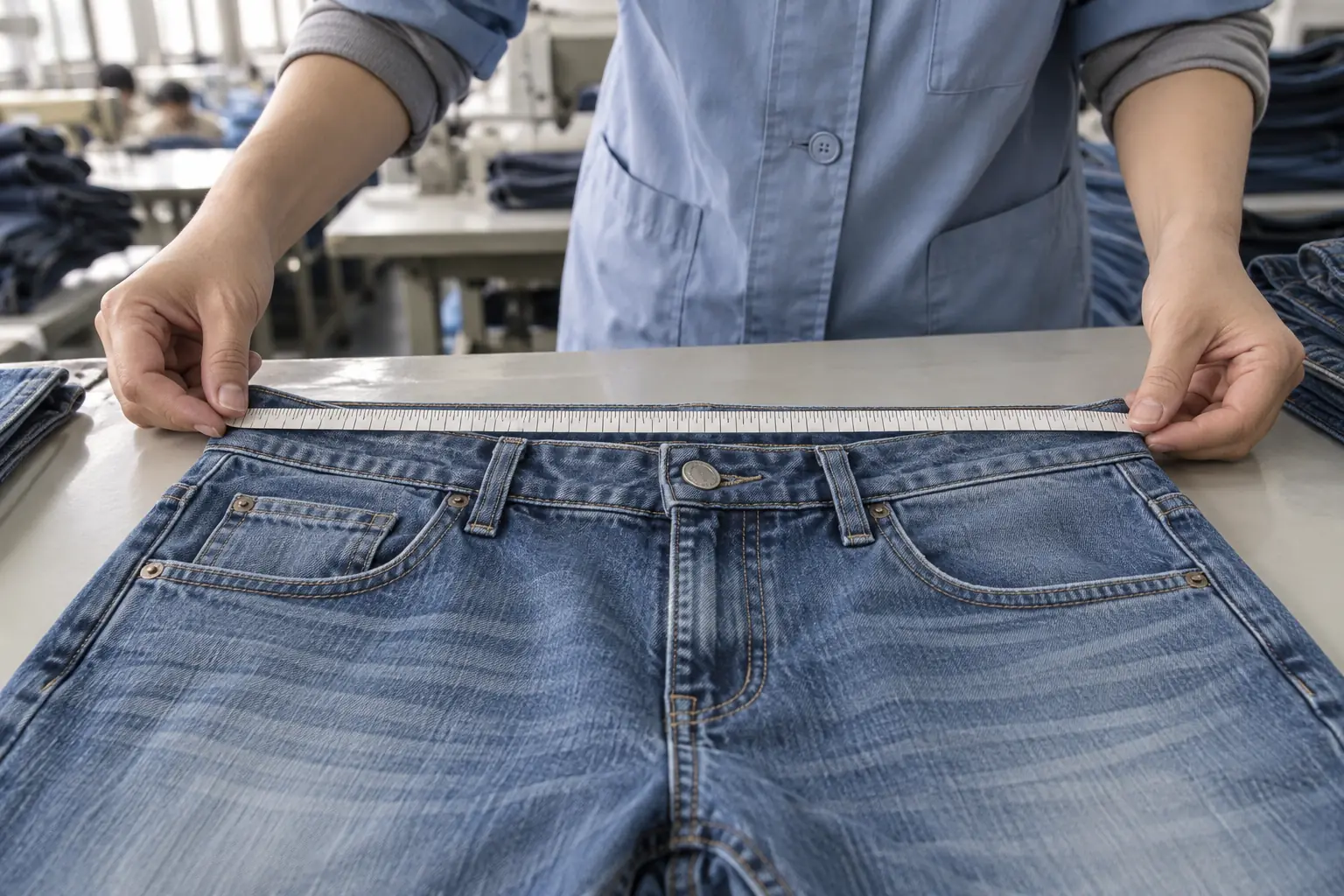
Measure samples only after the complete agreed finishing route, including drying and any final pressing. A damp sample or a waistband stretched immediately before inspection can give misleading results. Specify the conditioning period and room conditions in the project instructions; for example, both parties might agree to measure after garments rest flat overnight. Treat that as a project method, not a universal textile standard.
Use the same fastening state and handling method on both finishes. Close the button and fly, smooth the garment without pulling it, and align the legs without forcing twisted seams straight. State whether the waistband follows its curve or is measured straight across. For stretch denim, distinguish a relaxed dimension from an extended measurement and define the applied method before comparing results.
Photograph the tape position on disputed points. A hip reading taken a different distance below the waistband can resemble wash shrinkage even when the garment has not changed. If two inspectors disagree, have them measure the same conditioned sample using the documented landmarks before requesting a pattern correction.
Define what counts as an edge on a damaged garment
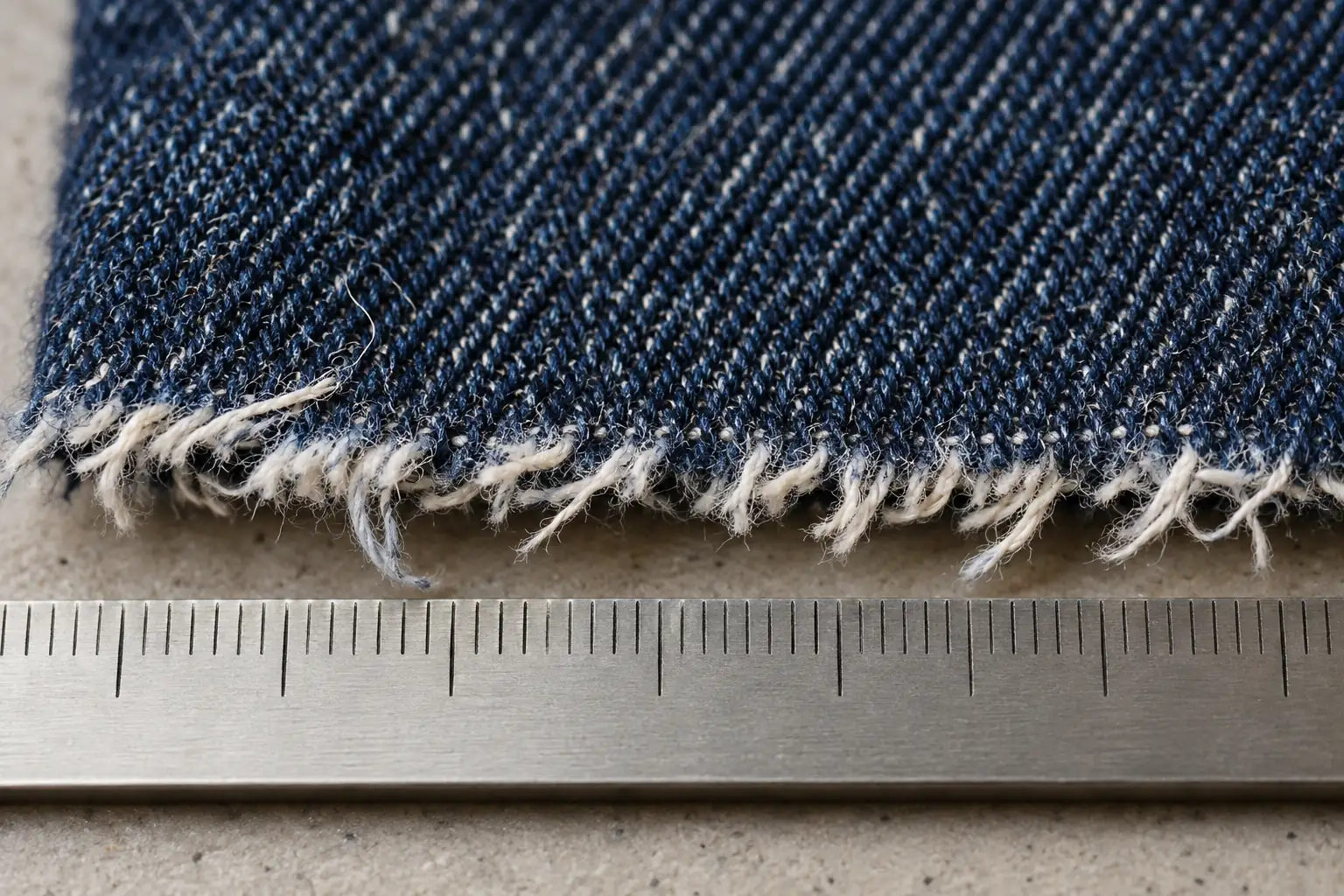
Clean hems usually provide a clear endpoint. Raw hems and torn panels need additional definitions because the longest loose thread is not a dependable finished length. The following examples show how to write the method; all tolerances must be agreed for the project, size range, and fabric.
| Point | Clean finish | Distressed finish |
|---|---|---|
| Inseam length | Crotch intersection to finished hem edge | Crotch intersection to defined base edge, excluding loose fringe |
| Leg opening | Flat width at finished hem | Flat width at an agreed intact line above the fray |
| Knee width | Width at specified distance below crotch | Same location, with torn edges resting naturally and no gap pulled open |
| Damage extent | Not applicable unless abrasion is specified | Separate maximum opening and retained-thread envelope |
If a hole crosses the knee measuring line, define a supplementary intact measurement above or below it. Keep the original point visible in the report rather than silently relocating it. The supplementary reading helps diagnose fit but does not automatically replace the approved knee specification.
For an asymmetric ripped hem, identify the length reference for each leg and specify the intended difference. A photograph alone may communicate the look but rarely establishes whether a shorter edge is deliberate or a finishing defect.
Use paired samples to locate the source of a mismatch
Compare clean and distressed samples made from the same documented fabric and pattern revision where possible. Record each garment before and after its finishing route. Those paired readings help separate overall dimensional change from local distortion around abrasion. A clean control is useful evidence, but its approval does not qualify a distressed route automatically.
For example, an illustrative prewash inseam of 82.0 cm that becomes 79.5 cm has shortened by approximately 3.0%, calculated against the prewash value. If the clean version meets the target but the distressed version finishes shorter, investigate the different wash, drying, and mechanical treatment before adding length to both patterns. One sample establishes a development observation, not a dependable bulk shrinkage allowance.
Likewise, a wider reading across a ripped knee may come from spreading the opening during measurement rather than a larger leg. Check the intact supplementary point and inspect the garment on the intended fit form or wearer. Record restriction, seam rotation, and whether the hole opens excessively during normal knee bending.
When a correction is needed, identify its owner and scope: pattern allowance, wash route, distress placement, or measuring method. Change the relevant variable, then resubmit the affected finish. Avoid correcting every discrepancy with extra pattern width; that can create loose clean garments while leaving the distressed version unstable.
Release each finish against a measurable QC checklist
Set tolerances by measurement point rather than applying one allowance everywhere. As an illustrative proposal only, a buyer might discuss ±0.5 cm for a flat waistband reading and ±1.0 cm for inseam length. Confirm achievable limits with the manufacturer and fit requirements before adoption. State whether values are flat measurements or full circumferences; a 0.5 cm flat-width difference is not the same as a 0.5 cm circumference difference.
- Identity: Record style, size, fabric reference, pattern revision, wash reference, and distress version on every report.
- Dimensions: Check agreed points on both legs where symmetry matters, retaining actual readings rather than only pass marks.
- Damage boundaries: Compare opening size, placement, fringe, and protected zones against the approved map.
- Construction: Inspect seam integrity, pocket attachments, exposed raw edges, and reinforcement around damaged areas.
- Fit behavior: Check sitting and bending for restriction or unexpected spreading at holes, using consistent fit assessment conditions.
- Disposition: Mark each finish approved, held, or requiring resubmission, with specific corrective comments.
Agree bulk inspection coverage across sizes and wash batches. An average within tolerance can conceal individual failures, so retain individual readings and investigate repeated drift. Keep a sealed reference sample for each finish alongside its measurement report. A clean reference cannot fully represent the acceptable variation in a distressed style.
Carry the decision into the production handoff
The approval package should contain dated measurement sheets, tape-position photographs, the distress map, finish references, and a record of accepted exceptions. An exception must identify the exact point, size, and finish it covers. “Looks good” does not tell production whether a shortened hem was accepted or simply overlooked.
StitchQuote provides cut-and-sew, private label, sampling, fabric and trim sourcing, branding, and QC before packing. Denim starts from 100 pieces per style. Confirm how clean and distressed versions will be grouped for the proposed order. A 7-day sample is available for standard styles with confirmed specs and available materials; complex styles, custom washes, and custom-developed fabric take longer. Build the approval schedule around the actual finishing route and necessary revisions.
Questions buyers ask when one pattern has two finishes
Can the clean version be approved while distressing is revised?
Yes, if the approvals are clearly separated and the unresolved work does not affect shared specifications. Identify the clean finish as approved and the distressed finish as held. Any later change to shared fabric or construction needs an impact review.
Should every tear have an exact matching outline?
Define an acceptable visual range, placement limits, and maximum opening dimensions. Specify which differences are intentional. Requiring identical torn outlines may be unrealistic for the chosen process, but uncontrolled variation can change coverage and fit.
Does passing after-wash measurement prove home-laundry stability?
No. Factory-finished dimensions describe one condition. If stability after consumer laundering is required, agree a separate test using the intended care instructions, cycle count, conditioning method, and acceptance criteria. Assess damage growth as well as dimensional change.
What if a distressed sample meets dimensions but feels restrictive?
Hold fit approval and investigate. Retained threads across an opening, local reinforcement, or seam distortion can affect movement despite acceptable flat readings. Review the same motions on the clean version and document the construction change needed before resampling.
Related reading and project support
- Prepare the measurement methods in your tech pack
- Review sampling and MOQ planning
- Coordinate the denim wash approval process
- Discuss your denim approval requirements with StitchQuote
Request a manufacturing quote
Share your product type, quantity range, and destination. We usually reply within one business day.