Custom Streetwear, Casualwear & Denim Manufacturer•MOQ 50 pcs•Denim MOQ 100 pcs•7-Day Sample Available

How to Align Packaging with MOQ, Budget, and Delivery Method
Use packaging MOQ budget delivery apparel to compare private label decisions more clearly, protect brand consistency, and keep product, trims, and commercial scope.

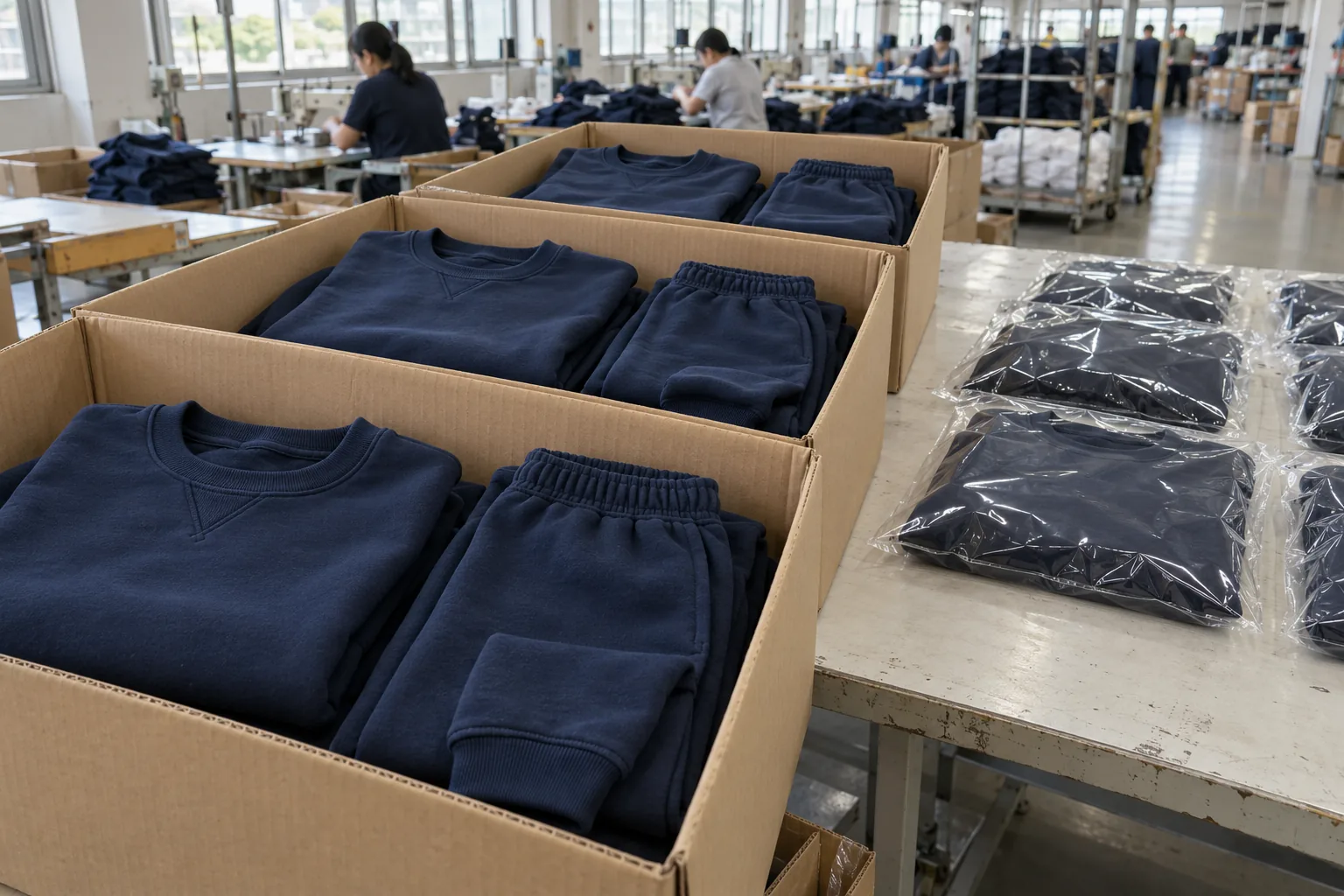
A sweatshirt and jogger can leave production as two independently saleable garments or as one coordinated set. That choice changes the number of bags, the barcode structure, the packing labor, and the space your shipment occupies. Choosing a decorative box before deciding what customers can actually buy often creates a packaging commitment that the assortment cannot support.
For a small apparel launch, start with the selling unit: one garment, a fixed-size set, or a bundle assembled from separate sizes. Then build the packaging budget and delivery plan around that unit. The useful comparison is the total cost of getting an accurate, undamaged order to its next destination, including any work your warehouse must perform after arrival.
Decide whether the set exists in inventory or only at checkout
A fixed set has a defined combination, such as one medium sweatshirt plus one medium jogger. It can be counted, scanned, and shipped as a single inventory unit. A mix-and-match offer, such as a small top with large bottoms, behaves differently: the components must remain identifiable and available separately until the customer chooses them.
Consider a launch with 120 tops and 120 bottoms. Prepacking every matching-size pair produces at most 120 sets, provided the size quantities match. It does not create 240 saleable sets. If the tops contain 40 mediums but the bottoms contain 25, only 25 medium pairs are possible; the remaining tops need another allocation.
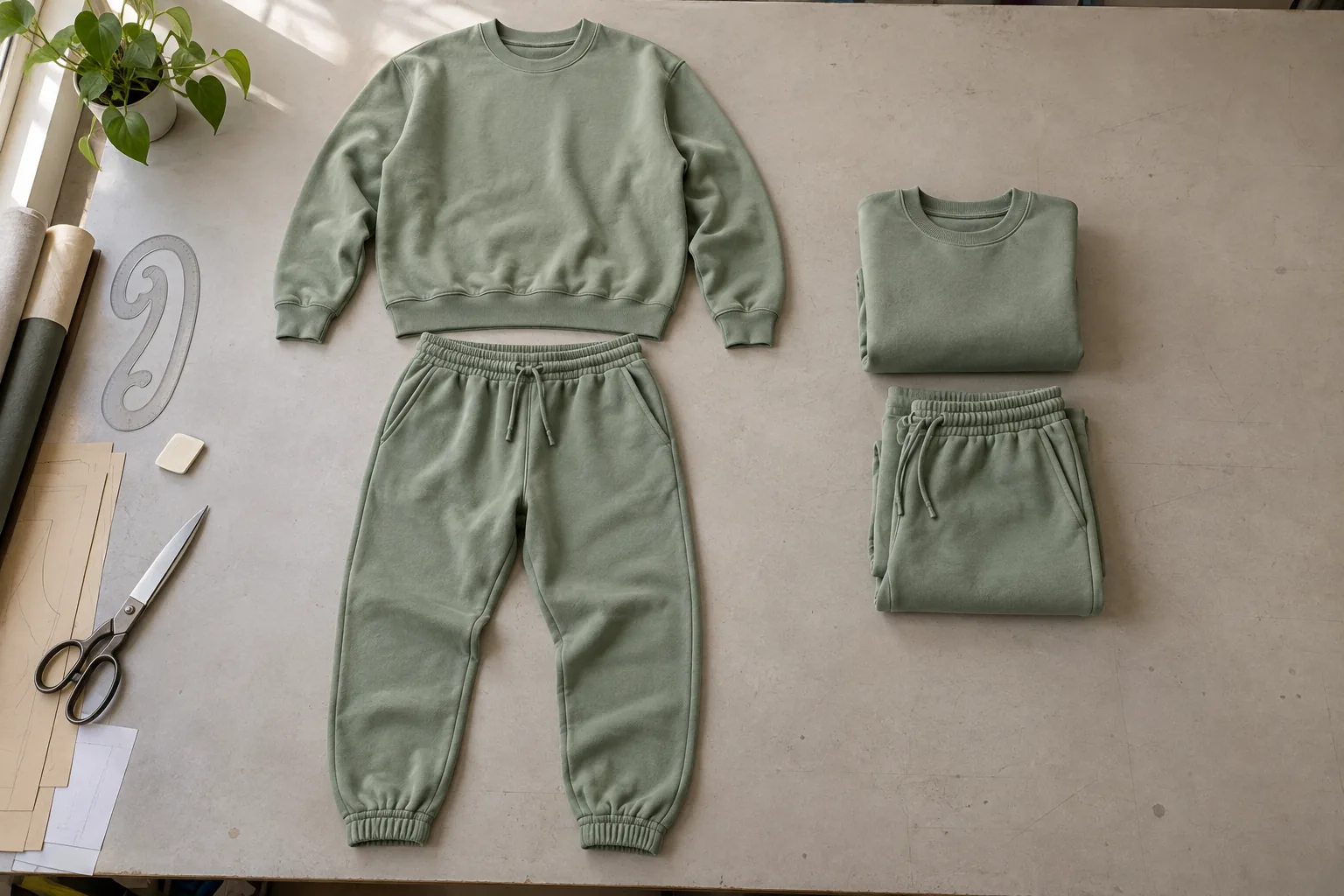
Write one sentence in the packing brief that settles ownership of assembly: “Factory packs fixed-size pairs,” or “Warehouse combines individually packed components.” This decision controls which labels belong on each garment, whether a shared outer pack is needed, and who checks that the two sizes match.
Keep garment minimums separate from packaging purchase quantities
StitchQuote’s MOQ for most categories starts from 50 pieces per style; denim starts from 100 pieces per style. A coordinated top and bottom should not automatically be treated as one style for minimum-order purposes. Ask for confirmation against the actual designs, fabrics, colors, and quantity breakdown. Calling two garments a set does not resolve the production requirements of either garment.
Packaging also has its own purchasing logic. A stock bag with a separate identification sticker may support a small run more easily than a custom-printed bag sized for one particular set. Confirm each packaging item’s minimum purchase, usable quantity, setup charge where applicable, and treatment of unused stock. These are project-specific supplier terms, not extensions of the garment MOQ.
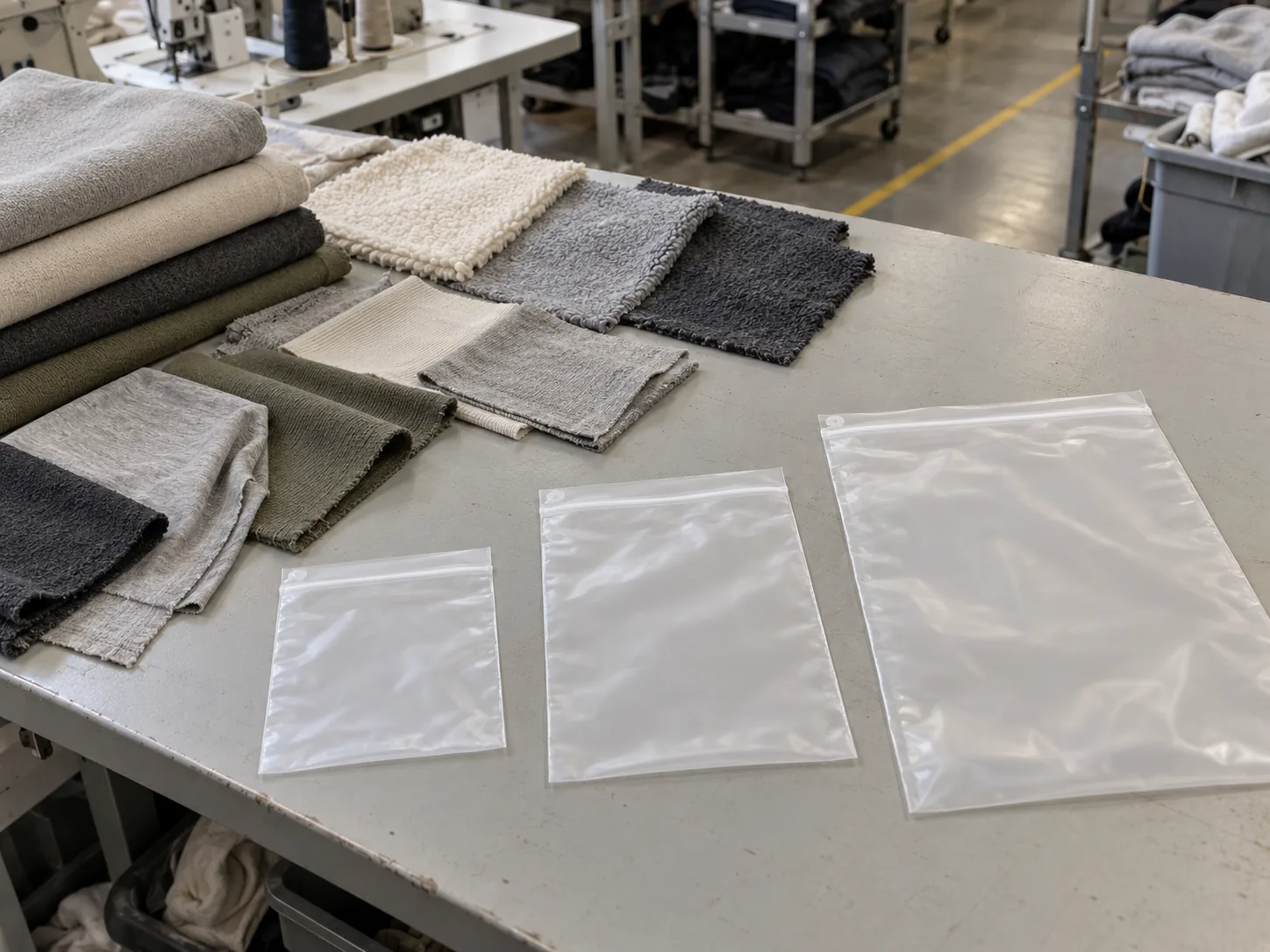
Suppose a packaging supplier quotes a minimum of 500 printed sleeves for a planned run of 100 sets. That hypothetical purchase leaves 400 sleeves after initial packing, before allowances for damage. Ask whether the sleeve artwork will still work for a reorder, a new color, or separate garment sales. A lower unit price is less useful when most of the purchased quantity cannot be used.
Standardizing one bag across several styles can help, but test the smallest and bulkiest garments. A bag that fits a lightweight tee may strain around a fleece pair; an oversized bag can create unnecessary folds and loose movement around a single tee.
Quote three packing routes against the same assortment
Ask for alternatives using identical garment quantities and size splits. Otherwise, a cheaper packaging quote may simply reflect fewer assembled sets or work shifted to your fulfillment team. The following comparison separates common routes without assuming that one is always the lowest-cost option.
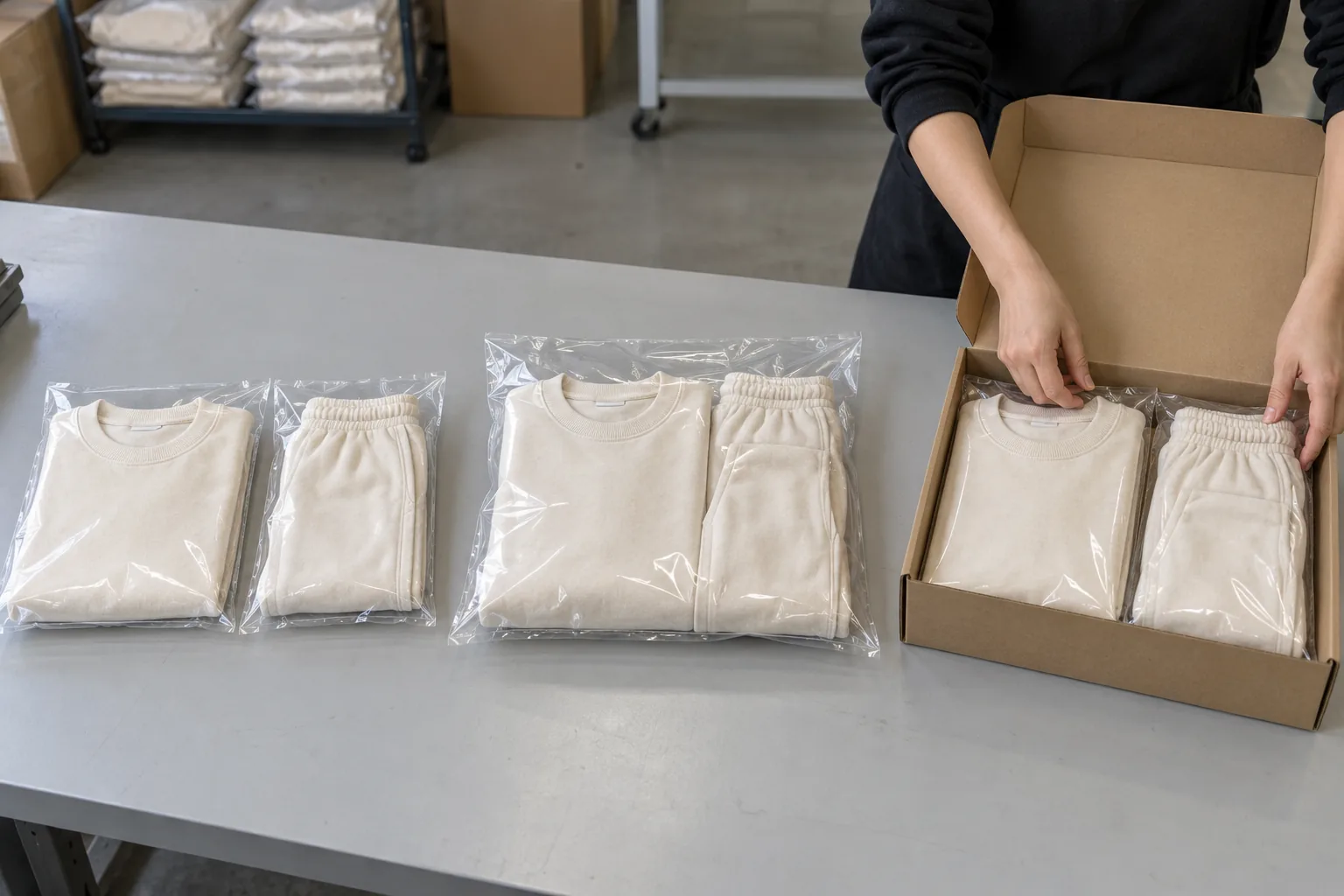
| Packing route | Best suited to | Cost or handling question |
|---|---|---|
| Individual garment bags | Separate sales and flexible-size bundles | Who pays for later picking and set assembly? |
| One shared set bag | Fixed pairs sold together | How are mismatched or returned components handled? |
| Individual protection inside a set box | Presentation-led sets with confirmed box dimensions | Does the extra volume justify the presentation benefit? |
Request separate figures for garment production, packaging materials, packing labor, and any additional labeling. Keep freight estimates distinct until dimensions and shipment details are available. For internal budgeting, compare total purchased packaging cost divided by the number of saleable units in the first run; also record leftover stock separately so it is not mistaken for material already consumed.
A shared bag may reduce bag count but add pairing labor. Individual bags may simplify stock management but require two picks for every online set order. A box may improve presentation while increasing storage space. Evaluate these consequences with your warehouse before approving the purchase order.
Use a packed sample to choose the delivery configuration
A garment sample alone cannot establish shipping volume. Fold the approved components, add the proposed inserts and protection, and pack an actual representative unit. Include a bulky size combination as well as the most common size. Measure the filled package rather than relying on the supplier’s empty-bag or flat-box dimensions.
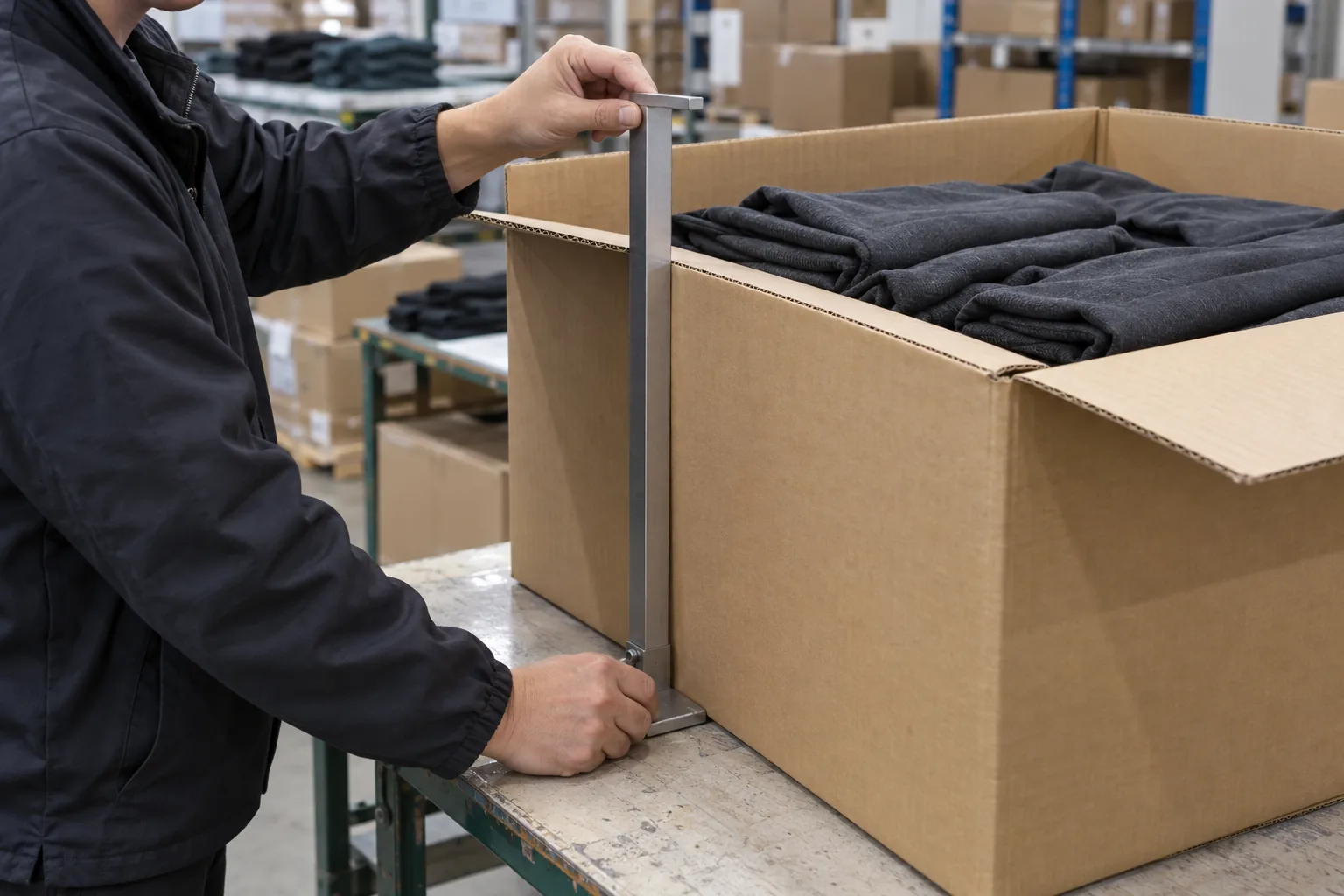
For an express or air shipment, ask the carrier or forwarder to compare actual weight with dimensional weight using its applicable rules. For example, a carton measuring 60 × 40 × 40 cm occupies 0.096 cubic meters. Reducing its height to 30 cm changes that to 0.072 cubic meters, a 25% volume reduction. Freight savings will depend on chargeable weight, minimum charges, and the service selected.
For sea freight or delivery into warehouse storage, confirm carton strength, stacking requirements, moisture protection, and receiving limits. Avoid compressing garments solely to achieve a smaller carton: heavy folds can mark prints, and protruding hardware can damage adjacent fabric. A neatly closed carton should preserve the approved presentation after unpacking.
StitchQuote offers a 7-day sample for standard styles with confirmed specifications and available materials. Complex styles, custom washes, and custom-developed fabric take longer. Confirm packaging development and material arrival separately; garment sample timing does not establish when a custom box or printed sleeve will be ready.
Release packing only after the pair passes its own checklist
A set adds a relationship between two garments that single-style inspection does not cover. Two correctly made pieces can still form the wrong pair. StitchQuote provides QC before packing; agree on the specific set checks, inspection scope, and records required for your order instead of assuming every packaging detail is included automatically.
- Component identity: Check top and bottom style codes, color names, and sizes against the approved pairing matrix. Record mixed-size bundles explicitly.
- Visual compatibility: Compare paired garments under consistent lighting against approved references. Different fabrics may reflect light differently; approve acceptable appearance during development.
- Fold and fit: Define a target folded footprint and an agreed tolerance. A proposed ±1 cm tolerance is a discussion starting point, not a universal standard; validate it with the actual fabric and bag.
- Identification: Scan the outer set barcode and check the intended SKU. Ensure visible component barcodes cannot cause an unintended scan at receiving.
- Protection: Check that zippers, drawcord tips, and other hardware cannot rub exposed fabric or decoration during handling.
- Count reconciliation: Match packed sets, loose garments, and held units to the original component quantities. List incomplete pairs separately from finished sets.
Keep an approved packed reference or clear photographs showing both the fold and label position. If a late change replaces a shared bag with individual bags, revise the packing instructions, carton count, and warehouse receiving information together.
Questions buyers ask when switching between sets and singles
Can we reserve part of the run for individual sales?
Yes, if the allocation is defined before packing and confirmed with the supplier. Specify quantities by style, color, and size for each route. “Half as sets” is ambiguous unless it states how many complete pairs and how many loose components should remain.
Should a shared pack show both component sizes?
For mixed-size combinations, showing both sizes helps receiving and customer service distinguish them. Use an unambiguous format in the approved artwork, such as “Top S / Bottom L,” and connect that combination to the inventory system’s bundle identifier.
What happens if a customer returns only one piece?
That depends on your returns policy and inventory setup. Before choosing sealed set packaging, decide whether components can be resold individually and how warehouse staff will identify them. Component-level identification remains useful even when the pair has its own outer barcode.
What should we send for a useful packaging quote?
Send the assortment matrix, selling-unit definition, fold reference, branding artwork, destination, delivery method, and warehouse packing rules. StitchQuote’s services include cut-and-sew, private label, sampling, fabric and trim sourcing, and branding through woven labels, prints, and embroidery. Confirm the proposed packaging materials and assembly requirements for your specific project.
Related reading for your order brief
- Prepare the garment specifications and packing references
- Review sampling and minimum-order planning
- Build the hoodie component of your production budget
- Discuss your set quantities and packaging brief with StitchQuote
Request a manufacturing quote
Share your product type, quantity range, and destination. We usually reply within one business day.