Custom Streetwear, Casualwear & Denim Manufacturer•MOQ 50 pcs•Denim MOQ 100 pcs•7-Day Sample Available

How to Price a Matching Set Without Misreading the True Cost
Understand matching set cost factors apparel through fit, fabric, decoration, and production logic so streetwear and premium basics buyers can make cleaner.

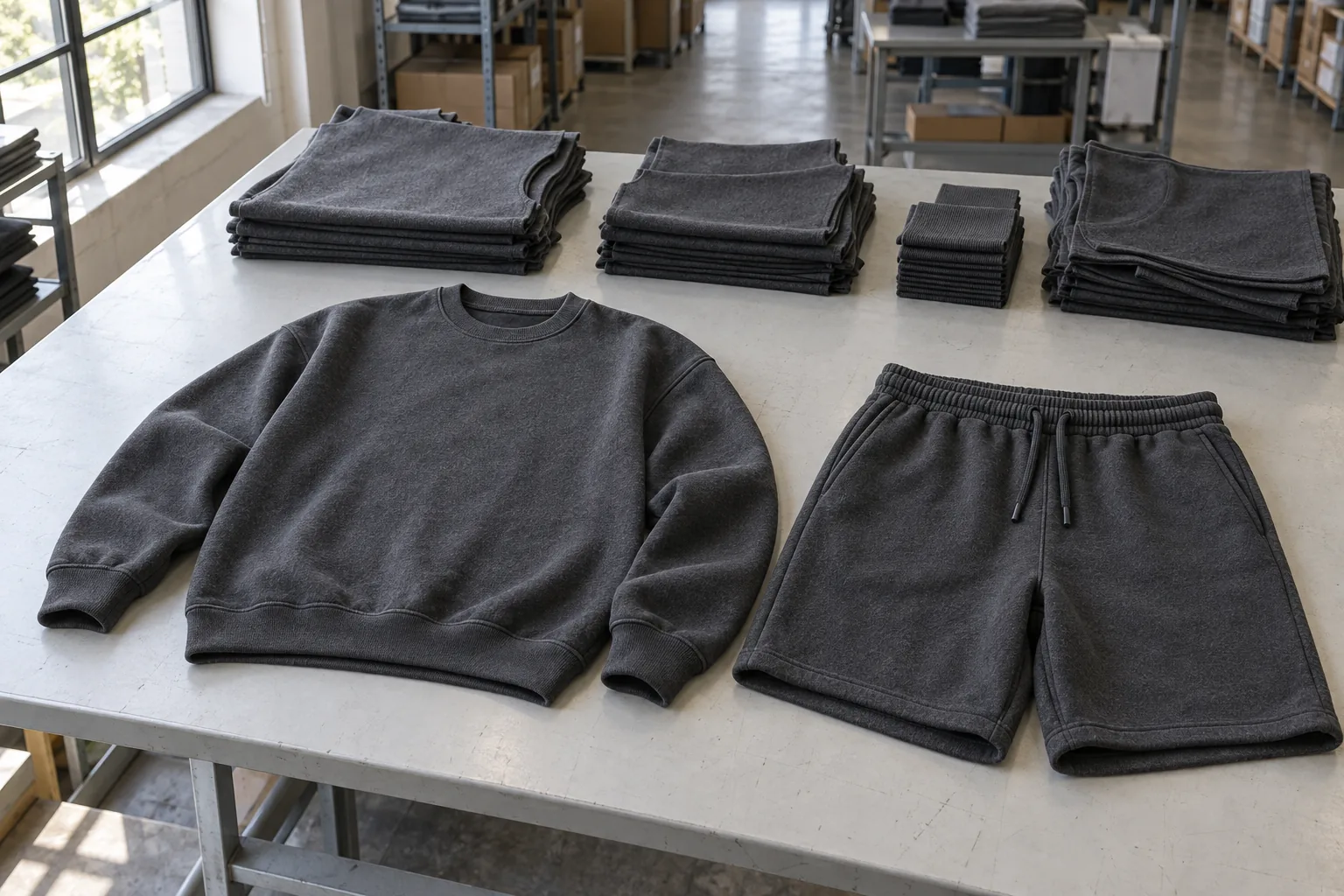
A matching set can look like one product on a storefront while behaving like several separate orders in production. A sweatshirt and shorts may share fabric, but their cutting, sewing, decoration, and packing requirements do not automatically share minimums. Pricing the pair by adding two attractive unit quotes can therefore miss the cash committed to fabric, setup, and unmatched inventory.
The useful starting point is a process map: identify which operation sets each minimum, what quantity it counts, and who owns any remainder. That lets a buyer distinguish a workable launch quantity from a nominal garment MOQ before approving samples or setting a retail price.
Count garments, pairs, and process batches separately
Write the order in three units: pieces per style, planned sellable pairs, and quantities passing through each process. For example, 80 sweatshirts and 80 shorts represent 160 garments but only 80 complete sets. If 12 sweatshirts are reserved for individual sales, the maximum paired inventory falls to 68 unless the shorts also have a separate sales plan.
StitchQuote’s MOQ for most categories starts from 50 pcs per style; denim starts from 100 pcs per style. These are starting points, not confirmation that every fabric, color, wash, or decoration is feasible at that quantity. Treat the two components as separate styles when requesting clarification, and ask whether each proposed color split is accepted.
A quote request should state whether customers must buy identical top and bottom sizes or can mix sizes. Fifty medium tops and fifty medium bottoms do not solve demand for medium tops paired with small bottoms. The commercial unit is the pair customers can actually select, not merely two pieces counted together.
Find the fabric commitment before dividing by garments
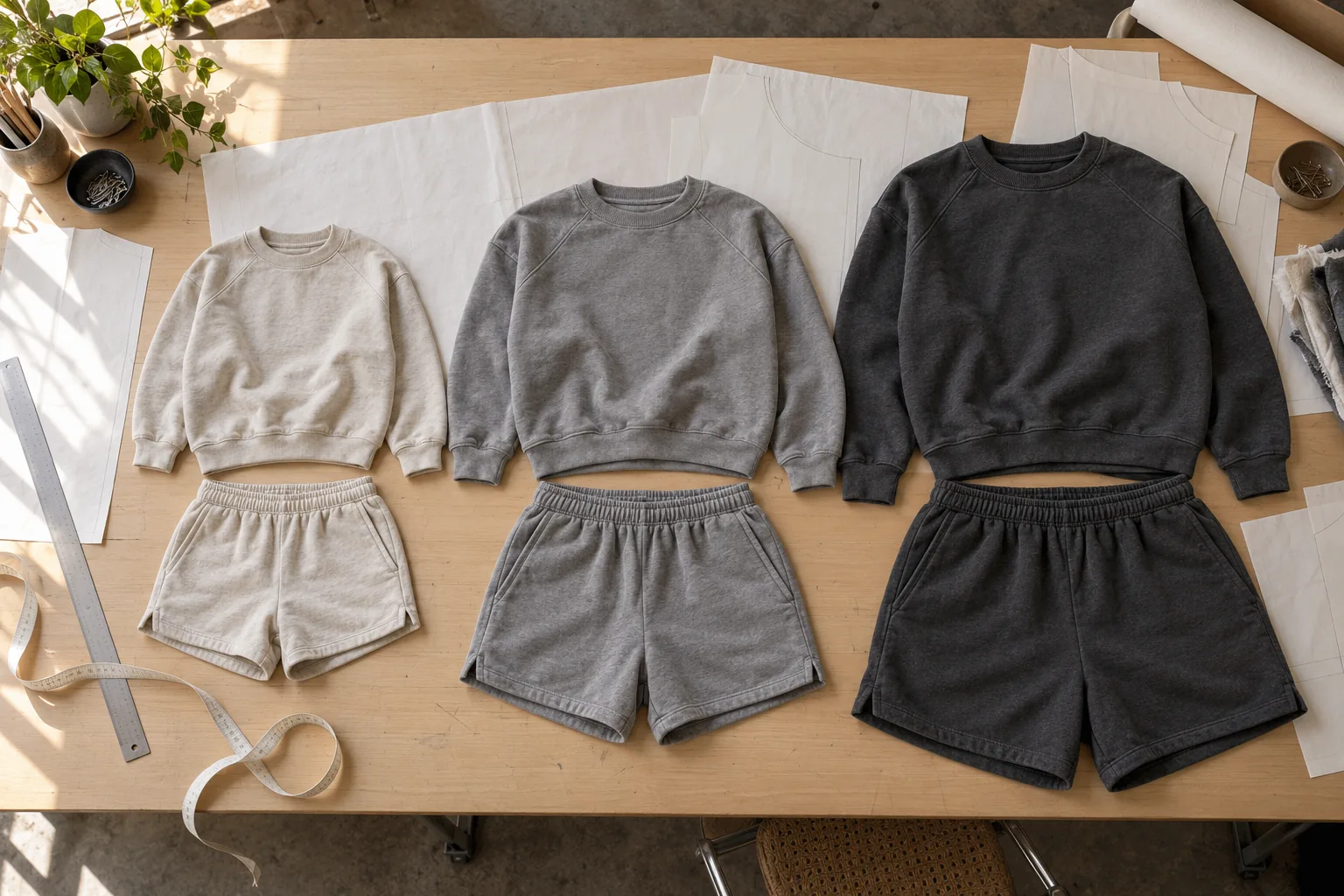
A mill or fabric supplier may count a minimum in kilograms, meters, or a dye batch rather than finished pieces. Ask the manufacturer to translate that commitment into estimated consumption for both styles using the actual size ratio. An oversized sweatshirt with a double-layer hood consumes differently from a crewneck, even when both use the same base fabric.
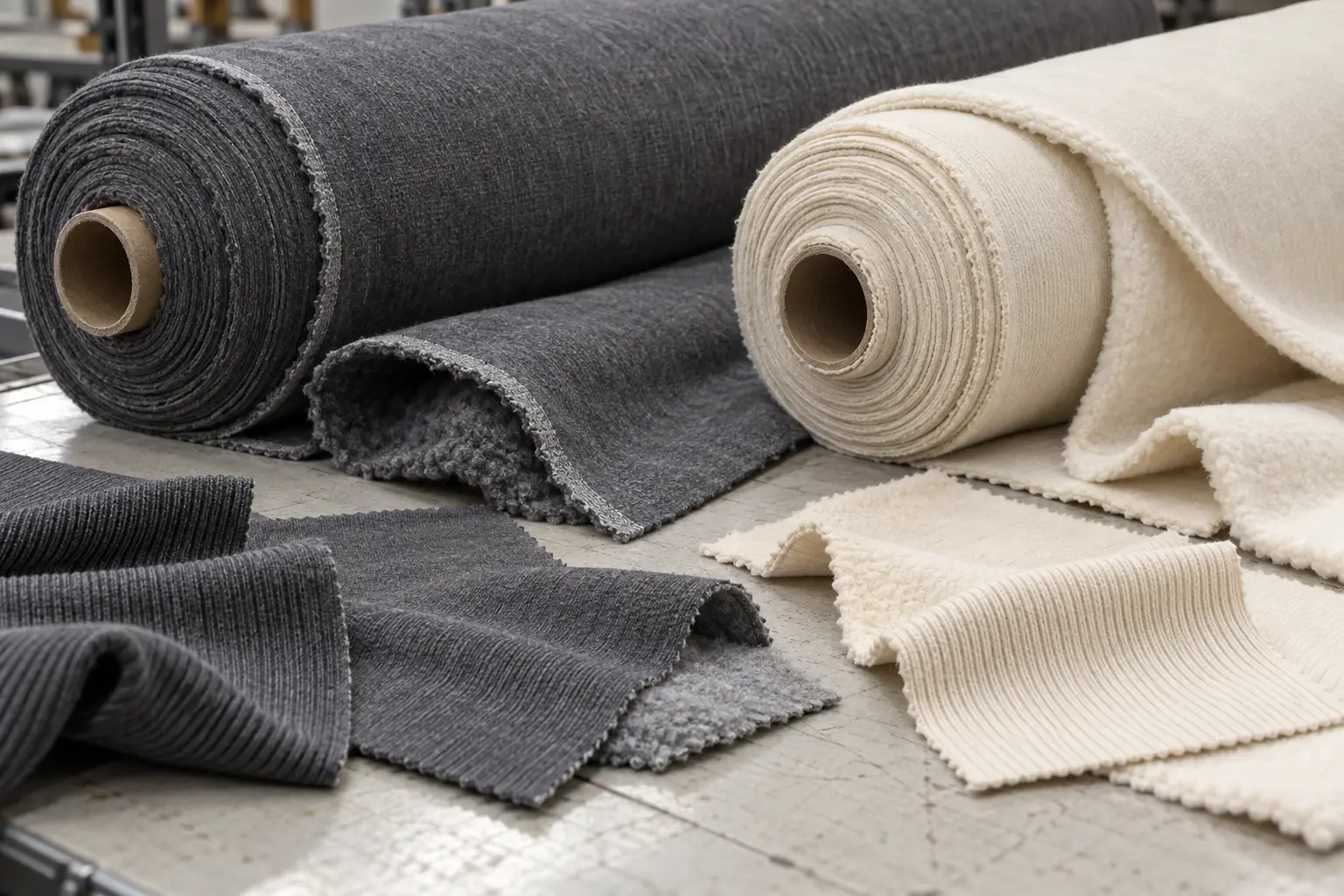
Consider a proposed 340 gsm cotton-rich fleece set with rib cuffs on the top and elastic at the shorts waistband. The fleece, rib, and elastic are three sourcing lines. Sharing fleece may consolidate purchasing, but matching rib can still require its own color approval or minimum. Confirm usable width, composition, finishing, and whether consumption includes cutting waste and expected processing shrinkage.
For two colors, request separate fabric commitments rather than assuming the total garment order satisfies both. An available stock shade may support a smaller launch than a custom dye, but availability and repeat shade consistency need confirmation. Document whether surplus fabric is charged now, stored for a reorder, returned, or otherwise handled. Do not allocate its cost to a future drop that has not been approved.
Separate sewing minimums from decoration and wash minimums
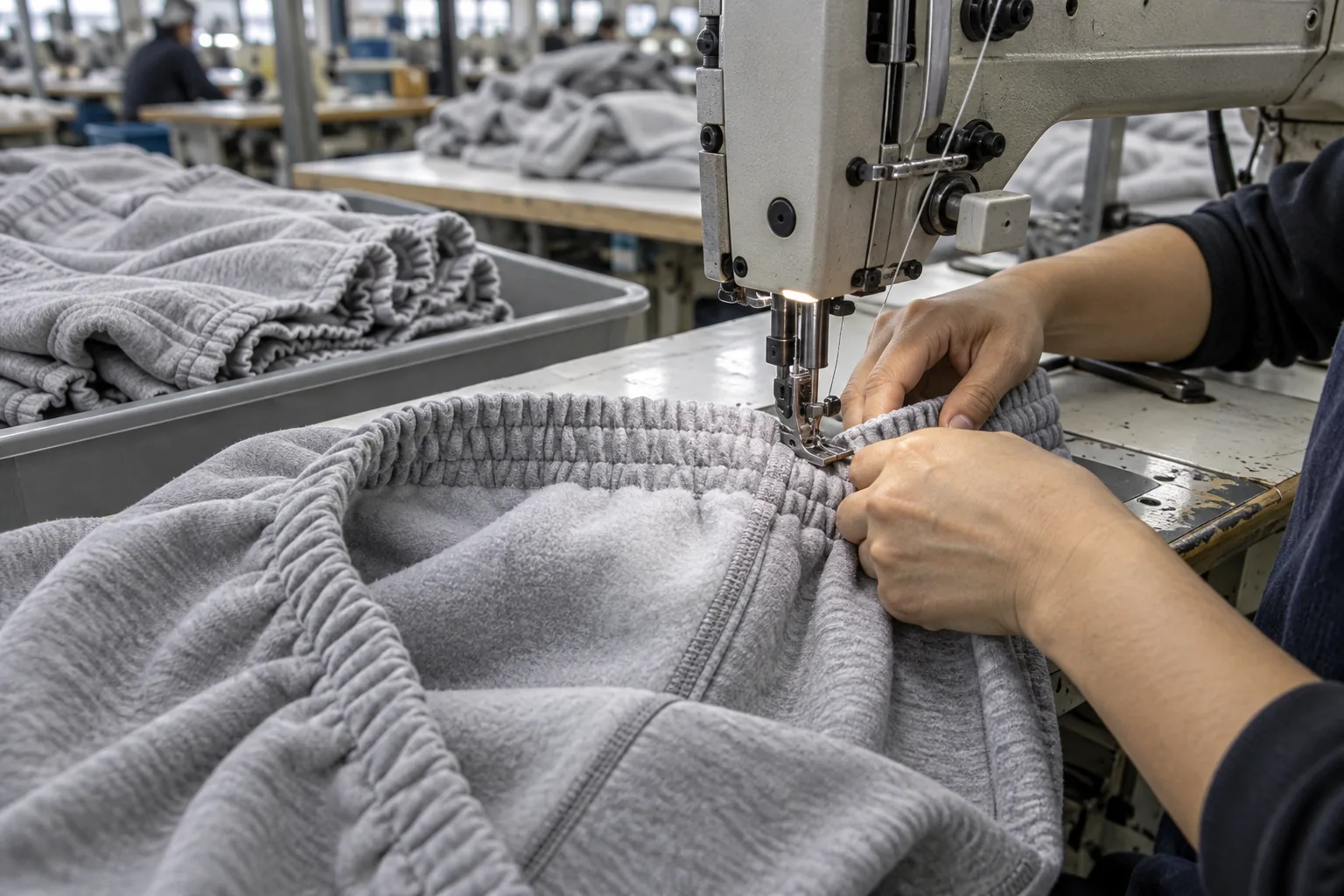
Cutting and sewing capacity follows construction. A sweatshirt needs neckline or hood operations; shorts need a waistband, rise seams, and pocket assembly. Even in identical fabric, each style requires its own pattern, size grading, operation sequence, and inspection points. Ask whether the quoted quantity assumes one construction repeated across colors or several distinct versions.
Decoration introduces another counting system. A small embroidered motif on the top and a larger version on the bottom may require different programs and running times. Screen printing can introduce setup by artwork, color, and placement. A shared logo does not establish a shared setup charge. Obtain the basis for each charge and identify which costs recur on a reorder.
For washed sets, ask whether both components can be processed under compatible conditions and approved together. Different seam bulk, rib composition, or fabric lots can produce visibly different results. A denim jacket and jeans also need their own construction assessment; the denim starting MOQ does not guarantee a particular custom wash at the same quantity.
| Process | Quantity basis to confirm | Potential cost outside sewing |
|---|---|---|
| Fabric dyeing | Weight or length per shade | Unused dyed material |
| Cutting and sewing | Pieces per style and accepted split | Pattern and grading work |
| Print or embroidery | Artwork, placement, and run quantity | Screens or digitizing |
| Garment washing | Accepted batch and treatment | Trials and handling |
Build a cost per saleable pair, then test the launch mix
Request component unit prices and separate lines for development, decoration setup, material minimum charges, packaging, and any agreed tests. Check what each unit price already includes before adding extras. Freight, duties, and receiving costs belong in the landed-cost calculation, with estimates clearly separated from confirmed supplier charges.
Use a simple calculation: total costs allocated to the paired launch divided by expected saleable pairs. If the plan includes standalone sales, document how shared costs are allocated between those sales and sets. Otherwise, the same fabric charge may be counted twice or disappear from both calculations.
As a planning example, an order of 60 tops and 60 bottoms yields at most 60 pairs. If inspection leaves 58 acceptable tops and 60 acceptable bottoms, immediate paired availability is 58, pending agreed repair or replacement. The remaining two bottoms retain value, but they do not create two more complete sets. Model this exposure without treating a hypothetical defect rate as an accepted production allowance.
Compare three quote scenarios: one stock color, two stock colors, and one custom color. Keep construction and size quantities fixed so the difference reveals the cost of color fragmentation. Then assess retail margin using net sales revenue after planned discounts and applicable selling costs. A larger order can reduce setup cost per piece while increasing total cash and inventory exposure.
Approve samples against the minimum-driving decisions
Sample the decisions that could change the order economics: main fabric, coordinating rib, decoration method, wash, and component fit. A sample made in substitute fabric can help assess shape, but it does not validate the final consumption, shade pairing, shrinkage, or material minimum. Record those limits in the approval comments.
For a fleece set, specify measurement methods for chest width, body length, relaxed waistband, stretched waistband, front rise, and inseam. As proposed project tolerances, a buyer might request ±1 cm for half-chest and ±0.5 cm for inseam; feasibility must be agreed for the construction and fabric. Do not apply one tolerance to every measurement.
StitchQuote offers a 7-day sample for standard styles with confirmed specs and available materials. Complex styles, custom washes, and custom-developed fabric take longer. Its services include cut-and-sew, private label, sampling, fabric/trim sourcing, and branding through woven labels, prints, and embroidery. Confirm the sample scope before treating its completion as authorization for all bulk processes.
Inspect the set as a pair before releasing packed stock
QC before packing is part of StitchQuote’s service. Agree the inspection criteria and reporting scope before production, including checks that compare both components. Passing each garment separately does not prove the pair meets the intended appearance or selling configuration.
- Shade pairing: compare tops, bottoms, and rib under agreed lighting against approved references. Review pieces from different production batches where applicable.
- Dimensional change: measure both components before and after the agreed wash test. Record the care method and judge results against approved limits.
- Decoration: check placement from defined seam reference points, appearance, and any agreed durability test. Avoid judging placement from a folded garment.
- Size availability: reconcile accepted quantities by component and size against the intended pairing matrix before declaring sets ready.
- Packing: verify whether components are individually bagged or packed together, and check size identification, count, and the handling of unmatched pieces.
Put the resolution route for mismatches in writing: segregation, repair assessment, replacement discussion, or another agreed disposition. This keeps rejected components from silently reducing the launch quantity after the retail commitment is made.
Questions buyers ask when process minimums collide
Can top and bottom quantities be combined to reach one style minimum?
Do not assume so. They are separate constructions, even if sold under one product name. Confirm the minimum for each style and the accepted color and size breakdown. Fabric purchasing may be shared without combining the sewing minimum.
Does removing embroidery always make a small set order viable?
No. It removes one potential setup or run constraint, but a custom fabric or dye batch may still determine the commitment. Ask which process currently prevents the requested quantity, then revise that specification and obtain a new quote.
Should leftover fabric reduce the cost assigned to the first launch?
Only use a documented allocation consistent with your accounting approach and a realistic reuse plan. Track the full cash payment separately. Confirm ownership, storage terms, remaining usable quantity, and whether a reorder can match the original trims and shade.
What should accompany a request for a paired quote?
Send both style specifications, quantities by color and size, fabric requirements, artwork dimensions, wash expectations, and packing configuration. Ask for the minimum-driving process and all excluded charges. The references below support preparation and a project-specific discussion.
Related reading and next steps
- Prepare specifications for both components
- Review sampling and MOQ planning
- Explore hoodie manufacturing cost factors
- Request a matching-set project review
Request a manufacturing quote
Share your product type, quantity range, and destination. We usually reply within one business day.