Custom Streetwear, Casualwear & Denim Manufacturer•MOQ 50 pcs•Denim MOQ 100 pcs•7-Day Sample Available

What Makes a Hoodie Sample Pass or Fail for Premium Basics Brands
Understand premium basics hoodie sample through fit, fabric, decoration, and production logic so streetwear and premium basics buyers can make cleaner development.

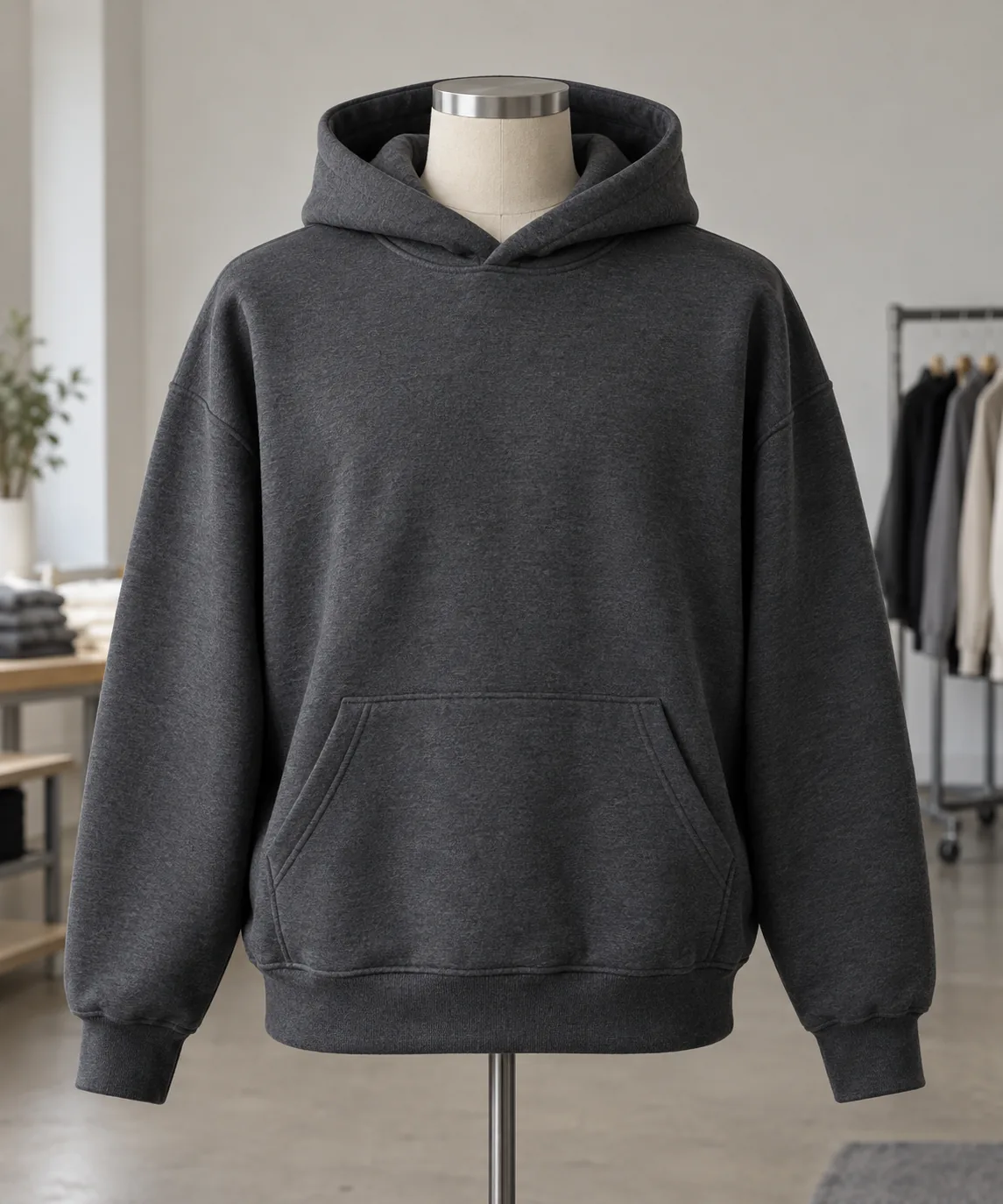
A premium hoodie can have a convincing silhouette and still fail the moment someone puts their hands into its pocket. A kangaroo pocket that sits too high lifts the shoulders; one that sits too low pulls against the waistband. Uneven openings can make an otherwise balanced front look twisted. These are approval issues that a flat photograph rarely settles.
For a brand reviewing a development sample, pocket placement provides a practical test of whether appearance, comfort, and repeatability agree. Use the review to establish measurable coordinates, test them on the intended wearer, and decide which findings require another sample. The aim is a pocket that works in the finished garment and can be reproduced across the size range.
Establish pocket coordinates before judging the front
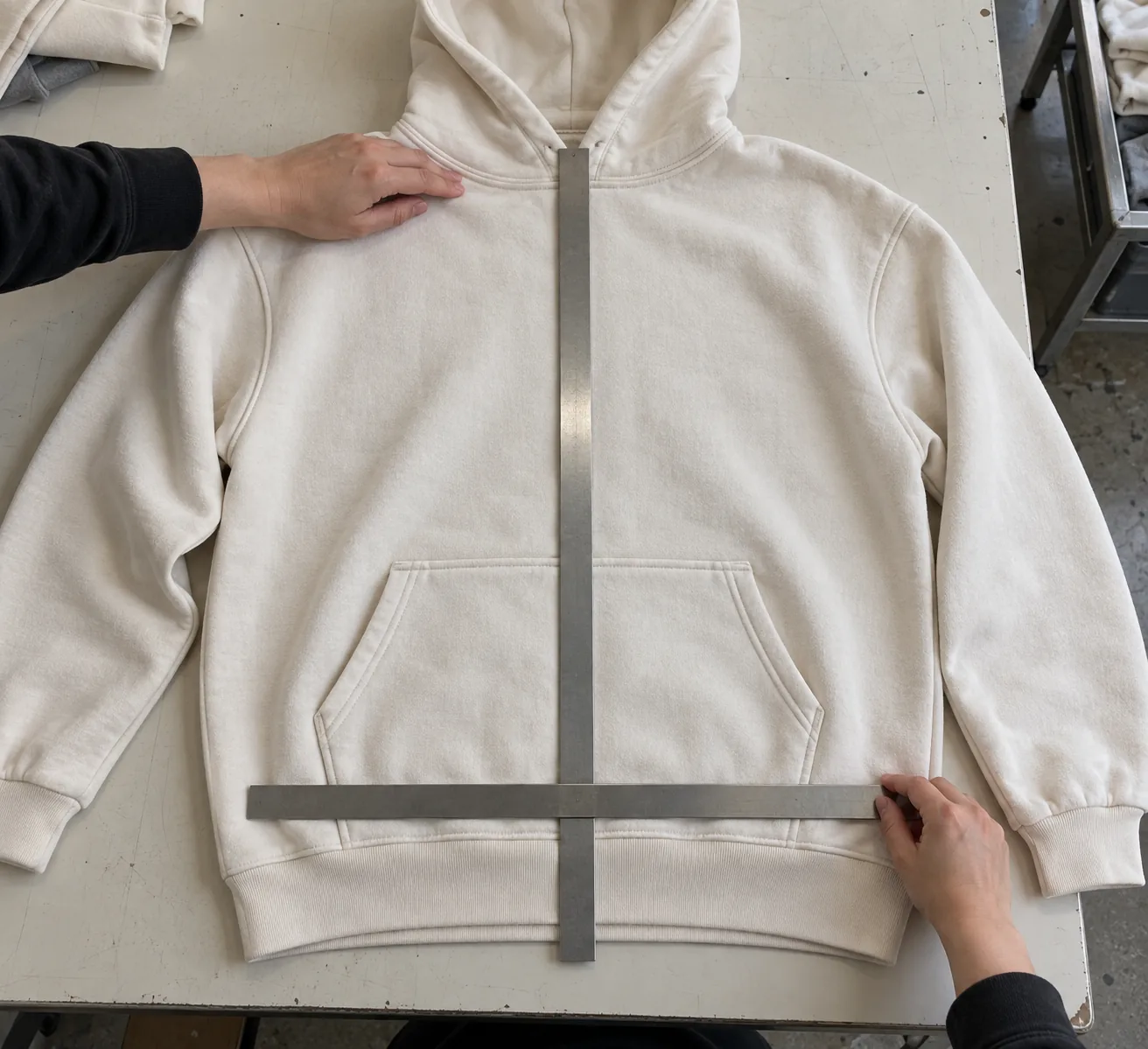
Start with the hoodie relaxed on a flat table, without stretching the waistband or pulling the side seams into alignment. Identify the body centerline independently of the pocket. On a pullover, use the pattern’s center-front reference; on a zip hoodie, define whether measurements begin at the zipper center or its attachment seam. Those references are not interchangeable.
Record pocket width, height, top-edge level, and horizontal offset. Define exactly where each measurement starts and ends: finished fold, stitch line, and raw pattern edge produce different readings. For a curved top edge, specify whether height is taken at center front or at the highest point. Include a dimensioned sketch so a second reviewer can repeat the check.
Use both a body reference and a waistband reference when diagnosing placement. A pocket may be correctly positioned from the shoulder while appearing too close to the rib because body length is short. Moving the pocket to disguise that problem transfers a body-length error into the pocket specification.
Make the acceptance window explicit
“Move it down slightly” leaves the next sample open to interpretation. Give a target, a measurement method, and an agreed tolerance. The illustrative values below are discussion points for one adult pullover base size, not universal hoodie standards or StitchQuote production guarantees. Confirm feasibility for the fabric, construction, and intended fit.
| Checkpoint | Illustrative target | Review method |
|---|---|---|
| Pocket center offset | 0 mm; maximum 4 mm either side | Compare pocket midpoint with body centerline |
| Bottom clearance above rib joining seam | 30 mm ± 5 mm | Measure at center front, body relaxed |
| Left/right opening height difference | Maximum 3 mm | Compare corresponding finished endpoints |
| Usable opening length | 160 mm ± 5 mm | Measure between reinforcement ends along the opening |
A sample can meet each individual dimension and still look unbalanced when deviations accumulate. Check the complete front as well as the numbers. Record appearance concerns with straight-on photographs taken at garment level; an angled phone image can exaggerate a small offset or conceal a real one.
Separate a design target from a manufacturing allowance. If the target position is uncomfortable, tightening the tolerance will only reproduce the discomfort more consistently.
Test hand entry while the hoodie is being worn
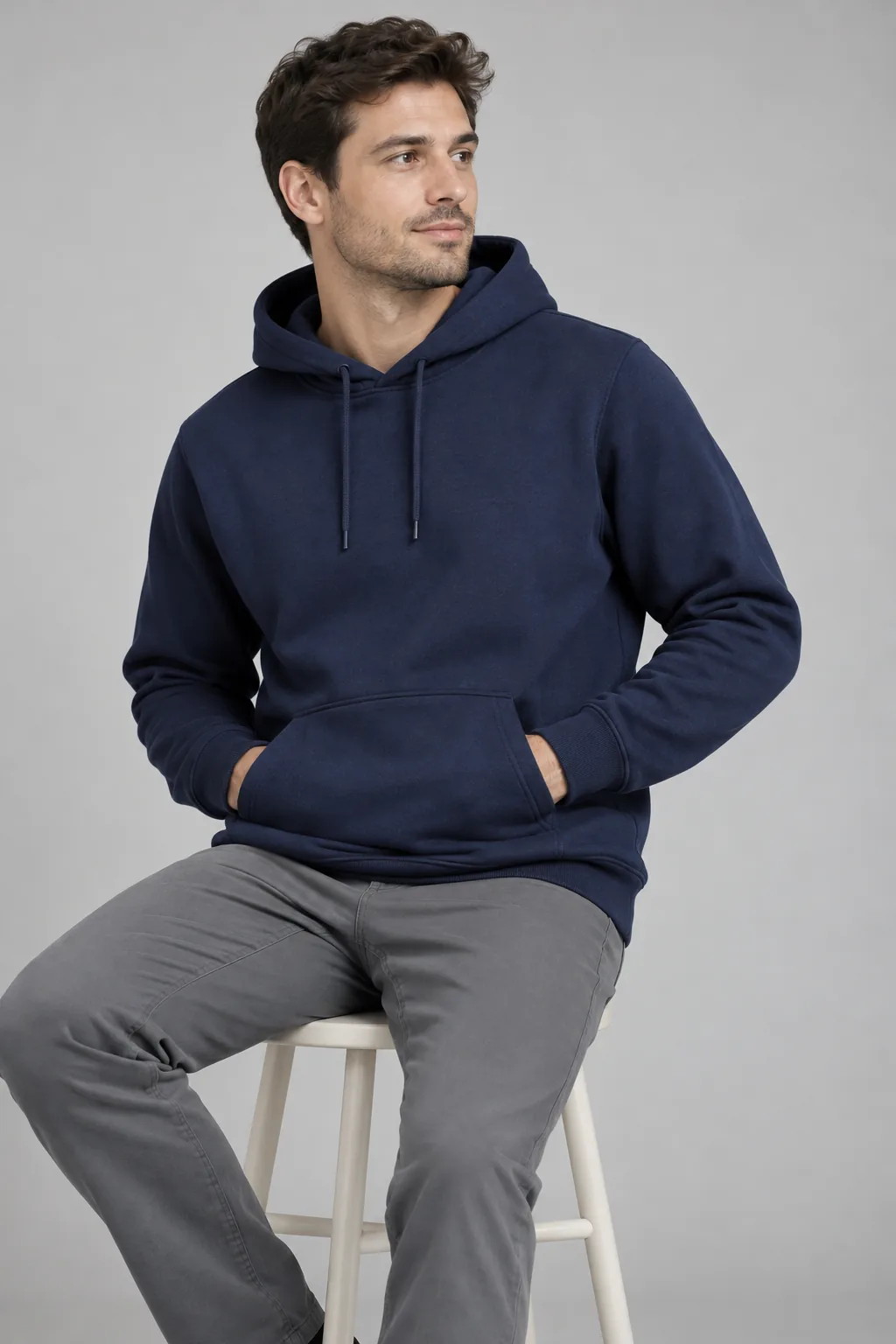
Fit the sample on a person within the intended size’s body-measurement range, wearing the expected base layer. Ask them to enter both hands naturally, then sit, walk, and reach forward. Watch whether the shoulders rise, elbows flare, or the front hem lifts. Record the movement that triggers a problem rather than simply calling the pocket uncomfortable.
On a cropped, wide hoodie, a conventional pocket shape may leave too little space between the opening and waistband. Raising it can improve clearance but force an awkward wrist angle. Consider changing opening angle or pocket height alongside placement, then isolate those changes in the next trial.
If the product brief includes carrying a phone, test a representative device and record its dimensions and mass. Check whether it tips toward the opening when seated and whether its weight drags the pocket below the rib seam. Do not assume a handwarmer pocket provides secure storage unless that function has been designed and tested.
Separate placement errors from fabric and sewing distortion
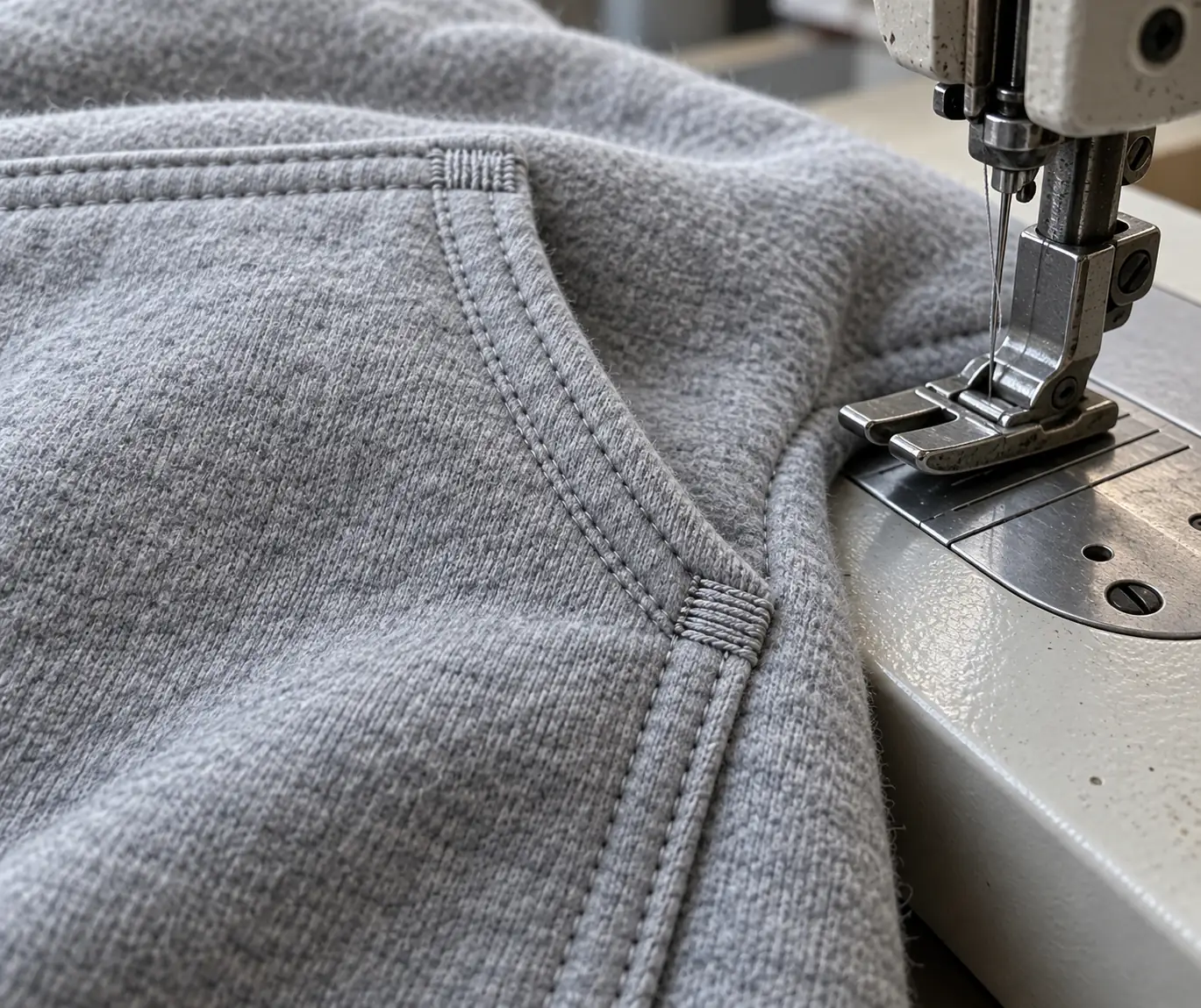
A pocket that appears misplaced may have been attached at the intended coordinates but distorted during assembly. Compare the left and right edges for stretching, check whether the body fabric puckers beneath the top corners, and inspect the opening binding or folded edge. An opening sewn under tension may curl inward and reduce usable access.
Fabric weight alone does not predict this behavior. Two fabrics with similar GSM can differ in stretch, recovery, thickness, and dimensional stability. A soft brushed fleece pocket can sag under a load that a firmer loopback construction supports. Review the actual proposed fabric and pocket construction together before approving coordinates for production.
Inspect the reverse side around reinforcement points. Dense stitching or bulky seam buildup can create hard spots where the wearer’s knuckles enter. Request an attachment adjustment when the seam is causing distortion; request a pattern adjustment when the shape or position itself is wrong. Naming the cause helps prevent an unnecessary redesign.
Verify the position after washing and across sizes
Measure the sample before and after the agreed care procedure, using the same reference points. Record wash and drying conditions, then allow the garment to relax consistently before remeasuring. Different changes in the body, pocket, and rib can alter clearance even when all three looked correct before washing.
For example, a pocket bottom that starts 30 mm above the rib joining seam might end up visibly crowded after care. Investigate the dimensional changes before moving its pattern position upward. A placement correction alone may not solve continuing distortion or puckering. Keep pre-care and post-care results separate in the approval record.
Size grading also needs a placement decision. Do not assume pocket width, opening length, and vertical position should grow at the same rate as chest circumference. Review a smaller and larger size appropriate to the order’s range, especially for oversized fits. Larger chest width does not automatically imply proportionally longer arms or a need for a much lower pocket.
Check the relationship to front decoration as well. A pocket that clears a chest print in the base size may approach it in another size if the artwork position stays fixed while pocket coordinates change.
Use a pocket approval checklist to close the sample round
Assign the review to one person who consolidates fit, design, and technical comments. A single marked-up record is easier to act on than conflicting messages. Before closing the round, check the following against the current specification revision:
- Position: Confirm center alignment, vertical level, and rib clearance using the defined references.
- Symmetry: Compare opening endpoints, visible corner shapes, and left/right attachment lines.
- Function: Confirm comfortable hand entry while standing and seated, plus any specified carrying test.
- Construction: Inspect reinforcement, seam security, puckering, and uncomfortable bulk inside the openings.
- Stability: Record post-care dimensions and resolve any unexplained change in shape or clearance.
- Transfer: Put approved coordinates and grading decisions into the specification, with dated photographs.
Give the sample a clear disposition. Approve when the agreed criteria are met. Request a correction and verification when a limited sewing issue remains. Require another sample when placement, pocket geometry, or fabric changes affect fit and function. A promise to “fix in bulk” is insufficient evidence for a change that has never been worn or measured.
StitchQuote offers cut-and-sew, private label, sampling, fabric and trim sourcing, branding, and QC before packing. Its MOQ for most categories starts from 50 pieces per style. A 7-day sample is available for standard styles with confirmed specs and available materials; complex styles, custom washes, and custom-developed fabric take longer. Include pocket-specific acceptance criteria in the sampling brief.
Questions buyers ask before signing off pocket placement
Can I approve the body fit while leaving the pocket unresolved?
Yes, provided the approval record explicitly limits what has been accepted. State that pocket placement and function remain pending, identify the next verification step, and avoid treating the garment as fully approved for production. Changing the pocket can still affect the front’s drape.
Should the pocket sit at the same distance from the hem in every size?
That depends on the intended proportions and wearer reach. Use the rib joining seam or another clearly defined reference rather than an unspecified “hem.” Validate the proposed grading rule on additional sizes before applying it throughout the range.
What if the measurements pass but the pocket looks crooked?
Check body twist, uneven rib attachment, pocket shape, and stretched edges. Reposition the garment without forcing it square and compare both sides again. A dimensional pass does not override a visible construction defect; document the cause and required correction.
Can a photograph replace the revised physical sample?
A photograph can confirm a visible detail, but it cannot prove comfortable reach, internal bulk, or loaded sag. If the revision changes those properties, inspect a physical sample. Match the verification method to the specific issue being closed.
Related reading and project support
- Prepare a tech pack with measurable garment details
- Review sampling and minimum order quantities
- Understand hoodie GSM and fabric weight
- Discuss your hoodie sample brief with StitchQuote
Request a manufacturing quote
Share your product type, quantity range, and destination. We usually reply within one business day.