Custom Streetwear, Casualwear & Denim Manufacturer•MOQ 50 pcs•Denim MOQ 100 pcs•7-Day Sample Available

Denim Mill, Garment Factory, or Wash House: Who Owns Each Approval?
Assign denim approvals across mill, garment factory, wash house, and buyer with an evidence matrix, handoff checklist, and after-wash fit example.

A denim mill typically supplies fabric, a garment factory develops and assembles the jeans, and a wash house carries out the agreed garment-finishing work. However, the buyer should not infer approval responsibility from those names. Identify who performs each task, who checks the evidence, who authorizes the next stage, and who coordinates corrections across the businesses.
When planning a denim manufacturing project, request a responsibility map before the first combined approval. One supplier may coordinate all three operations, or the buyer may contract with them separately. Neither arrangement removes the need for written handoffs, and a garment sourcing partner should not be assumed to be a fabric mill.
Map the actual route from fabric to finished jeans
Ask whether fabric is being purchased greige, partially processed, or finished to an identified specification. Greige refers to fabric before the relevant finishing processes, but the supplier should state the exact supplied condition rather than relying on shorthand. Identify any separate fabric finisher between the weaving mill and garment factory.
Then name the party responsible for pattern development, cutting, sewing, garment washing, pressing, inspection, and packing. Record subcontracted steps openly. The person sending the invoice may coordinate a process without physically performing it.
A useful map names both a technical contact and a commercial contact. The technical contact explains what changed in a fabric or wash trial. The commercial contact coordinates schedule, cost, and authorization consequences. Those responsibilities can sit with one person, but they should not be left undefined.
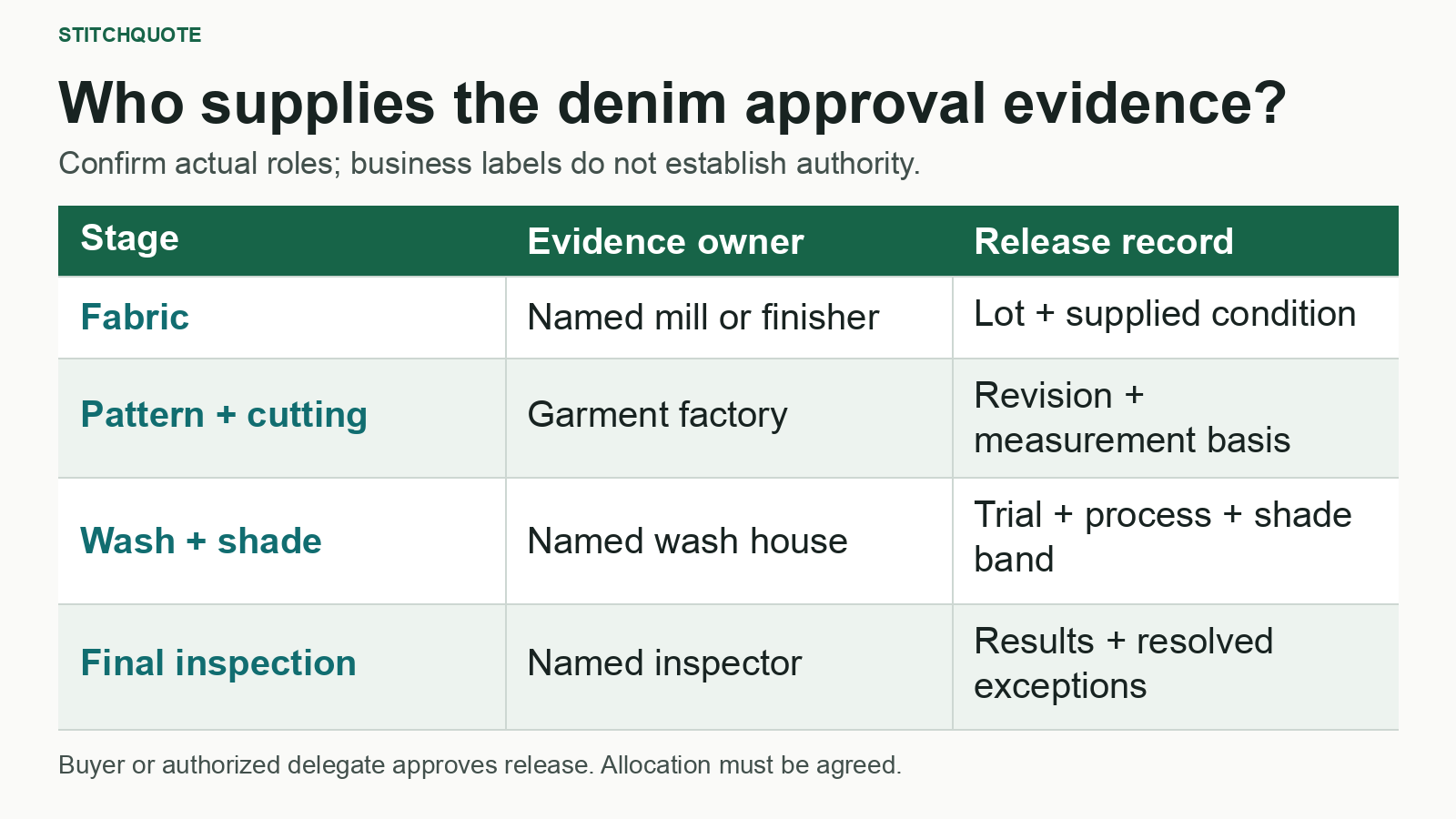
Assign evidence and release authority by stage
| Stage | Evidence provider to confirm | Buyer release question |
|---|---|---|
| Fabric supply | Mill or finisher: lot, construction, supplied state, test records | Is the identified material accepted for trials or bulk? |
| Pattern and cutting | Garment factory: revision and measurement basis | Does the pattern reflect the approved fabric and wash evidence? |
| Wash and shade | Wash house: trial ID, process revision, finished references | Are shade range and after-wash results approved? |
| Final inspection | Named inspector: garment, quantity, and exception records | Are release conditions met and exceptions resolved? |
This table proposes a starting allocation, not a universal contractual rule. Confirm each party’s actual role. The buyer may delegate a review to a qualified agent, but the approval record should show that authority rather than merely copying the buyer into an email.
The garment factory needs usable dimensional-change evidence when developing allowances. The mill’s fabric test and the wash house’s garment result can concern different conditions. Ask the technical team to explain how they relate instead of averaging incompatible figures or assuming a fabric report predicts every finished measurement.
Make the three-party handoff reproducible
Before the mill releases material, agree the fabric code, lot identifiers, quantity, supplied condition, inspection record, and recipient. The garment factory should preserve that identity through cutting and sewing batches. Without it, a later shade or fit issue may be impossible to connect to its source lot.
Before the wash house receives garments, supply the style revision, fabric lot, pre-wash measurement record, construction and trim information, and approved trial reference. Identify any hardware or labels that change the process sequence. Ask the wash house to confirm receipt and any discrepancy before processing.
After finishing, require the batch identity, applied process revision, after-wash measurements, shade assessment, and exception quantities. The wash development and bulk-repeatability guide addresses the supporting reference system. The ownership question here is who delivers and approves those records at each transfer.
- Use one shared style and lot identity across all handoffs.
- State the supplied condition and work authorized next.
- Record counts received, consumed for trials, held, and released.
- Name the recipient responsible for checking discrepancies.
- Identify which change requires a new buyer authorization.
Resolve an after-wash fit dispute with records
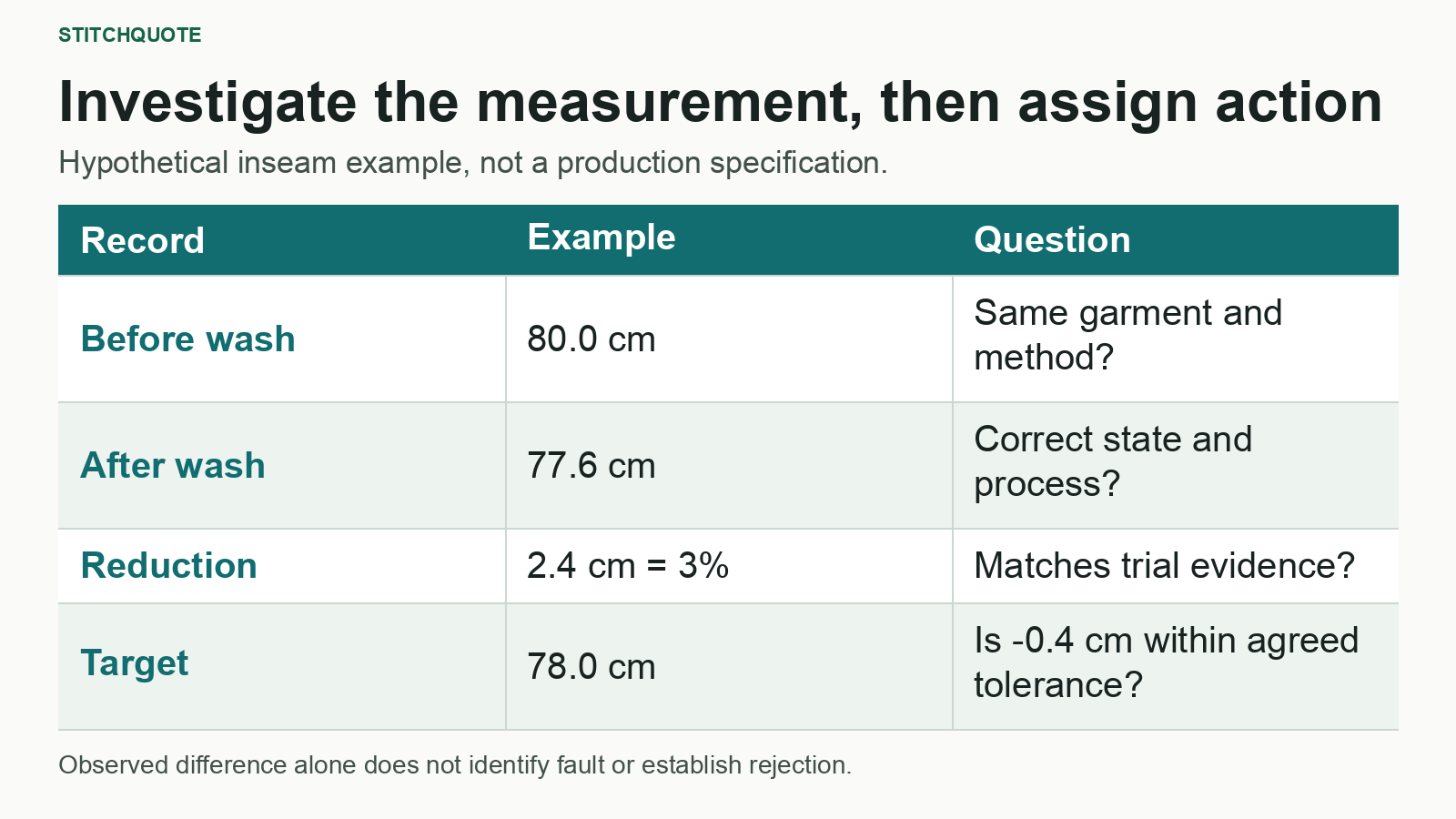
Consider a hypothetical inseam dispute. A garment measures 80.0 cm before washing and 77.6 cm afterward. The reduction is 2.4 cm, or 3% of the initial 80.0 cm. The buyer’s illustrative after-wash target is 78.0 cm, so the observed result is 0.4 cm shorter than target. These are example measurements, not recommended specifications or acceptance limits.
The garment factory might question the wash result; the wash house might question the allowance. Neither explanation should become the conclusion without evidence. First establish the measurement method, garment state, sample identity, and agreed tolerance. The difference from target cannot be classified as acceptable or defective until that basis is confirmed.
Then compare the actual material lot, pattern revision, pre-wash garment record, approved trial, and applied wash instruction. If the trial used different fabric, or the process changed, identify that mismatch and request a controlled retest. A single result does not establish which party caused the issue.
CottonWorks’ dimensional-change guidance explains that materials, construction, processing, and care can all contribute. Use a qualified technical reviewer where needed. Do not turn an operational responsibility matrix into a legal finding about fault or compensation.
Control changes and hold affected work
Require proposed changes to identify the old and new material or process, reason, affected quantities, technical evidence, and commercial impact. A new fabric lot may be routine within an agreed system, but an unreviewed material substitution or changed wash instruction should not inherit approval automatically.
Ask the coordinating supplier to name the work that can continue and the work that must pause. For example, a shade question might hold affected wash batches without requiring unrelated packing preparation to stop. The boundary should be written by the responsible team, not assumed from a general stop message.
The apparel sampling guide helps connect trials and PP approval to those release decisions. Keep the retained garment, fabric references, revision list, and sign-offs accessible to everyone who needs to reproduce the approved result.
FAQ
Can one supplier own all approvals?
One supplier can coordinate them, but document who performs each technical task and which approvals it may make on the buyer’s behalf. A single contact is useful only when the underlying responsibilities remain clear.
Does a mill’s fabric approval authorize cutting?
Not by itself. Confirm the garment factory’s checks and the buyer’s release conditions, including the material identity, pattern basis, and relevant wash evidence. Fabric acceptance and cutting authorization are different decisions.
Who pays when the after-wash size is wrong?
That depends on the evidence, agreed responsibilities, and contract terms. Preserve the records, agree a technical investigation, and seek qualified advice for remedies rather than assigning payment responsibility from a process label.
Send your denim supply route and open approval questions to StitchQuote to discuss a handoff plan with named evidence owners.
Request a manufacturing quote
Share your product type, quantity range, and destination. We usually reply within one business day.