Custom Streetwear, Casualwear & Denim Manufacturer•MOQ 50 pcs•Denim MOQ 100 pcs•7-Day Sample Available
Denim Pocket Placement Approval Checklist for Custom Jeans Production
Approve denim pocket placement before custom jeans production by checking front pockets, back pockets, symmetry, yoke relationship, wash behavior, grading, and PP samples.

Denim pocket placement is one of the most visible details in custom jeans production. A pair of jeans can have the right fabric, wash, hardware, and fit direction, but still look wrong if the front pockets, coin pocket, back pockets, or pocket stitching sit in the wrong place. Pocket placement affects proportion, wearer-facing fit, brand identity, and bulk QC.
For denim-specific quoting and production planning, review our custom jeans production page.
This checklist helps denim buyers approve pocket details before PP sample approval or low MOQ production. It focuses on practical checks: position, symmetry, yoke relationship, wash behavior, decoration conflicts, grading, and how to document the approved sample.
When denim hardware is part of the same approval round, use how to approve jeans buttons, rivets, and zippers before low moq denim production to check button, rivet, zipper, and trim sign-off before bulk denim production.
For denim wash, leg twist, pocket placement, or fit tolerance decisions, use how to approve jeans after-wash measurements before low moq production to confirm after-wash measurement approval before bulk jeans production.
Why Pocket Placement Matters
Pockets are not only storage. On jeans, pockets shape the front and back view. Back pocket placement affects how the seat looks. Front pocket opening affects comfort and hand access. Coin pocket size and position affect styling. Pocket bags affect bulk and inside comfort. Stitch lines, rivets, and embroidery can make a standard pocket feel like a branded detail.
If you are developing jeans with a custom denim manufacturer, pocket placement should be reviewed with the fit, not after it. A pocket that looks balanced on a flat table may shift when worn if the rise, hip, seat, or yoke shape changes.
Start With the Fit and Rise
Pocket placement depends on fit. High-rise, mid-rise, low-rise, relaxed, slim, straight, wide-leg, and baggy jeans all need different pocket proportions. A back pocket that works on a slim jean can look too small or too high on a loose fit. A pocket that works on a high rise can sit awkwardly on a lower rise.
Before approving pockets, confirm the core fit measurements. The guide to jeans fit tolerance explains why waist, rise, hip, thigh, inseam, and leg opening should be controlled before final production approval.
Check Back Pocket Size, Height, and Angle
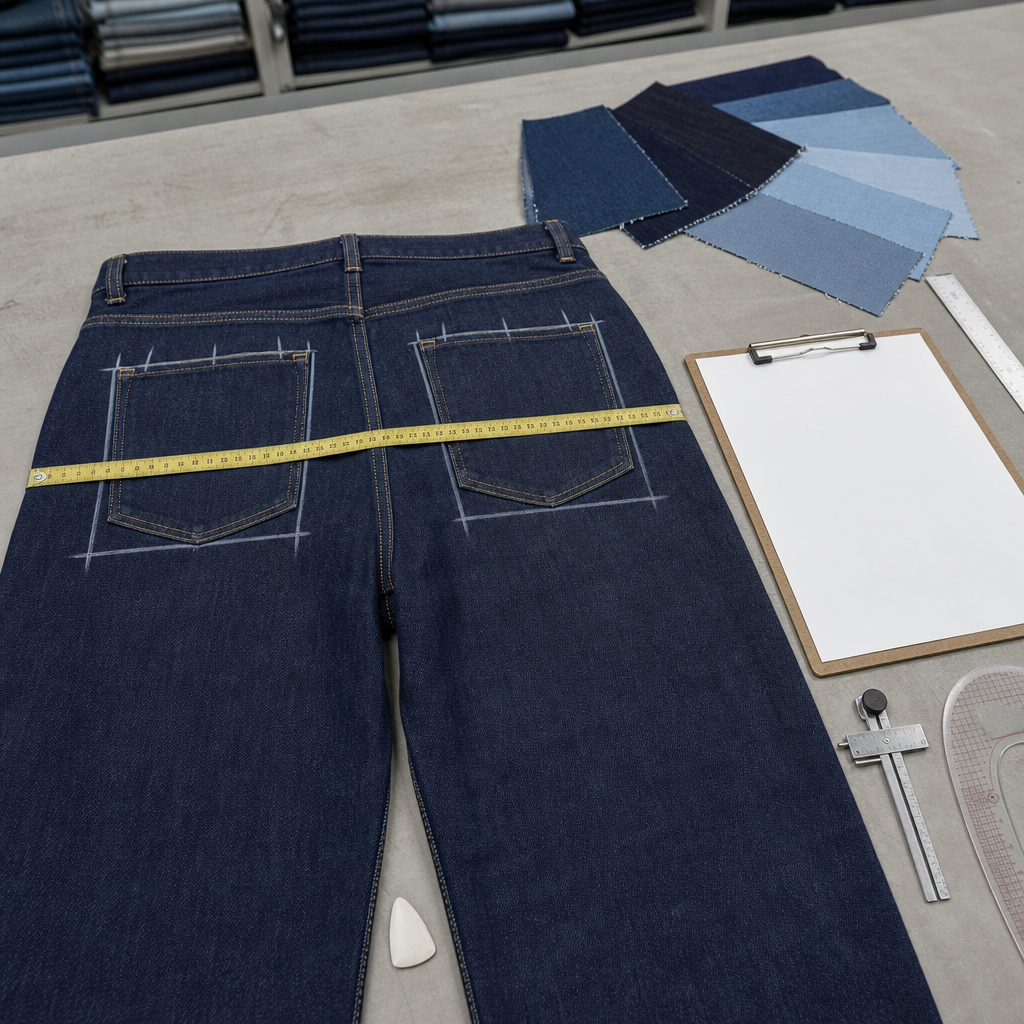
Back pockets are one of the first details customers notice. Review pocket width, height, top opening angle, distance from center back seam, distance from yoke seam, and distance from side seam. Also check whether the two pockets are mirrored correctly.
Small changes can make the back view look balanced or distorted. Pockets placed too high may shorten the seat visually. Pockets placed too low may make the back view look heavy. Pockets placed too far apart can widen the seat, while pockets placed too close can look cramped.
Review Yoke and Pocket Relationship
The yoke seam and back pocket should be approved together. If the yoke angle changes, the pocket may need to move. If the pocket sits too close to the yoke, washing and seam bulk can make the area look crowded. If it sits too far down, the back view may lose structure.
Ask for flat photos and worn photos when possible. Mark the pocket position on the sample photo so the factory knows what is approved. A written comment like “move pocket slightly lower” is not enough unless the amount and reference point are clear.
Approve Front Pocket Shape and Function
Front pocket approval should include pocket opening shape, pocket bag depth, coin pocket placement, rivet position, seam allowance, and whether the pocket is comfortable to use. A pocket can look correct but feel shallow, tight, or bulky.
If the jeans use heavy denim, pocket bag fabric and seam bulk matter more. If the style uses a washed or distressed finish, front pocket edges may change after wash. Review these details before bulk cutting, not only after the PP sample arrives.
Watch Decoration and Hardware Conflicts
Back pocket embroidery, arcs, patches, rivets, labels, bartacks, and contrast stitching can all interact with pocket placement. A rivet too close to the pocket opening can be uncomfortable. Embroidery placed too low can distort after sitting. A leather patch can conflict visually with a high back pocket.
Use the denim hardware workflow in denim hardware approval together with pocket placement notes when the design includes custom buttons, rivets, zippers, or branded trims.
Consider Wash and Shrinkage Effects
Denim pockets can change after wash. The pocket may pucker, shrink slightly, twist, or become more prominent depending on fabric, stitching, seam tension, and finishing. If the jeans use enzyme wash, stone wash, acid wash, pigment effects, or hand sanding, pocket appearance should be checked after the intended wash process.
Pair pocket approval with denim wash approval. A pocket position approved before washing may not look the same after finishing, especially when contrast abrasion or fading is part of the style.
Grade Pocket Placement Across Sizes
Back pocket placement should not be blindly scaled across the size range. Smaller and larger sizes may need adjustments so the pocket still sits in the right visual zone. The same applies to pocket size, distance from center back, and relationship to the yoke.
For low MOQ production, buyers may be tempted to approve only the sample size. That creates risk when the size range includes very different body proportions. At minimum, define which pocket measurements are critical and how they should change across sizes.
Use the PP Sample as the Final Pocket Check
The PP sample should confirm pocket placement, not start the pocket discussion from zero. Before PP approval, check:
- front pocket opening shape and usability;
- coin pocket size and position;
- back pocket width, height, angle, and symmetry;
- distance from yoke, center back seam, and side seam;
- rivets, bartacks, embroidery, labels, and stitching;
- post-wash pocket appearance;
- grading notes for the full size range;
- approved photos and measurement points.
The article on what to check in a denim PP sample can be used with this pocket checklist when preparing final approval notes.
Document Pocket Measurements Clearly
Pocket placement notes should be measurable. Use reference points such as center back seam, yoke seam, waistband seam, side seam, pocket top edge, and pocket corners. Include photos with marks when possible. If pocket placement has a tolerance, write that tolerance into the spec.
For general measurement discipline, connect pocket notes to garment measurement tolerances. The goal is to give QC a repeatable standard, not to rely on memory of how one sample looked.
Practical StitchQuote Note
When StitchQuote reviews custom jeans, pocket placement is treated as part of the fit and wash system. Rise, yoke, seat, pocket size, stitch line, hardware, wash effect, and grading are reviewed together. This helps buyers approve jeans that look balanced in real wear, not only in a flat sample photo.
FAQ
What is the most important pocket placement check on jeans?
Back pocket position is often the most visible because it affects the seat and back view. Buyers should check height, width, angle, symmetry, and relationship to the yoke and center back seam.
Should pocket placement be checked on body?
Yes when possible. Flat-lay checks are useful, but worn photos show how pocket placement interacts with rise, seat, hip, and yoke shape.
Can denim washing change pocket appearance?
Yes. Washing can create puckering, shrinkage, seam torque, fading, and abrasion effects around pockets. Review pocket placement after the intended wash when wash is part of the design.
How should pocket placement be documented?
Use measurements from clear reference points, marked sample photos, approved PP sample images, and tolerance notes so bulk QC can compare production against the approved standard.
[…] the denim pocket placement approval checklist together with hardware review, because pocket shape and rivet placement are usually approved […]