Custom Streetwear, Casualwear & Denim Manufacturer•MOQ 50 pcs•Denim MOQ 100 pcs•7-Day Sample Available


How to Create a Men’s Streetwear Size Chart Your Customers Can Trust

A men’s streetwear size chart does more work than most founders expect. It is the last thing a customer checks before buying an oversized hoodie or boxy tee online, and it is one of the main tools they have to avoid a return. Yet many emerging brands copy a generic chart or publish numbers that don’t match what the factory produced.
This guide walks through how to build a size chart for a men’s streetwear line selling to customers in the US and Europe: which measurements to show, how to handle inches and centimeters, how to explain oversized and boxy fits, and how to keep the published chart tied to your factory spec sheet.
Size Chart vs. Spec Sheet: Know Which One You’re Writing
First, separate two documents that often get mixed up.
- The spec sheet (or graded measurement chart) lives in your tech pack. It lists every point of measure for every size, with tolerances, so the factory can sew and inspect the garment.
- The customer size chart lives on your product page. It shows a short list of measurements a shopper can understand and compare against a garment they already own.
Your customer chart should be pulled from the approved spec sheet, never written separately. If the two drift apart, customers will receive pieces that don’t match what they read, and that usually shows up as returns and negative reviews. If you are still building the tech pack, start there first; the custom streetwear manufacturer page outlines how a streetwear brief usually moves from references to sample.
Garment Measurements or Body Measurements?
There are two common approaches, and men’s streetwear brands usually lean toward the first.
Garment (flat) measurements
These are taken from the finished garment laid flat: chest width, body length, sleeve length, and so on. For relaxed and oversized fits, garment measurements are more honest because the fit is intentionally loose.
Body measurements
These describe the person (chest circumference, waist, height) and tell them which size to choose. Body charts are common for fitted and tailored menswear, but they get confusing with streetwear, because a size M boxy tee is designed to hang well away from an M-sized body.
Practical approach: show garment measurements as the main chart, then add a short fit note such as “Model is 6’0″ and wears size M for an oversized fit.” Base that note on your own sample fittings, and only publish details you have actually confirmed.

Which Measurements to Include, by Category
Keep the customer chart short. Three to five measurements per product is usually enough. Here is a practical starting point for core men’s streetwear categories.
Hoodies and crewnecks
- Chest width (pit to pit, measured 1 inch / 2.5 cm below the armhole)
- Body length (high point shoulder to hem)
- Sleeve length (for drop-shoulder styles, measure from center back neck to cuff, and say so)
- Shoulder width (only for set-in sleeves; it is misleading on heavy drop-shoulder blocks)
Drop-shoulder hoodies are where size charts most often confuse people. If your shoulder seam sits on the upper arm, a “sleeve length” measured from the shoulder seam will look short. Measuring from center back makes styles easier to compare. For more on how hoodie measurements behave across sizes, see our guide to hoodie fit blocks and size grading.
T-shirts
- Chest width
- Body length
- Sleeve length (from shoulder seam or center back; be consistent)
- Shoulder width (optional for boxy, drop-shoulder tees)
Sweatpants and joggers
- Waist (relaxed, laid flat, and stretched if elastic)
- Hip or seat
- Inseam
- Leg opening or cuff width
- Front rise (helpful for customers who care about how the pant sits)
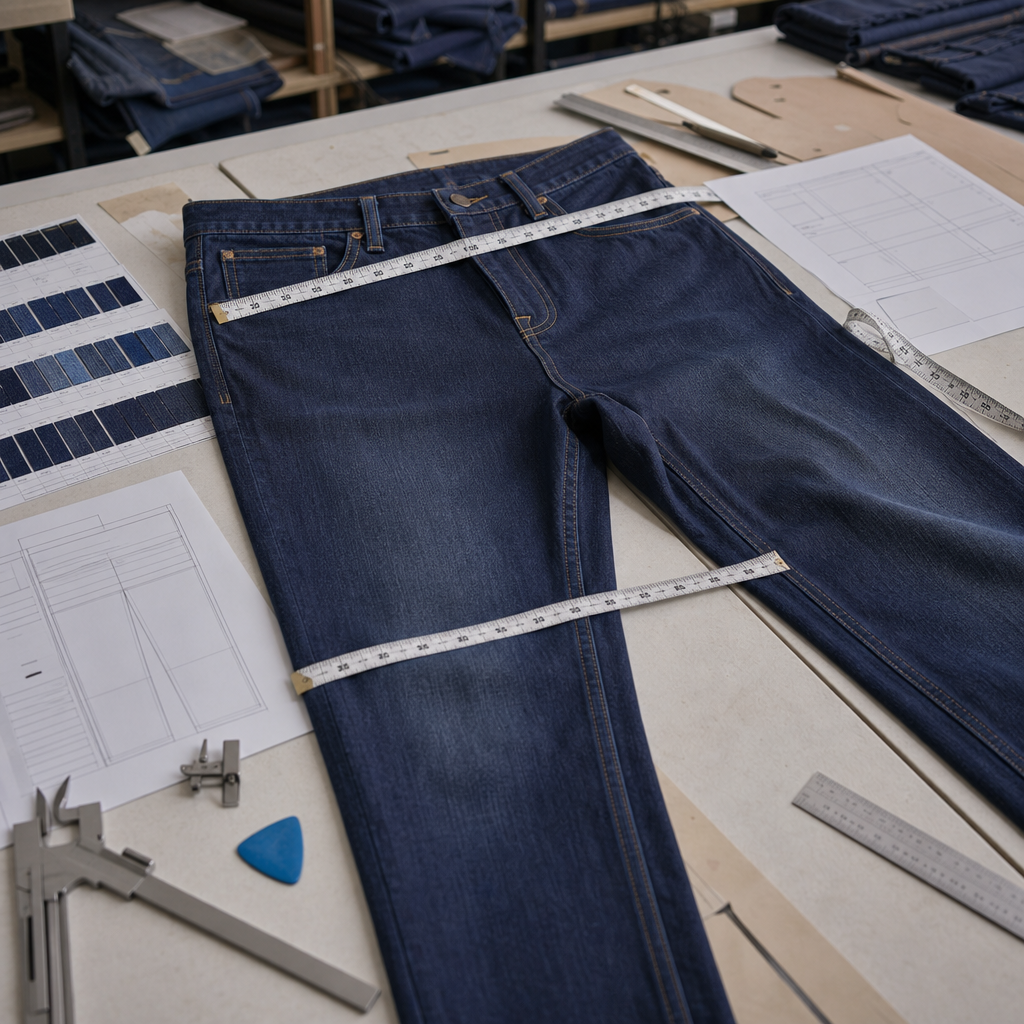
Jeans
Men’s denim shoppers in both the US and Europe are used to waist and inseam sizing in inches (for example, W32 L32). If you sell denim:
- Label sizes by waist and length, and also give the actual garment measurements
- Include waist, front rise, thigh, knee, leg opening, and inseam
- Note whether measurements were taken after washing
Denim can change significantly through the wash process, so your chart should reflect post-wash numbers from the approved sample. Our article on approving jeans measurements after washing explains why.
Inches, Centimeters, and US vs. EU Customers
If you sell to both the US and Europe, plan for both units from day one.
- Show both inches and centimeters. US customers think in inches; most European customers think in centimeters. A toggle or a dual-column table works well.
- Convert from one source. Pick one unit as the master (whatever your spec sheet uses) and convert the other with consistent rounding.
- Round sensibly. Rounding to the nearest 0.5 inch or the nearest centimeter is easier to read than long decimals.
- Letter sizes travel well. S, M, L, XL, and XXL are widely used for men’s casualwear in both markets, so most streetwear brands keep letter sizing for tops and bottoms. EU numeric sizes (like 48 or 50) are more common in tailoring, so you generally don’t need them for hoodies and tees.
- Explain “flat” vs. “circumference.” European shoppers may expect a full chest circumference, while many US streetwear brands publish flat (half) chest width. Label it clearly, for example “Chest width (flat, pit to pit),” so nobody doubles or halves the number by mistake.
How to Explain Oversized and Boxy Fits
Fit language causes more confusion than the numbers do. “Oversized” means different things at different brands, so spell it out.
- Describe the intent: “Designed oversized. Size down for a closer fit.”
- Give a comparison point: “Wider and shorter than a standard tee” for a boxy fit, or “Drop shoulder, longer sleeve” for an oversized hoodie.
- Keep fit names consistent: if “Boxy Fit” means one specific block, use the same name and block every season.
If you’re deciding between fits, our explainer on boxy t-shirt fit for streetwear brands covers how proportions change between boxy and standard oversized blocks.
Account for Shrinkage and Tolerance
Your size chart is a promise, and two production realities affect how closely you can keep it.
Shrinkage
Cotton fleece, French terry, and jersey can shrink after the customer’s first wash, depending on fabric, finishing, and care. Decide whether your chart shows pre-wash measurements, post-wash measurements, or both, and say which one. Test the approved fabric with the care method on your label before you publish numbers. Our guide on how fabric shrinkage affects garment measurements goes deeper.
Measurement tolerance
No cut-and-sew garment comes out identical every time. Factories work to an agreed tolerance for each measurement point. It is good practice to add a line such as “Measurements may vary slightly” under the chart, and to set those tolerances clearly with your manufacturer, ideally in writing in the tech pack. See garment measurement tolerances for small-batch orders for how to set them.
A Simple Process for Building Your Chart
- Approve the fit sample in your base size (often M for menswear).
- Review the size set (at least the smallest, base, and largest sizes) to confirm grading looks right across the range.
- Wash-test if your chart will show post-wash numbers.
- Pull the customer measurements from the approved, graded spec sheet.
- Convert units from one master source with consistent rounding.
- Add fit notes and a how-to-measure diagram that show exactly where each measurement is taken.
- Check bulk against the chart. When production arrives, measure a few pieces per size and compare them with the published chart before launch.
- Update and version it. If a reorder uses a new fabric or adjusted pattern, update the chart and note the change internally.
A clear chart can’t fix a size run that doesn’t match your customers. Our guide on choosing size breaks for a first low MOQ order covers how to spread a small first order across sizes.
Common Size Chart Mistakes
- Copying another brand’s chart instead of measuring your own approved samples
- Mixing flat and circumference measurements in the same table
- Measuring sleeves from the shoulder seam on drop-shoulder styles without saying so
- Publishing sample measurements that were never checked against bulk
- Forgetting to update the chart after a fabric or pattern change on a reorder
FAQ
Should a men’s streetwear size chart use body or garment measurements?
For oversized, boxy, and relaxed fits, garment measurements are usually clearer, because the fit is intentionally loose. Add a fit note or model reference to help customers choose.
Do I need separate size charts for US and European customers?
Usually not. One chart with letter sizes plus both inches and centimeters works for most streetwear brands. Just label clearly whether chest and waist are flat or full circumference.
Can my manufacturer help with the size chart?
A manufacturer can supply the graded measurement chart from the approved spec sheet and the inspection measurements from bulk. Your brand still decides which points to show customers and how to describe the fit.
Build Your Fit Before You Build Your Chart
A reliable men’s streetwear size chart starts with a reliable sample and a clear spec sheet. StitchQuote works with emerging streetwear brands on hoodies, tees, sweatpants, joggers, and denim, with sampling designed to lock fit and measurements before bulk. Most apparel categories start from 50 pieces per style, and denim starts from 100 pieces per style; the sampling and MOQ page explains how it works, including when a 7-day sample is realistic for standard styles.
If you are developing a men’s streetwear line and want to lock fit before you publish a single size chart, send us your tech pack or references to request a sample quote.
By StitchQuote Production Team
Request a manufacturing quote
Share your product type, quantity range, and destination. We usually reply within one business day.
One comment
Comments are closed.
[…] A clear tech pack and a reference garment are the cheapest way to cut sample rounds. Our guide to building a men’s streetwear size chart helps you lock measurements […]