Custom Streetwear, Casualwear & Denim Manufacturer•MOQ 50 pcs•Denim MOQ 100 pcs•7-Day Sample Available
Cut and Sew vs Blanks for Streetwear Brands
A practical comparison of cut-and-sew production and decorated blanks for streetwear brands, including fit control, MOQ, sampling risk, cost, and brand positioning.

Streetwear brands often ask whether they should start with cut-and-sew production or decorate existing blanks. The honest answer is that both routes can work, but they solve different problems. Blanks help a brand move faster with less product-development risk. Cut and sew gives more control over fit, fabric, construction, and long-term product identity.
The mistake is treating the choice as a status symbol. Cut and sew is not automatically better, and blanks are not automatically cheap or unserious. The right route depends on what the product needs to prove, what the brand can afford to sample, and how much control matters for the first drop.
For stitch type, stress-point, and seam finishing checks, review how to approve cut and sew seam construction before low moq bulk production before approving cut-and-sew bulk production.
What Blanks Actually Mean
A blank is a finished garment that already exists before your brand adds decoration, labels, packaging, or selected finishing details. A blank T-shirt, hoodie, sweatshirt, or sweatpant may be sourced from stock or from a supplier’s existing base style. The brand then adds screen print, embroidery, DTG, heat transfer, labels, hangtags, or packaging.
Blanks are useful when the core garment is not the main innovation. If your first release is driven by graphics, community, speed, or market testing, a good blank can reduce development time and simplify production.
What Cut and Sew Actually Means
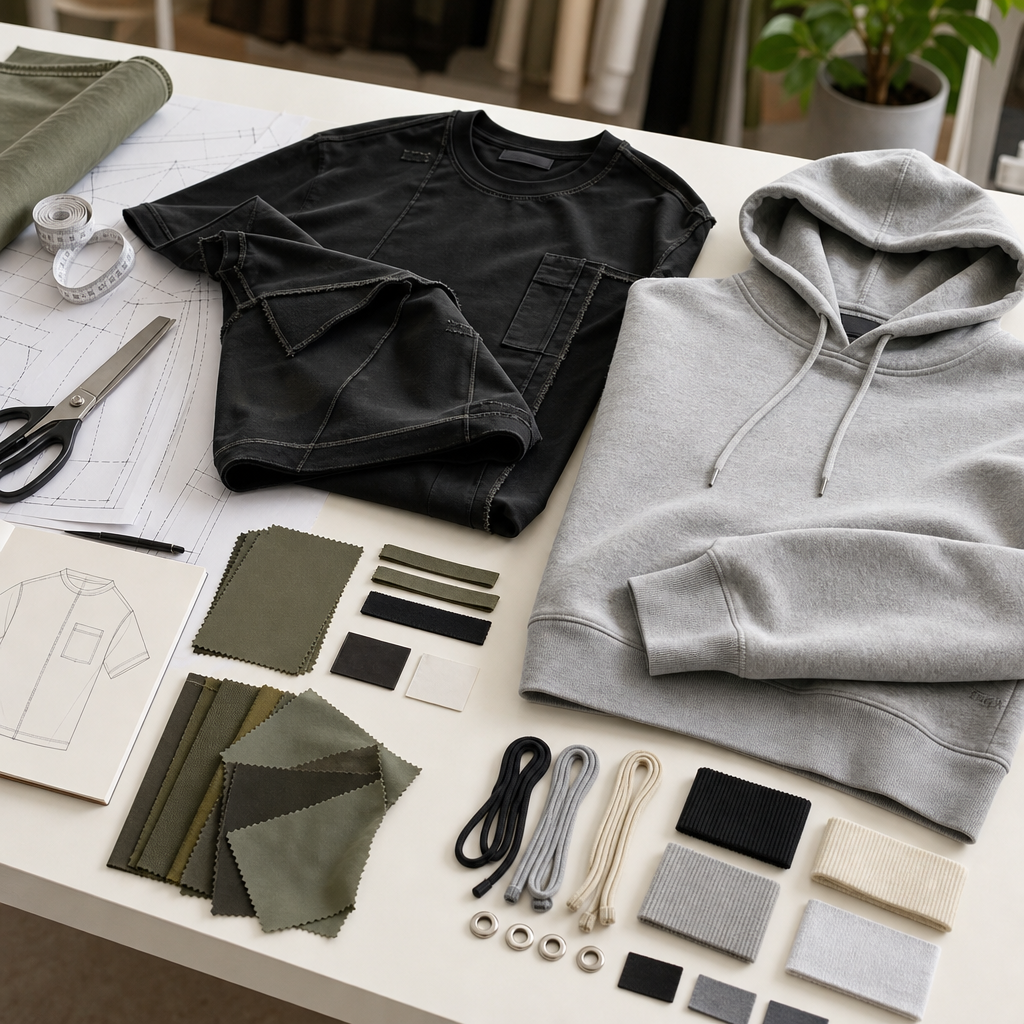
Cut and sew means the garment is made from fabric and pattern pieces rather than decorated after it already exists. The manufacturer cuts fabric panels, sews the garment, applies trims, and builds the product according to your spec. This gives the brand more control over silhouette, fabric, measurement, stitching, labels, and finishing.
Cut and sew is not only for complex fashion products. A heavyweight boxy T-shirt, cropped hoodie, custom sweatpant, or matching set can all be cut-and-sew products when the fit and material need to be specific.
If you are evaluating a long-term supplier, the distinction matters. A private label clothing manufacturer may support both routes, but the workflow, quote assumptions, and sampling risk are different.
When Blanks Are the Better First Move
Blanks usually make sense when speed and validation matter more than garment-level uniqueness. This is common for early drops, event merchandise, creator brands, community brands, and graphic-led capsules.
Blanks may be the better route when:
- You need to launch quickly.
- Your main value is artwork, message, or audience rather than fit engineering.
- You have not confirmed demand yet.
- You want to test several graphics or colors without developing every body from scratch.
- Your budget is better spent on content, sampling, photography, and customer acquisition.
- A proven blank already matches the fit and handfeel you want.
The trade-off is that many other brands can access similar bodies. You may still create a strong product through artwork, styling, packaging, and storytelling, but the garment itself may be harder to own as a signature fit.
When Cut and Sew Is Worth the Extra Work
Cut and sew is worth considering when the garment itself is central to the brand promise. If your customers are buying the shape, fabric, wash, construction, or fit, then blanks may limit the product too much.
Cut and sew may fit better when:
- You need a specific oversized, cropped, boxy, or relaxed silhouette.
- The fabric weight, drape, or surface feel is part of the product value.
- You want custom construction details, pockets, paneling, rib, stitching, or hardware.
- You need consistent private label branding inside the garment.
- You plan to reorder and improve the same product over time.
- You want the product to become a recognizable core style, not just a graphic canvas.
For streetwear, this is where a custom streetwear manufacturer can help translate brand references into production specs instead of only adding decoration to a stock item.
MOQ and Cost Are Not the Same Question
Many buyers compare blanks and cut-and-sew production only by unit price. That is too narrow. A blank may have a lower development cost and shorter timeline, but the final margin depends on blank cost, decoration, relabeling, packaging, shipping, defects, and selling price. Cut and sew may require more sampling, but it can support a stronger product position if the garment justifies a higher retail price.
MOQ also depends on fabric, color, trim, dyeing, decoration, and supplier workflow. A low MOQ route can still become expensive if the buyer asks for too many colors, special trims, and complex decoration at the same time. For more context, see StitchQuote’s low MOQ clothing manufacturer page.
Fit Control Is the Biggest Practical Difference
The biggest difference between cut and sew and blanks is fit control. With blanks, you choose from an existing body. You may be able to select a premium blank, heavyweight blank, boxy blank, or oversized blank, but you are still working inside an existing pattern.
With cut and sew, the fit can be developed around your target customer. You can adjust shoulder drop, body width, sleeve shape, neckline, hem, rise, inseam, or pocket placement. That control is valuable, but it also means you need clearer decisions and better sample review.
If your brand cannot yet explain what is wrong with existing blanks, cut and sew may be premature. If your brand knows exactly why existing blanks do not work, cut and sew becomes much easier to justify.
Sampling Risk Changes by Route
Blank-based products still need sample approval. You need to check decoration placement, print quality, embroidery density, label application, packaging, and color. But the base garment is usually already solved.
Cut-and-sew samples need broader review. The sample must prove the pattern, measurements, fabric, shrinkage expectation, sewing construction, trims, decoration, and finishing. That does not make cut and sew risky by itself. It means the sample has more jobs to do.
Use a structured sample checklist before approving either route. StitchQuote’s guide to what buyers should finalize before asking for a sample quote is a useful starting point.
A Hybrid Route Often Works Best
Many streetwear brands do not need to choose one route forever. A practical first collection might use blanks for graphic tees and cut and sew for the hero hoodie. Another brand might start with blanks to test demand, then move the best-selling silhouette into cut-and-sew production once sizing feedback and reorder confidence are stronger.
This hybrid approach keeps the first drop manageable. It also helps the brand learn which products deserve deeper development. Not every item needs to carry the same production complexity.
How to Decide Before You Quote
Before asking a factory for pricing, answer these questions:
- Is the garment body itself unique, or is the artwork the main value?
- Does an existing blank already match the fit and fabric target?
- How many sample rounds can the budget support?
- Is the product meant to validate demand or become a long-term core style?
- How many colors and sizes are really needed for the first order?
- Can the selling price support the chosen development route?
- What details must be custom now, and what can wait until reorders?
If the answers point toward speed and testing, blanks may be the cleaner first step. If the answers point toward fit ownership, fabric control, and long-term product identity, cut and sew may be worth the added development work.
Practical StitchQuote Note
For startup and growing streetwear brands, we usually look at the business goal before recommending a production route. A first drop should not become so complicated that it drains all budget before customers can respond. At the same time, a brand built around premium fit or fabric should not force itself into blanks if the blank body weakens the product promise.
The strongest sourcing decision is the one that matches the product’s job. Use blanks when they help you learn faster. Use cut and sew when the garment needs to become your own.
FAQ
Is cut and sew always higher quality than blanks?
No. Quality depends on fabric, construction, fit, finishing, and quality control. A strong blank can outperform a poorly developed cut-and-sew garment. Cut and sew gives more control, but control only helps when the spec and sample process are clear.
Are blanks better for low MOQ streetwear?
Blanks can be better when the brand needs speed, lower development risk, and simpler first-drop testing. Low MOQ cut-and-sew production can also work, but it needs clearer garment decisions and a realistic sample process.
Can I relabel blanks as private label products?
In many cases, yes, but the options depend on the blank supplier and the garment construction. Main labels, care labels, neck prints, hangtags, and packaging may be possible, but buyers should confirm what can be changed before ordering.
When should a brand move from blanks to cut and sew?
A brand should consider moving when it has demand proof, fit feedback, reorder confidence, or a clear reason existing blanks no longer support the product direction. Moving too early can add cost without improving the offer.
Can one collection use both routes?
Yes. A hybrid collection is often practical. For example, a brand might use blanks for graphic tees and cut and sew for a signature hoodie, sweatpant, or matching set. This keeps complexity focused where it matters most.
Request a manufacturing quote
Share your product type, quantity range, and destination. We usually reply within one business day.
6 Comments
Comments are closed.
[…] article on cut-and-sew versus blanks for streetwear brands explains the sourcing tradeoff. Once a buyer chooses cut-and-sew, the next risk is sample approval: […]
[…] the project is still deciding between decorating blanks and developing a custom body, read Cut and Sew vs Blanks for Streetwear Brands. The right production route affects how much control you have over fit, placement, fabric, and […]
[…] the buyer is still deciding between custom construction and ready-made blanks, review cut and sew vs blanks for streetwear brands. That decision affects how much pattern, measurement, material, and construction information the […]
[…] route, measurements, fabric, trims, and finishing need to match a custom product direction. Review cut and sew versus blanks when deciding how much construction control the project really […]
[…] Custom cut-and-sew vs. decorated blanks. Decorating blanks is faster and cheaper to start; cut-and-sew gives you your own fit and fabric but needs pattern and sample work. See cut and sew vs blanks. […]
[…] a fuller comparison, read cut and sew vs blanks for streetwear brands. If custom construction is essential, explore what to discuss with a cut-and-sew manufacturer […]