Custom Streetwear, Casualwear & Denim Manufacturer•MOQ 50 pcs•Denim MOQ 100 pcs•7-Day Sample Available
Startup Clothing Brand SKU Planning Before the First Production Order
Learn how startup clothing brands should plan SKUs before the first production order, including styles, colorways, size breaks, MOQ pressure, samples, and cash flow.

Startup clothing brand SKU planning should happen before the first production quote, not after the sample looks good. A SKU is not just a product idea. It is a specific style, color, size, fabric, trim, and sometimes print or wash combination that must be sampled, priced, produced, inspected, packed, stocked, and sold.
For a new apparel brand, too many SKUs can create MOQ pressure, cash-flow strain, slow decision-making, and inconsistent quality control. The goal is not to launch the smallest possible line. The goal is to launch a line that the buyer can explain clearly, the factory can produce reliably, and the brand can reorder if the first drop works.
Start With the Real SKU Formula
A common mistake is thinking in product names instead of SKU count. One hoodie does not equal one SKU if it comes in three colors and five sizes. That is 15 SKUs before adding packaging variations, embroidery placements, wash options, or matching pants.
Use this simple planning formula:
Style count x colorways x sizes x decoration or wash variants = operational SKU count.
A first order with two styles, three colors, and six sizes can already create 36 SKU positions. Even if the total order quantity sounds manageable, each SKU still needs a size curve, packing plan, label setup, inspection logic, and sales forecast. This is why SKU planning belongs inside the sourcing conversation with a clothing manufacturer for startup brands, not only inside the brand’s merchandising spreadsheet.
Choose a Launch Architecture Before Choosing Colors
Before deciding every colorway, decide the role of each style in the launch. A practical first line usually has one of these structures:
- Hero product launch: one core product, such as a heavyweight T-shirt or hoodie, with controlled color and size depth.
- Uniform capsule: two or three related styles that use compatible fabric, trims, labels, and branding.
- Matching set launch: top and bottom styles designed together, often using shared fleece, color, rib, and packaging decisions.
- Category test: a narrow test of one product category before expanding into more silhouettes.
The launch architecture should match the brand’s budget and production readiness. A startup does not need to prove every idea in the first order. It needs enough focus to learn what customers buy, what sizes move, what colors reorder, and which construction details should be refined.
Control Colorways Before They Multiply MOQ
Color is one of the easiest ways to overcomplicate a first order. Each color may require separate fabric availability checks, lab dips, dye lot approval, trim matching, artwork color review, and packing forecasts. If the same style uses different fabric colors and different print colors, the approval workload grows quickly.
For first production, consider starting with one core color, one commercial neutral, and one brand-specific accent only if demand and budget justify it. If the brand cannot explain why each color should exist, it may be better to reduce colorways and protect fit, fabric, and quality. The earlier article on why too many colors can break a small first order explains this risk in more detail.
Plan Size Breaks From the Sales Reality
Size planning is not only a fit decision. It is also an inventory decision. A full size range may look inclusive and professional, but it can spread a small order too thin if the total quantity is limited. The buyer should decide whether the first order needs every size immediately or whether the first production run should focus on the sizes most likely to sell.
When planning size breaks, ask:
- Which size range is essential for the target customer?
- Does the fit run oversized, standard, cropped, boxy, relaxed, or slim?
- Will size grading change fabric consumption enough to affect pricing?
- Can the pattern and measurements support the size range without distorting the design?
- How will the brand handle out-of-stock sizes if only a narrow curve is produced?
Fit and measurement clarity should be settled before the size curve is finalized. For production approval, connect the SKU plan to measurement notes and realistic tolerances. The guide to garment measurement tolerances for small batch clothing orders is useful when deciding how strict the first inspection should be.
Separate Product Testing From Full-Line Production
Some startup buyers try to sample every future product at once. That can be useful for design exploration, but it is not always the best path to a first sellable order. Sampling and bulk production have different goals.
Sampling should answer whether the fit, fabric, construction, decoration, and trim direction can work. Production should focus on the styles that are ready enough to repeat. If a style still needs pattern changes, fabric replacement, artwork adjustment, or trim sourcing, it may be better to keep it in development and produce a tighter first line.
Before asking for a quote, review the checklist in what buyers should finalize before asking for a sample quote. A manufacturer can quote more responsibly when the SKU plan, sample priority, and approval sequence are clear.
Compare Quotes by SKU Pressure, Not Only Unit Price
A low unit price can be misleading if the order is split across too many small SKU quantities. Factories still need to manage fabric ordering, cutting, sewing, trimming, labeling, packing, and inspection. Many tiny SKU lots can create inefficiency even when the total order quantity is not extremely small.
When comparing quotes, ask what changes if you reduce one color, combine trims, use the same fabric across styles, or increase depth in the strongest SKU. The article on price per piece at different MOQs gives a useful framework for understanding why the cheapest-looking option may not be the most practical first order.
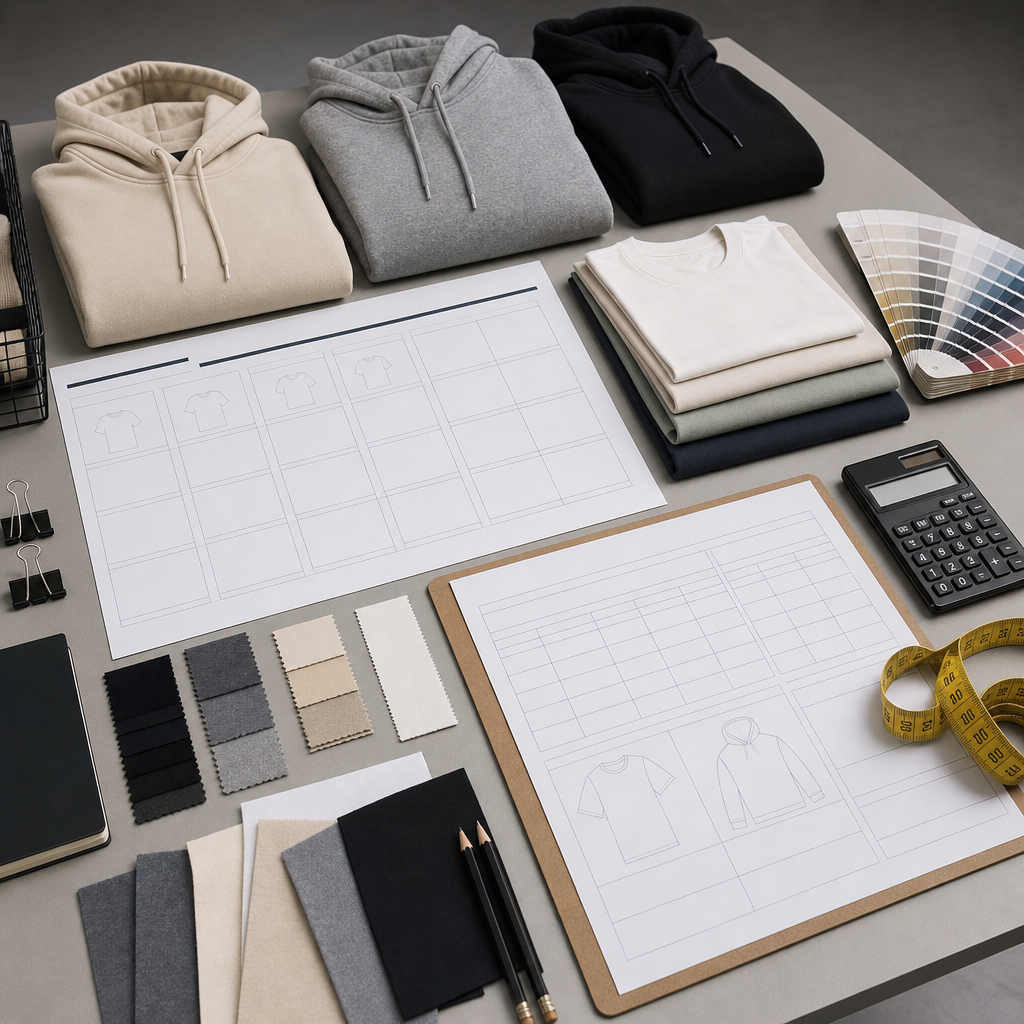
Build a First-Order SKU Planning Table
A simple table can prevent weeks of unclear communication. For each proposed SKU, list:
- style name and product category;
- fabric, weight, and finish;
- colorway and whether it needs lab dip approval;
- size range and planned quantity by size;
- decoration method, placement, and artwork version;
- label, hangtag, packaging, and trim notes;
- sample status: not started, first sample, revised sample, or approved;
- decision status: produce now, hold for revision, or save for reorder.
This table turns the brand’s launch idea into a manufacturing brief. It also helps the buyer see where complexity is hiding. If 80 percent of the revenue plan depends on one hoodie and one T-shirt, those products deserve more attention than a long list of unproven accessories.
Practical StitchQuote Note
StitchQuote usually recommends that startup buyers plan the first order around clarity: fewer unresolved fabrics, fewer untested colors, fewer custom trims, and a size curve the brand can actually sell. That does not mean the line has to look plain. It means the creative choices should be concentrated where they improve the product and support future reorders.
If you are comparing production paths, connect SKU planning to private label clothing manufacturing, low MOQ production, and the practical sample workflow. A clear SKU plan helps the supplier understand what must be made now and what can wait until the brand has sales feedback.
FAQ
How many SKUs should a startup clothing brand launch with?
There is no universal number. A first order should have enough SKUs to test the market without spreading budget, size depth, and quality control too thin. Many brands are better served by a focused first line than by a wide line with shallow quantities in every SKU.
Should a startup produce every sample it develops?
No. Sampling can explore future ideas, but production should focus on styles that are approved, commercially clear, and realistic to manage. Styles that still need major revisions can stay in development.
Why do colorways increase production risk?
Each colorway can add fabric checks, trim matching, artwork approval, packing complexity, and inventory risk. Colorways should be chosen because they support the launch plan, not because they look good in a design file.
How should SKU planning connect to MOQ?
MOQ should be reviewed at the SKU level, not only at the total order level. A total order can look reasonable while individual color and size combinations are too thin to produce efficiently or inspect consistently.
Request a manufacturing quote
Share your product type, quantity range, and destination. We usually reply within one business day.
3 Comments
Comments are closed.
[…] fit and size chart. If the fit is not stable, the size break is built on weak information. Use the startup clothing brand SKU planning guide to connect style count, color count, size count, and MOQ […]
[…] the first drop is still being shaped, review the startup SKU planning guide before asking factories to reprice. A tighter style, color, and size plan makes low MOQ quotes […]
OKAY. The following may well not seem relevant, but
yet my personal personal life working experience is legitimate.
Now, I’m a Prenatal Massage provider. I see different moms-to-be virtually every working day and be
of assistance to these individuals to build a much less nerve-racking, a lot
more satisfying, and less symptomatic pregnant state.
Every last particular person presents with different conditions.
massage at home new jersey tackles this process,
yet as a massage therapist I need to always be adaptive and flexible
to consider the best way to best offer assistance.
Right now there is basically no case study when a solitary solution would probably
guide almost everyone. Which is my personal situation, yet unfortunately my own style of conveying may perhaps be uncertain. Lower back pain is absolutely not just everything which a pregnant individual
is concerned with. Moreover, simply no classification of
folks at any time be hampered in a similar manner, and to assist the
whole bunch, LMTs have got to come to be exceptional audience and listen suitably.