Custom Streetwear, Casualwear & Denim Manufacturer•MOQ 50 pcs•Denim MOQ 100 pcs•7-Day Sample Available

How to Choose T-Shirt GSM for Low MOQ Premium Basics
A buyer-focused guide to choosing T-shirt GSM for low MOQ premium basics without overbuilding cost, shrinkage risk, or poor fit.

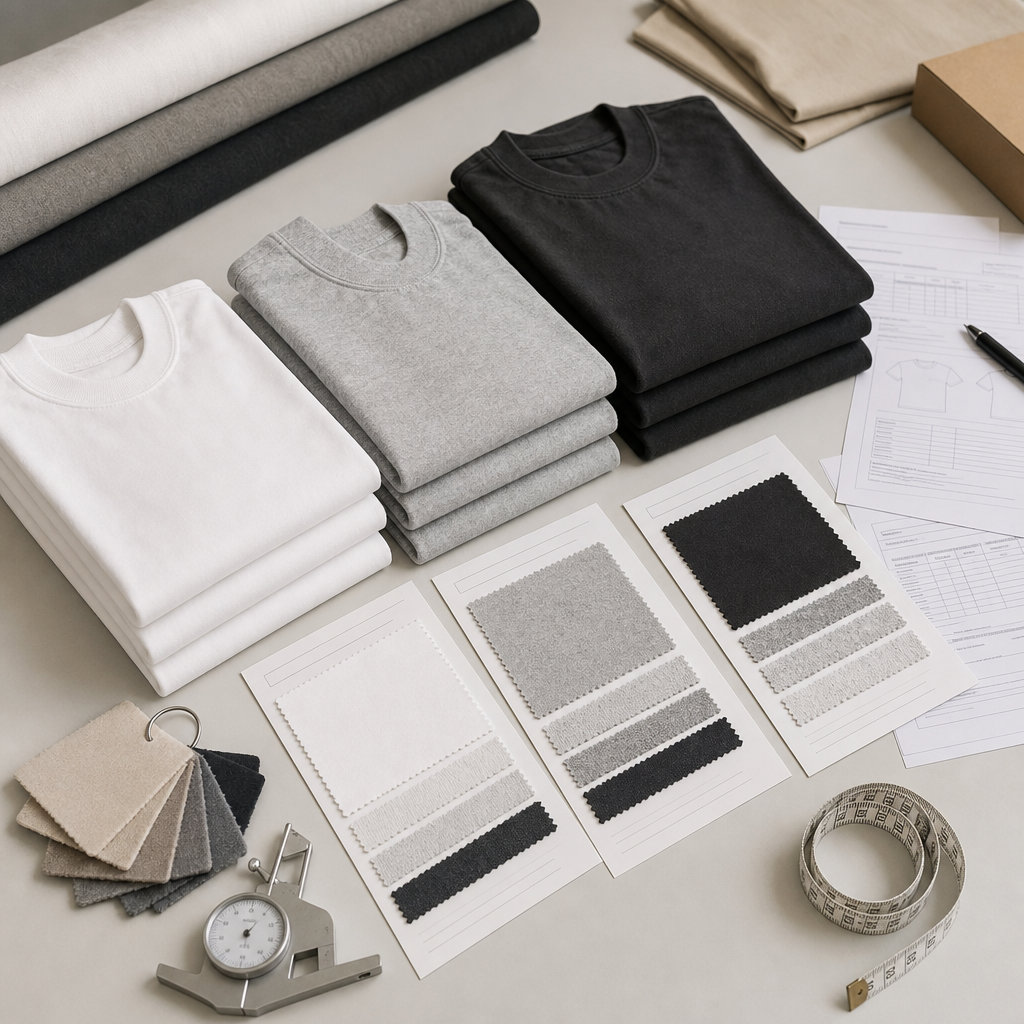
Choosing T-shirt GSM for low MOQ premium basics is a sourcing decision, not just a fabric preference. GSM changes the hand feel, opacity, drape, shrinkage risk, sewing behavior, print result, shipping weight, and final cost. A heavier T-shirt may feel more premium on a table, but it can also make the fit boxy in the wrong way or push the first order beyond a realistic budget.
For T-shirt-specific quoting and production planning, review our custom T-shirt manufacturer page.
Buyers often ask for “premium heavyweight” before defining the fit, season, target retail price, wash process, or reorder plan. A better workflow is to match GSM to the garment purpose and then test the fabric in a real sample before bulk approval.
For premium basics where GSM, neck rib, or side-seam balance can shift after washing, use how to check t-shirt fabric shrinkage before premium basics production to confirm fabric shrinkage checks before bulk T-shirt production.
Start With the Garment Position
A premium basics tee does not always need maximum weight. A daily summer tee, an oversized streetwear tee, and a structured retail blank can all need different GSM ranges. The buyer should first define whether the garment should feel soft, dense, dry, compact, drapey, structured, or washed down.
If the product is part of a broader premium basics line, read what buyers usually mean by premium basics. Fabric weight is only one part of the premium signal. Neck rib, stitching, shrinkage, shape retention, and color consistency also matter.
Do Not Choose GSM From a Number Alone
Two fabrics with the same GSM can feel different. Yarn count, knitting structure, finishing, compacting, enzyme wash, cotton type, and stretch recovery all affect the final hand feel. A 240 GSM jersey can feel soft and flexible or stiff and dry depending on construction.
Ask for physical swatches and, when possible, a sample in the intended fit. A fabric that feels strong as a swatch may be too heavy in an oversized body or may not drape well after washing. This is where sample approval is more reliable than a digital fabric description.
Balance GSM With Fit
Higher GSM can support a boxy or oversized silhouette, but it can also make the shoulder, sleeve, and hem look bulky. Lower GSM may drape more naturally, but it may show transparency or lose shape if the fabric is not stable enough.
For streetwear fits, connect GSM with body width, shoulder drop, sleeve opening, and print placement. StitchQuote’s guide to graphic placement on boxy fits explains why fabric structure and silhouette affect visual balance.
Test Shrinkage Before Bulk
GSM alone does not tell you how much a T-shirt will shrink. Buyers should check shrinkage before approving bulk, especially for heavyweight jersey, garment dye, pigment wash, and low MOQ programs using custom colors. Measure body length, chest, shoulder, sleeve length, and hem before and after wash.
Use the process in heavyweight T-shirt shrinkage testing before bulk production when the project uses dense cotton jersey or a wash process. Shrinkage results should influence both the pattern and the approved measurement tolerance.
Check Sewing and Trim Compatibility
Heavier fabric may need different needle choice, seam handling, rib fabric, neck tape, and pressing control. A premium tee can fail visually if the neck rib is too light for the body fabric or if seams look bulky. Buyers should review the body fabric together with collar rib and construction details.
The StitchQuote article on T-shirt neck rib approval is useful here because rib recovery and body GSM need to work together.
Ask Cost Questions Early
Higher GSM affects fabric cost and shipping weight. It may also increase MOQ pressure if the fabric is custom knitted or custom dyed. For a first order, the question is not only “Can we make this heavy?” but “Can we make this repeatably, within the launch budget, with enough size and color depth?”
Before requesting samples, align GSM with target retail price, expected margin, color count, size range, and reorder plan. The sampling and MOQ stage should confirm whether the selected fabric is realistic for the first run.
StitchQuote Note
For low MOQ clothing production, casualwear manufacturing, and custom streetwear manufacturing, StitchQuote treats GSM as part of fabric, fit, cost, and sample approval. The right choice is the one that supports the garment goal without creating unnecessary bulk, shrinkage, or reorder risk.
FAQ
Is higher GSM always better for premium T-shirts?
No. Higher GSM can feel more substantial, but it can also make the garment too stiff, warm, expensive, or bulky. Premium quality depends on fabric structure, fit, shrinkage control, sewing, rib quality, and color consistency.
Should startup brands use heavyweight T-shirts for a first order?
They can, but they should sample the actual fabric first and check shrinkage, fit, cost, and shipping impact. Heavyweight fabric is a positioning choice, not a default requirement.
What should buyers approve before bulk?
Approve physical swatches, sample fit, shrinkage results, neck rib compatibility, measurement tolerance, color standard, and final costing before moving into bulk production.
[…] T-shirt and premium basics programs, the article on choosing T-shirt GSM for low MOQ premium basics is useful because fabric weight affects drape, shrinkage, cost, sewing, and reorder […]
[…] the fabric decision is still open, use StitchQuote’s guide on choosing T-shirt GSM for low MOQ premium basics. It covers how fabric weight interacts with drape, shrinkage, sewing, cost, and reorder […]
[…] fabric selection is still open, review StitchQuote’s guide on choosing T-shirt GSM for low MOQ premium basics. GSM should be considered together with shrinkage, sewing, drape, and target […]